Thursday, 12 January 2012

Winter Feasting (iii) A Feast Indeed! or How to eat Terrine: with lashings of Bread & Butter, Pickles, the like...


Besides the Terrines, how to satiate the stomachs of twenty-odd banqueters?


Game Terrine

The stoic winter staples: Puy Lentils, Cabbage and Bread.  These, and piles of Pickles and Jellies from the shed.  This finished with Baked Apples, and a variety of alcoholic fruit, again to be found in the shed-cum-pantry.  A moment to rejoice in that Summer-Autumn of perpetual preserving!

Redcurrant Jelly and Pickled Crabapples

Before dining: long milling over Mulled Cider.  The Cider, a dream, made by a friend and sweetened slightly in its flagon with the addition of Honey.  It was mulled with Quince, Allspice, Cinnamon, Cloves, Lemons.

The Lentils I failed, once again, to photograph in their steaming glory.  Simply: cooked the night before with Onions softened in Butter, Garlic Cloves in their skins, Thyme, Bay Leaves, Juniper and Water, flavoured nearing the end with Balsamic Vinegar, Red Wine, some Apple/Rosemary Jelly, a touch of Soy Sauce, Salt and Pepper.  They sat luxuriating in their sauce for a day, and were then heated up.

Sliced Terrine and Cabbage

The Cabbage was cooked in batches on the day, first with onions in Olive Oil, then slowly in a light, homemade Cider Vinegar, and masses of Caraway.  Reheated at the last minute, laid on Cabbage leaves and topped with roast Pumpkin Seeds.

An enormous Pumpkin

The enormous Pumpkin, was chopped into big beautiful chunks, and doused in a Marinade of Olive Oil, Chilli, Demarara Sugar (for lack of Maple Syrup), and a touch of Balsamic and Soy Sauce, and French coarse Sea Salt.  After about an hour of marinating it was roasted at high heat in the oven, and served hot.  The idea for the recipe (minus Soy and Balsamic) came from a fortnight spent in November back ‘midst the gales on Clare Island, a recipe for Pumpkin Crisps made with Uchiki Kuri.  I shall tell about the fortnight anon.

...chopped in big, beautiful chunks, sat in marinade

The Bread, all five loaves, were cooked as per the previous recipe.

Bread


Great sloshing bowls of Pickled Apples, Pickled Crabapples, Bar-Le-Duc Redcurrant Jelly and Rosemary Jelly were lain between bowls full of Butter.

Apples baked in Gin-soaked Bullace

Following on from that Baked Apples, stuffed with Figs (Norfolk Figs – oven dried) and Sultanas soaked in Quince Brandy.  Cooked in a bed of Gin-soaked Bullace, these the remnants from the Bullace Gin.  With those, to feed the multitude, Potted Brandy Figs, and a selection of post-Christmas chocolates of all varieties, Satsumas, and bowls of Hazelnuts and Walnuts (again from local gardens).

Potted Brandy Figs

Oh ‘twas a feast indeed…

...

...breakfasting on leftovers

Tuesday, 3 January 2012

Winter Feasting (ii) - Venison and Game Terrines


In a moment of over-zealous Christmas jollity, a last-minute festive feast was planned, friends were invited, crockery searched out, rugs shook, candles borrowed, firewood cut, a Christmas Tree erected.  Long debates necessarily ensued over the menu, how to seat and feed such numbers, more to the point, on what… So it was that we settled on a variety of cold Terrines, and on Boxing Day, while others slept off their Christmas indulgence, banqueted languorously on cold cuts, on Tongue and the previous day’s Plum Pudding, or set themselves up for a serious bout of telly-watching, we mopped our brows and set to concocting Terrines.


Now, it has to be said that a Terrine, like a Chutney, improves with age.  If covered with Goose fat, or clarified butter, it can happily last a week, longer even.  Time however, had pressed us to last minute structuring, and I have to say these seemed none the worse off for having sat a mere twenty-four hours.  Both of us claiming to be experts, and each distrusting the other’s method, cookery books – Elizabeth David, Constance Spry, Hugh Fearnley-Whittingstall – were heavily consulted.  Eventually we took ideas from all, a hefty pinch of common sense, of foody inspiration and adoration… and the recipe that follows is what we came up with.

Before I begin however, two things:  Firstly, a Terrine is simply a Pâté, made in a terrine dish.  Once you have the method you can adulterate it as you wish, adding and removing ingredients according to preference or what is available.  That said, I have known a Terrine to fall apart, so I do suggest having at least equal quantities of farce to chopped meat.  Secondly, in a burst of immodesty, I have to say these were the best Terrines I have ever eaten, not only did they look sublime, but the flavourings, the texture, the moistness, all combined to make them taste utterly heavenly, and quite worthy of French charcuterie…  Whether this is repeatable simply by following a recipe, I don’t know – but do have a go, and do let me know.

The following should fill three two pint Terrine dishes.

For the Farce:
2lb Sausage Meat
½ lb Pheasant Livers
8 Chestnuts
6 Dried Figs
6 Dried Apricots
Sage
Rosemary
Thyme
15 Juniper Berries
2 Blades Mace
1 Egg
1 tea-cup White Wine
Black Pepper


Chop the Pheasant Livers; Roast the Chestnuts; 
Soak the chopped Figs and Apricots

The Farce is literally the stuffing, it holds the Terrine together.  To make it, first chop the Pheasant (or Chicken) Livers very small, keeping any blood; Roast the Chestnuts and peel them, breaking them into small bits; Soak the chopped Figs and Apricots in hot water; Crush the herbs and spices (to taste).  Then mix all ingredients, including the blood from the Pheasant Livers.  Season with Black Pepper.  If you find you want to further moisten the mixture, you can use the water the fruit soaked in.  If you want to dry it or bulk it out, use stale Breadcrumbs or Oatmeal.

Crush the herbs and spices

For one Venison Terrine, one Pheasant Terrine, one Venison and Pheasant Terrine:
1 ½  lb Pheasant meat
1 ½   lb Venison
21b streaky Bacon
Bay Leaves

Thus using about 1lb of meat in each Terrine.  The meat should be in pieces, but chopped thinly so it can be lain in layers through the Terrine.  Stretch the Bacon on a chopping board using the back of a knife.  Any Bacon Fat or bits that break off can be added to the Farce.  Line Terrine dishes, or Loaf Tins with the Bacon, leaving enough so it can fold over the top and wrap around the whole Terrine.  You can place Bay Leaves or other Herbs in the base, these will produce a pattern when the Terrine is turned out.

Line Terrine dishes with Bacon

Now layer Farce, followed by meat in thin layers, to fill the Terrine.  Aim to commence and finish with Farce, so that the Terrine holds together.  In the Venison Terrine I added a layer of Bar-Le-Duc Redcurrant Jelly, made this Summer, after the Meat, this added a tart sweetness to the Terrine.  


Finally the Bacon is wrapped around, tucked in and the Terrines are covered and cooked for 1 ½ to 2 hours in a Bain-Marie at 160-180C until firm, shrunken from the sides, the juices running clear when a knife is stuck in.


Any juices will eventually form a jelly when the Terrine cools.  If you are fortunate this might even enrobe the sides and top of the Terrine when turned out and provide a delicious glaze – ours slipped off.  The Terrines are then left, pressed under a weight to finalise the togetherness of the Terrine and to create a flat base for when they are turned out.   Leave for up to three days, or, if longer cover with a fat, or freeze. Turn them out prior to serving using a butter knife to slip around the edges.


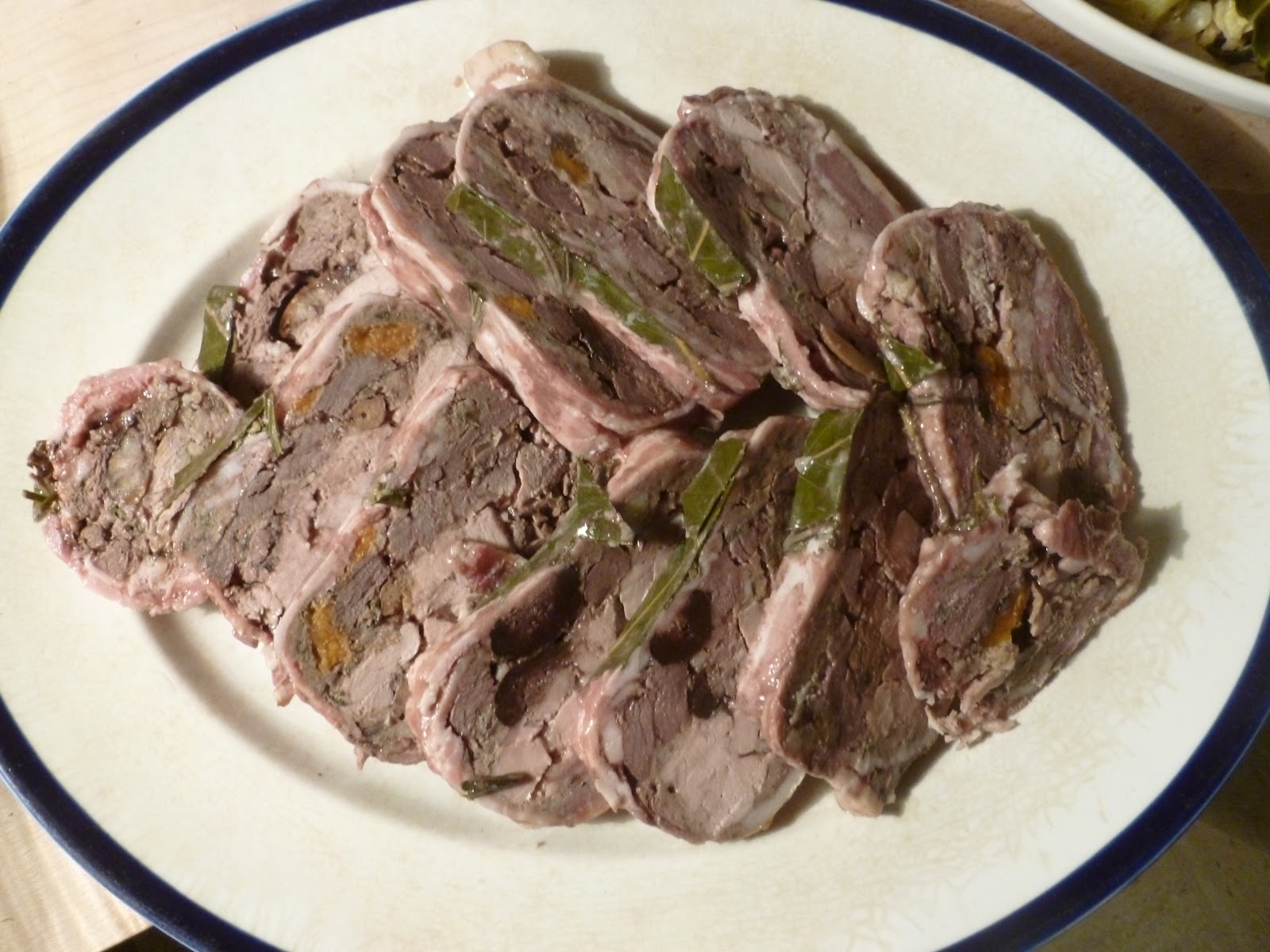
When sliced, all the layers of meat and farce, as well as the fruits and nuts become apparent:


...to follow: the entire feast.  

Sunday, 18 December 2011

Winter Feasting - Partridge; Beef Stouties; Celeriac Gratin; Woodcock on Toast


I haven’t blogged this last month, but I have certainly been eating.  Winter staples, repeated ad infinitum, which we fail to bore of, and so banal I haven’t photographed them are:  Puy Lentils, seasoned with Herbs, Garlic, a dash of Balsamic, of Soy Sauce, of Red Wine, sometimes Bacon... and Cabbage, cooked long and slow in home-made Apple Cider Vinegar, with Carrots or Onions, Beetroot or Marrow, Caraway or Sage, whatever comes to hand.  These bring repeated joy and are quite my favourite foods of a frugal winter, nourishing and full of simple vitamins, piping hot coursing right to the soul…

There have however been occasions of more flamboyant feasting, and, while I failed to note down the exact recipes, I have some photos, and share them here:


Perdriz aux Choux - Patridge cooked in Cabbage


The Partridge a gift, the recipe was taken directly from Elizabeth David's French Country Cooking.  It is the same recipe I used for the Rabbit in October, and you can find it here.  The only adulterations were the additions of Russet Apples and Jerusalem Artichokes to Mrs David's recipe, to not use Sugar, and to cook it in Apple Cider Vinegar.


Beef Stouties with Flageolet Beans


These come from Charcutier Jules of De-Lish.  The Stouties I believe are Beef and Horseradish Sausages soaked in Stout - he'll no doubt correct me.  I cooked them in Onions and a can of Bitter, added the liquid to some Flageolet Beans (cooked previously with herbs), then plunged the whole lot together and baked it in the oven.  This was eaten with Jerusalem Artichoke and Potato Mash and slow-cooked sweet vinegary Cabbage.

Celeriac and Marrow Gratin


This recipe is originally, I hear, a Hugh Fearnley-Whittingstall creation.  I picked it up on Clare Island, and added the Marrow to fill the pot.  Steam thinly sliced Celeriac and fry off peeled half moons of Marrow.  Layer the lot with Olive Oil, Creme Fraiche, Yogurt, Garlic, Chilli, Salt and Pepper in an ovenproof dish.  Cover and cook slowly for about forty minutes. At the last minute top with Curd or similar Fresh Cheese and place under the grill.

This is very rich and doesn't really need an accompaniment - some bread perhaps to mop it up, or a bowl of rice.

Woodcock on Toast with Pickled Crabapples


Le Piece de Resistance - I have always thought Woodcock on Toast quite the sexiest rustic dish, though, need I say, it is utterly inappropriate for the squeamish.  The bird is cooked with all its innards minus the gizzard (remove using your little finger once plucked), its beak spiked through the body, holding the legs together and a piece of bacon over the breast.  A mere eight to twenty minutes, if that, then the Bacon is removed, the guts scraped out, fried with the chopped Bacon, Butter and Port, Salt and Pepper, then spread on toast.  The Woodcock is sat beside, on a separate piece of Toast.

The whole bird is eaten and the ritual approaches that of the Ortolan Bunting.  It is an utter dream, the flavours are rich, indeed, exquisite.   Despite being miniscule, the dish is very filling, often served as  a starter I would suggest this as a main, perhaps with something sharp and light aterwards to cut through the heavenly richness.  Serve with a deep peppery and robust Red Wine.  Here we ate it with the Pickled Crabapples, which stood up superbly and smartly complemented the rich flavours of the bird.

Monday, 14 November 2011

I know a boy who bakes...


I know a boy who bakes...


His technique honed over many a long Georgian winter


Strong Organic White Flour; Easy-blend Yeast;
Rock Salt; Table Salt; Demerara Sugar


He adds water, at body temperature to the dry mix...


Then kneads the dough:


Kneaded, he adds some water, again wetting the dough...


And, while we drink Coffee, rises it warm


The dough, risen to more than double its original size,


is scooped from the bowl, cut into three,


briefly kneaded by folding,


placed on a baking tray, 


slashed


...and proven a second time


...while we hunt for Mushrooms to adorn our breakfast


On our return, the bread is baked, left a moment to cool,


then eaten with Baked Eggs and Ham, a plate of Mushrooms,
a Sunday morning...

Saturday, 12 November 2011

Chillies- Harissa, Zhoug, Chilli Jam... and Roasted Peppers


Utterly unseasonal with the skies outside sitting grey on the land, the land thick with fallen leaves.  Chillies ache of Summer heat, of Mediterranean, Asian, Caribbean flavours and sit strongly in contrast with an English Autumn. 

But, I have been meaning to write about these fiery fruits Summer long, and recently those friends in Kabul found themselves in the ‘midst of a Chilli glut and sent the following question:.  Is there any chance you know what type of chilis these are in the first photo? we're going to try doing osmething with them because we have too many and they'll go to waste but not sure if theyll make good chili powder or good pickles.


A succinct response from Tweeter @Rhizowen of Radix : pequin type C. annuum

Produce from a home in Kabul

So it was, yesterday I set to work with a pile of Chillies to try out some recipes:  Harissa, Zhoug, Chilli Jam.

Harissa 

Harissa is a Moroccan Chilli Paste.  Used in Tajines, Couscous, for marinades etc, it can also just be served as a spicy accompaniment to a meal.  There are a multitude of recipes, it can be raw or cooked, contain tomatoes, peppers or neither.  I briefly noted some Harissa recipes to accompany a Lamb and Fig Tagine here.  To my mind Harissa has to be very hot, very salty and full of Cumin.

Yesterday’s Recipe went thus:

Grill three small Red Peppers (or one large), twelve very small Plum Tomatoes (or equivalent), six cloves Garlic.  The Peppers should be turned, so they are charred on all sides, the Tomatoes just bursting and the Garlic's skin browning.  Meanwhile toast one and a bit tablespoons of Cumin Seed in a dry pan.  Peel the Peppers and remove seeds and stalks.  Pop the soft Garlic out of its skins.  Grind 2/3 of the Cumin in a Pestle and Mortar.  Blend Peppers, Tomatoes, Garlic.  Finely chop chillies (the amount of which has to be played about with to get the suitable heat).  I used two or three Scotch Bonnets and one long red Chilli. Put the whole lot, including the ground Cumin in a pan, bring to heat and simmer until nearly a dry paste.  Remove from heat and allow to cool, add remainder of whole toasted Cumin Seed, two teaspoons of Salt, douse with Olive Oil.  Stir the lot and taste, it should be very salty, slightly sweet, with a palpable texture.


Mine made yesterday was sublime.  Grilling or roasting the ingredients gives it a nutty sweet flavour behind the Chilli heat – I could eat it by the spoonful.  

...

Zhoug

Zhoug is a Green Chilli and Coriander paste from Yemen.  I made it a couple of years ago on Clare Island according to a recipe I found I thinking The Gate vegetarian cookbook.  Or, perhaps Denis Cotter’s sumptuous Café Paradiso cookbooks.  Either way, I couldn’t find same online yesterday, so went for a mishmash.  

Toast one tsp Cumin, one tsp Coriander seed, one Cardamon pod, one tsp Caraway seed.  Grind with a few Peppercorns in Pestle and Mortar.  Add three cloves of Garlic, grind.  Add this blend to a large bunch of Coriander, roughly chopped, stalks and all, a few sprigs of Parsley, Two Chillies (or according to taste) and juice of one Lemon.  I used Red Chilies as had no Green to hand.  Blend the lot.  Return to Pestle and Mortar, grind again adding coarse Salt and Olive Oil to taste.  Eat immediately – I smothered this zesty Chilli Coriander paste on my poached eggs this morning – a great kickstart to the day!  Whilst best eaten with Flatbreads, Olives and Yogurts, Hummus and Falafel, drinking sweet shots of Coffee, this paste can also serve as a base for spicy green dishes. 

If you wish to keep the Zhoug, it is best kept short-term in the fridge or for larger amounts, frozen.  Otherwise, keeping salt and oil content high, pop in sterilised jars cover with a layer of Olive Oil, store in a cool, dark place, and it should keep several months.

...


Chilli Jam

I had long planned to make a Chilli Jam recipe I had espied on An English Kitchen blog.  But, the day came and the recipe, blog, the lot, had vanished.  I was directed by a kindly Kentish Kitchen to another recipe here: Saladclub.  Altered it as is my tendency, and made Chilli Jam according to the following method:

Blend 1lb peeled Tomatoes, 3 Scotch Bonnets, 2 Red Chillis, 3 small red Peppers, 1 large Orange Pepper, 12 cloves Garlic, 4 in Ginger.  Put lot in Maslin pan, adding 4 tbsp Fish Sauce, 16oz Sugar, 300ml Red Wine Vinegar, and 1lb raw chopped Tomatoes.  Bring to boil, stirring occasionally.  When jammy pot in sterilised jars.


Mine is very hot indeed, you might want to reduce the Scotch Bonnets.  I am retaining half of the batch at that heat and adding another 1lb of Tomatoes to the rest to make a gentler jam.  But, delicious it is, sweet, with a thick jammy texture and the obvious Chilli kick.

A bite of sweet Chilli joy for coming winter days.

 ...

Chillies can also be dried against a sunny wall or window, then kept in a jar for when needed.  When dry they can also be rehydrated in warm water.  


Another, and very luxurious way, of storing vegetables is in the Italian manner by roasting or grilling them and jarring in oil.  Courgettes, Aubergines, Peppers and Chillis store very well this way.  I made a pot of grilled Peppers this Summer – see the pictures below.


…

N.B.  I have used Scotch Bonnets in these recipes, I was likely lured by their beauty.  They have a real biting heat that comes at the end of the mouthful.  If you find Chilli difficult  I would replace these with something milder.

...

Rumour has it that the Kabul Kitchen might soon commence blogging its own cooking ventures... with a mere scrape of ingredients, how to live it up in an ex-pat kitchen in Kabul... I'll keep you posted.  - Indeed it has already, see: Kabul Kitchen - The unlikely adventures of a war photographer in Kabul with no weighing scales...