Showing posts with label Game. Show all posts

Monday, 30 January 2012

Pot-Roast Partridge

I have to acknowledge having, these last few days, fed friends on the likes of Steak Tartare and Chips, dishes that are utterly inconsistent with the rustic glow I aim to emanate here.  Admittedly the Tartare was made of the finest of Norfolk cows, adorned with the yellow Yolks of my mother’s hens’ eggs, Nasturtium Capers and Lacto-Fermented Cucumber, the Chips cooked over gas by starlight in the garden.

The Tartare… preceded by raw Jerusalem Artichoke and Fennel salad, preceding Pear Cake made with the beautiful sweet Josephine pears that are best stored till now, and eaten peeled, running with sweet juices… The Tartare therefore, photogenic though it was, was not photographed.

A Pot-Roast Partridge

More in line with the wholesome theme of this blog however were last week’s Pot-Roast Partridges.  Envisage the artful cooking of the meat as in a roast, the vegetables meanwhile cooking slow in the bird’s juices, all in one pot, for a couple of hours, till the meat is falling, melting in the vegetables, the vegetables are tender but not falling apart… This is the simplest and quite my favourite way of cooking game.  (That is besides enrobing it in Cabbage as in this Rabbit and this Partridge.)

A brace of Partridge, kindly given.  Hung four days.  Plucked, Gutted.  Necks and hearts reserved for stock.  Partridge sealed in butter, stuffed with Butter, Onion, Carrots, Bay Leaves.  Swede, Celariac, Potatoes, Carrots chopped into chunks.  The Partridge lain on these in a big pot.  The mere addition of a knob of Butter, Salt, Black Pepper, an inch of water, some Herbs.   This is brought to the boil on the hob them put into the oven, with a lid on, to cook at about 150-180C for two hours.  The birds tender, the vegetables slow-cooked and rife with flavour…  Eat with the juices, a teaspoonful of jelly, and that’s all.


...

Save the carcass for stock.  Add to this vegetable peelings, the reserved necks and hearts of the birds.   Simmer covered in water overnight and use the liquid for the base of winter soups.

Thursday, 12 January 2012

Winter Feasting (iii) A Feast Indeed! or How to eat Terrine: with lashings of Bread & Butter, Pickles, the like...


Besides the Terrines, how to satiate the stomachs of twenty-odd banqueters?


Game Terrine

The stoic winter staples: Puy Lentils, Cabbage and Bread.  These, and piles of Pickles and Jellies from the shed.  This finished with Baked Apples, and a variety of alcoholic fruit, again to be found in the shed-cum-pantry.  A moment to rejoice in that Summer-Autumn of perpetual preserving!

Redcurrant Jelly and Pickled Crabapples

Before dining: long milling over Mulled Cider.  The Cider, a dream, made by a friend and sweetened slightly in its flagon with the addition of Honey.  It was mulled with Quince, Allspice, Cinnamon, Cloves, Lemons.

The Lentils I failed, once again, to photograph in their steaming glory.  Simply: cooked the night before with Onions softened in Butter, Garlic Cloves in their skins, Thyme, Bay Leaves, Juniper and Water, flavoured nearing the end with Balsamic Vinegar, Red Wine, some Apple/Rosemary Jelly, a touch of Soy Sauce, Salt and Pepper.  They sat luxuriating in their sauce for a day, and were then heated up.

Sliced Terrine and Cabbage

The Cabbage was cooked in batches on the day, first with onions in Olive Oil, then slowly in a light, homemade Cider Vinegar, and masses of Caraway.  Reheated at the last minute, laid on Cabbage leaves and topped with roast Pumpkin Seeds.

An enormous Pumpkin

The enormous Pumpkin, was chopped into big beautiful chunks, and doused in a Marinade of Olive Oil, Chilli, Demarara Sugar (for lack of Maple Syrup), and a touch of Balsamic and Soy Sauce, and French coarse Sea Salt.  After about an hour of marinating it was roasted at high heat in the oven, and served hot.  The idea for the recipe (minus Soy and Balsamic) came from a fortnight spent in November back ‘midst the gales on Clare Island, a recipe for Pumpkin Crisps made with Uchiki Kuri.  I shall tell about the fortnight anon.

...chopped in big, beautiful chunks, sat in marinade

The Bread, all five loaves, were cooked as per the previous recipe.

Bread


Great sloshing bowls of Pickled Apples, Pickled Crabapples, Bar-Le-Duc Redcurrant Jelly and Rosemary Jelly were lain between bowls full of Butter.

Apples baked in Gin-soaked Bullace

Following on from that Baked Apples, stuffed with Figs (Norfolk Figs – oven dried) and Sultanas soaked in Quince Brandy.  Cooked in a bed of Gin-soaked Bullace, these the remnants from the Bullace Gin.  With those, to feed the multitude, Potted Brandy Figs, and a selection of post-Christmas chocolates of all varieties, Satsumas, and bowls of Hazelnuts and Walnuts (again from local gardens).

Potted Brandy Figs

Oh ‘twas a feast indeed…

...

...breakfasting on leftovers

Tuesday, 3 January 2012

Winter Feasting (ii) - Venison and Game Terrines


In a moment of over-zealous Christmas jollity, a last-minute festive feast was planned, friends were invited, crockery searched out, rugs shook, candles borrowed, firewood cut, a Christmas Tree erected.  Long debates necessarily ensued over the menu, how to seat and feed such numbers, more to the point, on what… So it was that we settled on a variety of cold Terrines, and on Boxing Day, while others slept off their Christmas indulgence, banqueted languorously on cold cuts, on Tongue and the previous day’s Plum Pudding, or set themselves up for a serious bout of telly-watching, we mopped our brows and set to concocting Terrines.


Now, it has to be said that a Terrine, like a Chutney, improves with age.  If covered with Goose fat, or clarified butter, it can happily last a week, longer even.  Time however, had pressed us to last minute structuring, and I have to say these seemed none the worse off for having sat a mere twenty-four hours.  Both of us claiming to be experts, and each distrusting the other’s method, cookery books – Elizabeth David, Constance Spry, Hugh Fearnley-Whittingstall – were heavily consulted.  Eventually we took ideas from all, a hefty pinch of common sense, of foody inspiration and adoration… and the recipe that follows is what we came up with.

Before I begin however, two things:  Firstly, a Terrine is simply a Pâté, made in a terrine dish.  Once you have the method you can adulterate it as you wish, adding and removing ingredients according to preference or what is available.  That said, I have known a Terrine to fall apart, so I do suggest having at least equal quantities of farce to chopped meat.  Secondly, in a burst of immodesty, I have to say these were the best Terrines I have ever eaten, not only did they look sublime, but the flavourings, the texture, the moistness, all combined to make them taste utterly heavenly, and quite worthy of French charcuterie…  Whether this is repeatable simply by following a recipe, I don’t know – but do have a go, and do let me know.

The following should fill three two pint Terrine dishes.

For the Farce:
2lb Sausage Meat
½ lb Pheasant Livers
8 Chestnuts
6 Dried Figs
6 Dried Apricots
Sage
Rosemary
Thyme
15 Juniper Berries
2 Blades Mace
1 Egg
1 tea-cup White Wine
Black Pepper


Chop the Pheasant Livers; Roast the Chestnuts; 
Soak the chopped Figs and Apricots

The Farce is literally the stuffing, it holds the Terrine together.  To make it, first chop the Pheasant (or Chicken) Livers very small, keeping any blood; Roast the Chestnuts and peel them, breaking them into small bits; Soak the chopped Figs and Apricots in hot water; Crush the herbs and spices (to taste).  Then mix all ingredients, including the blood from the Pheasant Livers.  Season with Black Pepper.  If you find you want to further moisten the mixture, you can use the water the fruit soaked in.  If you want to dry it or bulk it out, use stale Breadcrumbs or Oatmeal.

Crush the herbs and spices

For one Venison Terrine, one Pheasant Terrine, one Venison and Pheasant Terrine:
1 ½  lb Pheasant meat
1 ½   lb Venison
21b streaky Bacon
Bay Leaves

Thus using about 1lb of meat in each Terrine.  The meat should be in pieces, but chopped thinly so it can be lain in layers through the Terrine.  Stretch the Bacon on a chopping board using the back of a knife.  Any Bacon Fat or bits that break off can be added to the Farce.  Line Terrine dishes, or Loaf Tins with the Bacon, leaving enough so it can fold over the top and wrap around the whole Terrine.  You can place Bay Leaves or other Herbs in the base, these will produce a pattern when the Terrine is turned out.

Line Terrine dishes with Bacon

Now layer Farce, followed by meat in thin layers, to fill the Terrine.  Aim to commence and finish with Farce, so that the Terrine holds together.  In the Venison Terrine I added a layer of Bar-Le-Duc Redcurrant Jelly, made this Summer, after the Meat, this added a tart sweetness to the Terrine.  


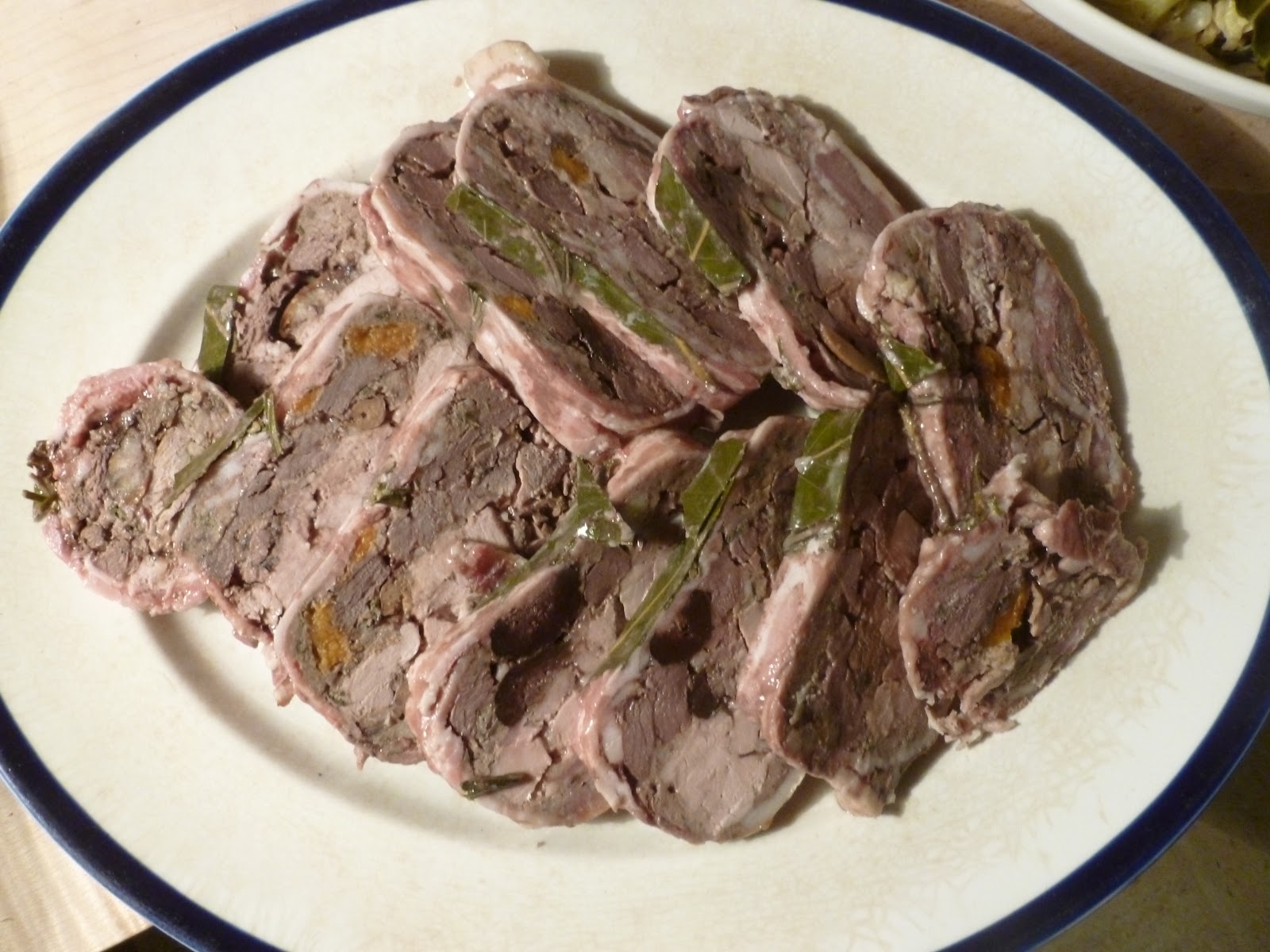
Finally the Bacon is wrapped around, tucked in and the Terrines are covered and cooked for 1 ½ to 2 hours in a Bain-Marie at 160-180C until firm, shrunken from the sides, the juices running clear when a knife is stuck in.


Any juices will eventually form a jelly when the Terrine cools.  If you are fortunate this might even enrobe the sides and top of the Terrine when turned out and provide a delicious glaze – ours slipped off.  The Terrines are then left, pressed under a weight to finalise the togetherness of the Terrine and to create a flat base for when they are turned out.   Leave for up to three days, or, if longer cover with a fat, or freeze. Turn them out prior to serving using a butter knife to slip around the edges.


When sliced, all the layers of meat and farce, as well as the fruits and nuts become apparent:


...to follow: the entire feast.  

Sunday, 18 December 2011

Winter Feasting - Partridge; Beef Stouties; Celeriac Gratin; Woodcock on Toast


I haven’t blogged this last month, but I have certainly been eating.  Winter staples, repeated ad infinitum, which we fail to bore of, and so banal I haven’t photographed them are:  Puy Lentils, seasoned with Herbs, Garlic, a dash of Balsamic, of Soy Sauce, of Red Wine, sometimes Bacon... and Cabbage, cooked long and slow in home-made Apple Cider Vinegar, with Carrots or Onions, Beetroot or Marrow, Caraway or Sage, whatever comes to hand.  These bring repeated joy and are quite my favourite foods of a frugal winter, nourishing and full of simple vitamins, piping hot coursing right to the soul…

There have however been occasions of more flamboyant feasting, and, while I failed to note down the exact recipes, I have some photos, and share them here:


Perdriz aux Choux - Patridge cooked in Cabbage


The Partridge a gift, the recipe was taken directly from Elizabeth David's French Country Cooking.  It is the same recipe I used for the Rabbit in October, and you can find it here.  The only adulterations were the additions of Russet Apples and Jerusalem Artichokes to Mrs David's recipe, to not use Sugar, and to cook it in Apple Cider Vinegar.


Beef Stouties with Flageolet Beans


These come from Charcutier Jules of De-Lish.  The Stouties I believe are Beef and Horseradish Sausages soaked in Stout - he'll no doubt correct me.  I cooked them in Onions and a can of Bitter, added the liquid to some Flageolet Beans (cooked previously with herbs), then plunged the whole lot together and baked it in the oven.  This was eaten with Jerusalem Artichoke and Potato Mash and slow-cooked sweet vinegary Cabbage.

Celeriac and Marrow Gratin


This recipe is originally, I hear, a Hugh Fearnley-Whittingstall creation.  I picked it up on Clare Island, and added the Marrow to fill the pot.  Steam thinly sliced Celeriac and fry off peeled half moons of Marrow.  Layer the lot with Olive Oil, Creme Fraiche, Yogurt, Garlic, Chilli, Salt and Pepper in an ovenproof dish.  Cover and cook slowly for about forty minutes. At the last minute top with Curd or similar Fresh Cheese and place under the grill.

This is very rich and doesn't really need an accompaniment - some bread perhaps to mop it up, or a bowl of rice.

Woodcock on Toast with Pickled Crabapples


Le Piece de Resistance - I have always thought Woodcock on Toast quite the sexiest rustic dish, though, need I say, it is utterly inappropriate for the squeamish.  The bird is cooked with all its innards minus the gizzard (remove using your little finger once plucked), its beak spiked through the body, holding the legs together and a piece of bacon over the breast.  A mere eight to twenty minutes, if that, then the Bacon is removed, the guts scraped out, fried with the chopped Bacon, Butter and Port, Salt and Pepper, then spread on toast.  The Woodcock is sat beside, on a separate piece of Toast.

The whole bird is eaten and the ritual approaches that of the Ortolan Bunting.  It is an utter dream, the flavours are rich, indeed, exquisite.   Despite being miniscule, the dish is very filling, often served as  a starter I would suggest this as a main, perhaps with something sharp and light aterwards to cut through the heavenly richness.  Serve with a deep peppery and robust Red Wine.  Here we ate it with the Pickled Crabapples, which stood up superbly and smartly complemented the rich flavours of the bird.

Monday, 24 October 2011

Got a Rabbit ... Lapin aux choux


Joy that is the coming of winter, lengthy, frosty nights spent hunkered down by the fire.  Autumn, ‘midst forays for wood, mulching of the garden or hanging heavy curtains has obliged late night fireside feasts…and this weekend it was themed: Rabbit.

For a mere fistful of coins, P & S Butchers in Holt – one reputed for its panoply of wild bird and beast – handed over a large Wild Rabbit, skinned, gutted and jointed and with that a slip of Pork Belly…


Unsure of how then to cook the creature, Amelia pronouncing Rabbit Satay to be quite the best manner in which to eat a rabbit, I shied once again from the fusional towards the provincial. Keen to use Cabbage and in my thoughts the eternal Pot au Feu, staple of the French home, I came across a recipe for Partridge in Elizabeth David’s French Country Cooking: Perdrix au choux, which proved the source of inspiration.

The recipe reads thus:

Brown the birds in Bacon fat; blanch the cabbages in boiling water for 7 or 8 minutes; drain them carefully, cut out the stalks and the hard inner part.  Cut the cabbages in fine slices and put a layer at the bottom of a large earthenwear pot; on top put the bacon, cut in large slices, the carrots, the sausages and the partridges; season with salt, pepper, a few juniper berries, 2 or 3 cloves of garlic, 2 lumps of sugar, nutmeg and a little grated lemon peel.
Cover with the rest of the cabbage, moisten with stock to half way up the cabbage, cover the casserole and cook in a very slow oven for 4 or 5 hours.

Cabbage layer topped with veg, bacon etc

My rabbit variation went thus:

Briefly sauté chunks of Pork Belly with Shallots in pan.  Remove.  Deglaze with Red Wine.  Brown rabbit.  Remove.  Sauté slices of Apple, Sage Leaves and whole cloves of Garlic in same pan, adding butter.  Meanwhile blanch Cabbage, retaining water, and chop as above.  Layer half the Cabbage in bottom of coverable oven dish.  Then layer on Pork, Shallots, Apples, Sage, Garlic, Rosemary, Thyme ,half Carrots, followed by Rabbit. Cover the lot with remaining Cabbage.  Mix 50ml Balsamic Vinegar, 50ml Cider Vinegar, 50ml Apple Juice/Cider, 50ml Red Wine, Pour over dish, topping to half way with Cabbage Water, season with Black Pepper.

Cook covered at 150C for about 3 hours, topping up with liquid and basting as necessary.

...and browned Rabbit

...finally, smothered with cabbage.


The ultimate in rustic fireside feasting, a near emulation of Russian peasantdom in its quintessential rurality.  Served as it was with a touch of Wholegrain Mustard, the Rabbit was delicious, if a touch dry, the vegetables a dream.   Perhaps placing the Rabbit lower in the pan, stacking it more and even stuffing the Saddle with fruit and veg that it remain moist, or as it is again a lean meat, enrobing it in Bacon as we did the Pheasant, would keep it tender.  On Sunday we cooked it for a further two hours, by which time the vegetables were of a sweetness near’ caramel, the rabbit meat falling from the bones, served with baked potatoes and a jus made of the Rabbit juices, Rosemary, Garlic, Red Wine…


The following day:
Luncheon of Pasta and Rabbit - serve, terribly continental, with the jus, the remaining veg and rabbit on a bowl of  hot pasta.


Friday, 21 October 2011

A Pheasant - Roadkill roast wi' Autumn Fruits

The roads again amok with Pheasants and the like, driving in the country at this time of year is akin to running the gauntlet, obliging severe and intrepid manoeuvring to avoid the creatures.  Last week however, I hit one.  And, as etiquette prevails, fast wrung its neck.  Unwilling to not eat a bird I had unwittingly killed, I took it home.

Sometime, and yet I haven’t the courage this morning, I shall write a treatise detailing my views on wild and reared meat… Here instead, let me simply say, I had never before eaten roadkill pheasant. 

I hung the hen pheasant in the shed for three days.  On Sunday, returned to the cottage and, as dark fell, put a pot of Lentils on the stove, plucked the bird.  I was lucky to have hit it in the neck/head region as the body was undamaged, the bird clean.

Plucking a Pheasant

On Preparing a Pheasant:
Remove all the feathers, pulling in the direction they grow so as not to tear the skin.  Then take off the Feet and the Head, discard, leaving the Neck intact.  Next remove as much length as possible of the Neck – this is a tasty piece of meat ideal for a stock, a stew or soup.  The Crop where the Pheasant momentarily holds its food (often corn) can be slipped out, the Windpipe likewise extracted from the neck end of the Pheasant.  Any yellow lumps of gathered fat should also be removed as these are not pleasant to eat.  The base of the Pheasant is then slit open.  Plunge a hand in and drag out the insides, of this the edible parts are: the Heart, the Liver, the outer layer of the Gizzard. The Gizzard is a delicious Muscle, which to be eaten has to be peeled off the inner part of the muscle where food is ground.   On one occasion, having gutted and spatchcocked a dozen Pheasant for a New Year’s party, I gathered all the Gizzards and prepared them in a Goose Fat Confit as the French might Gésiers de Canard.  These would then be served hot on Salad leaves with Croutes and Goat’s Cheese for a Provençal feel.


Prepared, the Pheasant was stuffed with chopped Apples, Onion, and Quince.  A knob of Butter, some Garlic Cloves, a bunch of Thyme.  Pheasant is a lean meat with very little of its own protective/ cooking fat, so it was covered in Bacon.  A sudden moment of inspiration led us to fill the tray with chunks of Pumpkin, Swede, Marrow, Parsnip, and more Fruit.  The lot was doused in Apple Juice, more Butter, Salt and Pepper and loads of Rosemary.  Put in the oven about 200C for roughly 30 mins, then 150C for 20 or so until cooked. Rested for ten before serving.

Despite the chaotic end to its life, the bird was beautifully tender, no doubt the Fruit and layers of Bacon kept it thus.  Served on a bed of Puy Lentils with the apple-juice-roasted fruits and veg, the meal was a joy, part medieval banquet part reminiscent of the provincial food of French Wayside Inns.

Wednesday, 21 September 2011

Notes: On Forage, Mushrooms and the Noma Cookbook

We do not stop the world when we eat; 
we go into it a little more deeply.
Olafur Eliasson (Noma)


Cep
... 

Allow me a paintbrush, a palette…a pile of artistic licence to tell of some friends of mine and their wild ways.  Boys they are, a huddle of them, bare’ approachable and and not easy to handle.  They can’t be tethered down and one won’t find them for looking.   But, one might come across them…

On the foreshore by night fighting the tide for a last Sea-bass; atop a tree, gathering Plums to pot a Pigeon in; plucking a Greylag large to feed a crowd.  Adventurous with tastes, unperturbed by roadkill, they’ll be smoking Mackerel in a filing-cabinet-cum-smoker; cooking Mullet in milk for fishcakes; stewing Cockles in a split can of cider on an open fire; barbecuing Samphire.  How very nineteenth century lyrical said a friend as I rhapsodised about baskets of Ceps, and indeed, these are the Huck Finn’s of today, the unassuming artistes of forage.

Dried Chanterelles

Last I called by, Muntjac was roasting in the oven, surfaces brimming with mushrooms gathered, some dried, a hoard: Shaggy Parasols; Chanterelles, orange and sweet-apricot-scented; something blue.  Another fellow appeared a basket in his hand large to gather wood, in it full - Penny-Buns, Ceps, plentiful as a baker’s.

We ate then Parasol:
The cap cut into long, thick strips, doused long in egg and salt and pepper breadcrumbs, fried quick and served slathered unashamedly in mayonnaise.  A dream.

Parasol Mushrooms in Bowl of Apples

The Ceps so plentiful I took some home.

This weekend, another scene: ‘midst fashionistas, florists and folklorists, stepping the streets of London town…  On gathering my basket and boots to return home, risen at dawn to the cockney cries of Columbia Road Flower Market, pressed into my hands was a copy of Noma, Time and Place in Nordic Cuisine by René Redzepi.  I have long hankered after this book and was delighted to be given it.  (Thanks Laur!) It is indeed an extraordinary book, but with over half of the pages covered in photos worthy of the wall, it is not a manual.  The recipes themselves, so daunting that I’m glad I didn’t turn to it to cook my Ceps, relying instead on friendly advice and Elizabeth David (see below).


Indeed, I now understand that the book is less a cookbook and more a book to wander through, wonder at, that tells of the story behind the Michelin starred Copenhagen restaurant Noma.  No longer silent, secret, unassuming; at Noma forage is ostentatious, it’s an artform plucked or peacocking, it is the very edgiest of foodthinking, where food overlaps with artthought and critical theory.  But on closer inspection, I am also ready to bow to this.  Of René’s moment of illumination, he writes:

I realized that we had to exploit the seasons in a better way, so that you could only get a particular dish here and now.  We should explore the extremes of nature, seek out the thousand or more species of edible fungi, the many wild plants, roots and seashore plants. […] The guests dining at Noma should feel a sensation of time and place in their very bones.

Ingredients were thus combined not only with those of same season, but those of their natural habitat.  If venison was on the menu, the meat should be served with snails, pine shoots and mushrooms.  Thus recipes such as: Bouillon of Steamed Birchwood, Chanterelles and Fresh  Hazelnut; Stone Crab and Beach Mustard, Cockle Gel or simply Snails and Moss.  And abruptly, the nineteenth century lyricists and the uber modern restaurant look no longer askance upon one another, artistes the both.

Ceps
Not Ceps and Poached Truffle Meringue (à la Noma) but Cèpes à la Bordelaise (Elizabeth David) with Brown Rice Risotto.

In her French Provincial Cooking, Elizabeth David quotes the recipe of Alcide Bontou (refer to the book to read more).  I shall do likewise:
“Choose 12 firm cèpes, small rather than large, and with dark heads; remove the stalks and peel them, but only wipe the heads; make incisions on the underside of the heads with the point of a knife.  Put a glass of olive oil in a frying-pan; when it is hot, put in the heads of the cèpes; turn them over when they have browned on one side.  Season with salt and pepper.
Chop the stalks with four cloves of garlic and some parsley.  Throw this mixture over the cèpes.  Let them all sauter in the pan for 3 or 4 minutes.
You may add a tablespoon of soft white breadcrumbs.  Serve.”

I made a pseudo-risotto with Short Grain Brown Rice, butter, Shallots, Bay-Leaves, White Wine and Wighton, a local creamy but hard cheese.  And served the Ceps on top.  Divine.

...

Another great friend, longdeserving of a blog post dedicated to her green fingers, her inexhaustible creative energy and her kitchen concoctions, whose latest addition to the home is a goat in the back garden (soon I hope we’ll be on milk and cheese)… makes a Puffpall Pâté of such flavour it is also worthy of Michelin stars.  

Puffball Pâté
I haven’t the exact recipe, and I rather doubt there is one.  Try:
Chop and very gently fry up Puffballs with Garlic and Cumin in Butter.  Blend the lot adding Salt and Pepper or a touch of Soy Sauce.  Spread on bread for a deeply mushroom flavour edged with garlic and cumin.  You could also try adding cream, cream-cheese.

If you do attempt this let me know!

Notes:
 -The Noma cookbook is indeed a gift, only on the verge of my foray into it, I hope to write more anon.
 -Writing at first light, I espy another forager: a grey squirrel feasting on the last of the overripe Bullace.
(In postscript - now mid-November, a friend writes from wild woodlands of Tuscany: I strongly reccommend Parasol Mushrooms, ripped, dipped in Egg, Breadcrumbs, Garlic and drizzled in Lemon Juice...  As only yesterday Amelia came across a field thick with same Macrolepiota procera, I too hope to try this in the week.)

Friday, 4 February 2011

A Good Stock

Mrs Beeton writes a recipe for Pocket-Soup.  An elaborate recipe, bringing one step-by-step through a lengthy process in which an animal carcass is slowly transformed into a dehydrated stock cube – an art indeed.

While the sight of a pot of Bisto, a stock cube and even an artisanal organic bouillon horrifies me, I will uphold the merits of a good stock.  Primarily, a Stock is an excellent example of the beneficial use of waste products, it’s a sort of alternative to the compost… and it doesn’t have to contain meat, one of the best summer stocks is the simple combination of Pea-Pods and Onion Skins.  

My Uncle has sent through pics of his post-Christmas Goose Stock.  The Recipe is as follows: add one Onion in its skin + 2 large Carrots + 2 Celery Sticks to 1 Goose Carcass, cover with water and simmer for +/- 8 hours, adding water when needed to cover carcass. 
 
Made by covering the ingredients in water, bringing to the boil and then allowing to simmer very slowly, preferable overnight, it is then strained, and the liquid kept.  The liquid can be used in soups or stews, where it adds a depth of flavour and structure to a dish, as a consommé on its own or as a simple addition to rice.

The joy of a stock is that you can use anything you can find, and each is a unique creation.  An excuse to let your creative juices run, Carrot tops, Bay leaves, Garlic Skins, Giblets and Lemon Rind are just some of the ingredients I like to stuff into the stock pot.  It is not quite alchemy, but certainly has something of the potion about it.  I never add salt to a stock but alter the salt levels when actually using the stock to cook with.  It can be used immediately (if it contains a lot of fat cool first and skim off with a metal spoon) or frozen and saved for another occasion.

p.s. More Stock Recipes avidly awaited!  Send to olivheal@gmail.com.


Monday, 3 January 2011

A Pickled Pear


New Year’s Eve 2010 was a medieval expression of magnificence in the culinary quarters chez les gastronomes of Stanny House Farm… extravagant platter followed on headily from the previous and so on and so forth… I shall elaborate anon.  Let me simply whet the appetite by mentioning the fruit that accompanied the second dish (I can’t resist, ‘twas woodcock on toast) - a pickled pear.

Those of you not as yet convinced by the combination of fruits and meats have only to experience the dextrous combination of rich deeply flavoured woodcock and the sharp, biting sweetness of the pickled pear.

The pears were pickled in September.  They are small, of a variety to be confirmed, and provide in abundance in early September.  I used windfalls – the winds were thundering through the county this September, the windfalls filling my basket over and over. 

I first peeled the pears leaving them whole. 

Then:
Cook the whole pears in water with a little salt and sugar, until tender.
Remove.

Combine 1 lt Vinegar of choice (I suggest cider vinegar), 400g Sugar, Cloves, Peppercorns, Lemon Rind, Ground Ginger, chopped Root Ginger, Mustard Seed and Onion (I like to quarter shallots).

Bring to the boil.
Add the pears.
Bring to the boil again.
Repeat.
Pot in sterilised jars, covering in the vinegar and adding bay leaves.

Leave a few months to allow time to pickle.  Serve come winter with game, cheeses or cold meats.


Friday, 3 December 2010

Game Feast

So sad to be missing the 2010 Game Feast. Hosted by Orlando Bridgeman and Patrick O'Connor. The Game Feast is an annual, intimate event of excessiveness, a celebration of winter food and drink, and a chance for people who appreciate the finer things in life to come together to compare notes. A luncheon at 4pm in the snowy climes of North Yorks. Sadly work, and it seems weather, confines me to Norfolk. But here's an amuse-bouche in the form of the Menu:

Friday night

Sherry
Harry's Essex Oysters - Cloudy Bay Sauvignon Blanc 2000
Smoked game (or failing that, roast), celeriac rarebit - Troplong Mondot St Emilion 2004
Semi-hard cheese (St Nectaire, Tomme de Savoie, etc) - Tyrells Vat 1 Semillon 2002
Yorkshire gingerbread - Muscat De Frontignan, Chateau De La Peyrade

Saturday dinner

Aperitif - interesting sparkler/aperitif. Or Champagne.
Pheasant consommé - Sercial Madeira
Creamy Parmesan Custard - Robert Weil Kabinett 2001
Roast bone marrow on toast - Grapillon d'Or
Pasta with game sauce - Bocca di Lupa Tormaresca 2001
Haunch of venison - Rene Le Clerc Gevrey Chambertin 2002
Belgian chocolates, satsumas, clementines - Chateau Dereszla Tokaji Aszu 5*
Hard and semi-hard cheese - Troplong Mondot and whatever is left.