Showing posts with label Forage. Show all posts

Saturday, 6 September 2014

A Fool


I should start this post with a one-liner: you'd have to be a fool not to be able to make one... or something.  Fergus Henderson, who is rather more direct, entitles his fool recipe "You Fool" and begins: "Who are you calling a fool?"  Whatever the pun, the fool is quite the easiest and most delicious of fruity puds.  While you can smarten it up with drizzles and jus and marblings, or replace some cream with yoghurt, I think simple is best: a true fool is just whipped cream, fruit and sugar.  To my mind the tarter the fruit the better the fool.  Think: Gooseberry Fool, Rhubarb Fool - the dreamiest of creamy puddings.

This season we are into Damson, Blackberry or Raspberry Fools.  Here is a suitably messy Blackberry and Raspberry Fool.  The raw fruit is macerated in the sugar for a few hours then folded into the whipped cream.  Fergus Henderson's recipe from The Complete Nose to Tail [brilliant, brilliant, brilliant book - every kitchen must have it - where else does tradition meet style so imperiously?!] reads more or less as follows:

200g Fruit - 50g Caster Sugar - 400ml Double Cream.

Lightly cook fruit with half the sugar till juices run, or if very ripe just mix with sugar and crush with fork.  Whip cream with rest of sugar to soft peaks.  Fold in fruit.  Serve with Shortbread.

Yes, shortbread is a super accompaniment to a fool. I follow his recipe for shortbread too, but rather than cutting shapes, press it into a tin and break it at the table.

750g Plain Flour - 500g Butter - 250g Caster Sugar

Half quantities suffice.  Grate the butter into the flour.  Breadcrumb it between the fingers.  Add Sugar.  Press into a tin. Cook about 15 - 20 mins 160 C.  Should be pale but crisp not doughy.

Wednesday, 3 September 2014

Giant Puffball and Radiccio


In a garden in the Val d'Orcia this summer I had a plate of chicken livers that reminded me that the simplest, humblest of rural foods can be quite the greatest delicacy.  And, as one seems to compose a map of the world according to what was eaten and where, I shall here recall another meal that took place about fifteen years previously: A salad of chicken livers and other gesiers in a hilltop restaurant somewhere in the Cevennes - as we ate a storm blew up and we sat in wavering candlelight watching as bolts of lightning illuminated the valleys below.

The Tuscan Chicken Livers were served hot on some radiccio leaves, which wilted in the livers' warmth, and with toast and olive oil.  So, when we came across a multitude of Giant Puffballs last week, I decided the buttery truffley marshmallowey richness would do well against bitter red Radiccio leaves.  The Puffball was sliced and fried in butter and garlic, seasoned and placed on a bed of Radiccio.  These were eaten with a homemade Baguette, Butter and a grating of Parmesan.

Monday, 1 September 2014

Hedgerow Loaf Cake


It has to be said that, after a hot and close Summer, this past fortnight has definitely felt like Autumn.  Along with the cooler weather, the hedgerow fruits are here in abundance.  Here then a recipe for a hedgerow fruit and nut cake, which will hold whatever fruits you deign to gather.  This simplest of recipes served as a wholesome birthday cake for a mother-in-law fond of the hedgerows, and is seen here the following day with coffee.

Cream 200g Butter with 150g Sugar.  Beat in 4 Eggs one by one.  Fold in 150g Spelt Flour, 1 level tsp Bicarb., 1 level tsp Baking Powder (all sieved) and 150g Ground Almonds.  Then fold in autumnal fruits, nuts and seeds.  In this case I have used Windfall Apples, Elderberries, Blackberries, Walnuts and Hazelnuts.  The fruits and nuts should be about the same volume as the mix so that when folded into the mixture it contains them, but only just.  Spoon into a lined loaf tin.  I have then topped it with slices of Apple and Flaked Almonds.

Bake at 180C for about 40 mins until cooked through.

...

Notes:
You could try replacing some of the ground almonds with ground hazelnuts - heat them, rub off the skins, then grind to flour.  I think that Maple Syrup instead of Sugar might taste really lovely in this cake.  I have yet to try this... Also, this is not a very sweet cake.  If you would like it to be sweeter you could sprinkle with Brown Sugar before cooking or drizzle with Honey or Maple Syrup once cooked and when still warm.

Wednesday, 27 August 2014

Spaghetti alla Vongole/Stewkey Blues


I love this picture, which captures the somewhat chaotic cockle lunch we had on Sunday.  Spaghetti alla Vongole is all about timing - timing is not my forte.  But we managed it - Cockles open, hot, Spaghetti still al dente, Samphire perhaps a touch undercooked.

Picnicking at Stiffkey (or Stewkey) on Saturday, a friend came upon a crock of the famed blue cockles, blue because of the mud they live in, and sent me home with a sackful and a recipe.  I have to admit, despite being local to Stiffkey - I have never cockled, and never eaten a cockle.

Much impressed, I set to purging them overnight in sea water with a handful of oats, that they spit the sand out.  Next day I rinsed them.  Then followed (more or less) his recipe:

Soften Shallots and Garlic in a mixture of Butter and Olive Oil.  Add about 300ml of White Wine, tiny touch of Salt and loads of Pepper and heat.  Meanwhile, get the salted water boiling for the Spaghetti.   Once the Spaghetti is in the water and boiling away, toss the Cockles into the wine, put the lid on.  Drain the Spaghetti when not quite cooked.  Shake the Cockle pan, after about 3 or 4 minutes all should be open, remove any that are still closed.  Add the Spaghetti to let it finish cooking in the winey cockley juices.  Meanwhile chop loads of Parsley, or in my case, for lack of Parsley: Spring Onions, Oregano, Rocket, Celery tops, Thyme...

Serve still hot, having removed most of the shells, with blanched Samphire on the side and doused in herbage.

This was so utterly delicious, and to my mind is even better than local Mussels.

...

N.B. On the purging front it seems a few hours will suffice.

Thursday, 31 July 2014

Blackberry Cake... longing for teatime


The Blackberries are definitely here.  The allotment is teeming.  I have persuaded some friends to come for tea, simply for an excuse to make a Blackberry Cake.

This is again taken from Sarah Raven's Garden Cookbook.  Mine an adulteration of her Blackcurrant and Almond Cake.

200g Butter
150g Demarara
3 Eggs
200g Ground Almonds
Zest of a Lemon
1 tsp Vanilla
200g Blackberries

Cream Sugar and Butter.  Beat in eggs.  Fold in Almonds, Vanilla and Lemon.  Put mix in tin and scatter with Blackberries.  Bake 30mins at 180C.

I added the Lemon Zest and used less Sugar.  The aim is a moist, buttery, zesty, puddingy cake with the sudden bite of the first Blackberries.  Cream wouldn't go amiss.

Just longing for teatime...


Monday, 30 April 2012

Beans, Greens and Butter

After the deluge...


These weeks of deluge bring green to the roadsides, woodlands and the veg patch.  My hands full of the green stuff, I this weekend nourished stomach and soul with garden pulses and as much of the chlorophyll as I could gather.  Here a very buttery Green Bean Stew.  


Soak a mugful of beans for 24 hours, or at least overnight.  Here I used Runner Beans collected from the pods last Autumn.  Change the water and cook the beans in water with a few Bay Leaves and Fennel Seeds (to counteract flatulent effects) and no salt - salt can make the skins tough.  Simmer on the hob or in the oven until the beans are soft, not quite falling apart.   Remove and use the same pan to cook the Veg.  I choose to cook them separately as I want the Green to be almost raw and rife with goodness.  The recipe may appear very convoluted.  It is really simply a steaming process, cooking the stuff at the base most and on the top the least.  The idea is to use whatever Greens, wild or cultivated you have to hand.  Here I have used fresh green Herbs, Land Cress, baby Alliums and a Cabbage.


I cooked the remainder in layers in the pan, only stirring the Onion.  Soften one large Onion in Butter.  Add very thinly sliced Cabbage, another knob of Butter and a water to cover the base of the pan.  Put on the lid and allow the Cabbage to steam slightly.  Add baby Leeks, Spring Onions and Wet Garlic, all finely chopped, Greens and all.  Add Lovage stalks and leaves.  Add more Butter and Savoury.  Continue to steam slowly.   


Then add the Beans and fill the pan with water until just visible at the height of the Beans.  Now, add some of the chopped Parsley, Chard, Land Cress, Sweet Cicely...  Steam a minute or so more.  Top with the remainder of the Greens, a knob of Butter.  Season and serve immediately with fresh Bread and Butter.

Thursday, 29 March 2012

Spring Eggs - Pheasant, Goose and Aracana...


I was today berated for not having written since the Garden Pesto - over a month ago.  As it is Spring, and the birds are a-laying, here is a post in celebration.  For, nothing beats the joy of a good egg.  Above, a Pheasant Egg Tart.  

Seventeen Pheasants Eggs

A friend, pruning a Fig tree, put the Pheasant Hen off her nest where she had left seventeen beautiful pink/green eggs.  Plenty for a tart.  These, the first Watercress leaves, Wild Garlic, Land Cress and Nettle tops made a  Springfilled quiche, mighty sustenance when rapidly wood-gathering before letting the forest be for the coming seasons.

The Forest

A Goose Egg

Here a Goose Egg.  Lady Goose will lay one every other day for the next eighty days.  It is enrobed in a Butterbur leaf - leaf once used to wrap butter, here wrapping an Egg.  We ate one boiled.  'Twas a dream, cooked for ten minutes from boiling, and shared between two.  I blew the second egg, for an omelette, and then wrapped it in Onion Skins, tied them with string and boiled the Egg shell thus, a mere ten, fifteen minutes.  The Pheasant's Eggs, the Goose and the Aracana will be blown and filled with Chocolate for Easter...

There is much to be said on the Egg, and, for that matter, the feather.  Gulls eggs are known to be a great delicacy - nowadays likely forage on the rooftops of local seaside towns - Lapwing eggs were once so sought after they were smuggled across borders.  Songbirds used to be trapped in France using a spinning scintillating mirror, giving the term "miroir aux alouettes" for a decoy. As for other posts on Eggs and birdish musings, see these on Turkey Eggs and Welsummers, on Chickens in Kabul, and on other feathery treats favoured by the gourmands: Woodcock on Toast and Ortolan Bunting,  not to mention that Bar Le Duc Jelly, the redcurrant pips removed using the quill of a goose...


Friday, 17 February 2012

A Garden Pesto


The snow melted, this morning I set out to see what edible greens could be found and foraged for a raw Garden Pesto.


I was hoping for Wild Garlic, but it doesn't seem to be coming up yet.  There was however a little bit of wild green:  Dandelion, Nettle, Comfrey.   And in the cultivated garden:  Land Cress, Chard, Beetroot Tops, Curly Kale, baby Leeks, Mustard,  Poached Egg Plant, Red Veined Sorrel, Fennel, Parsley, Marjoram...


I pinched the smaller leaves of all of the above and chopped the lot very finely indeed.  Toasted and ground some Cashew Nuts that were sitting around, these and some Pumpkin Seeds and Hemp seeds.  Stirred the lot into a mixture of Olive and Rapeseed Oils, added a squeeze of Garlic, some French coarse Sea Salt...
Oh!  The joy of a raw vegan Pesto from the scrapings of a winter's garden.  We ate it for lunch on some hot pasta, to pre-empt Spring.


If this is covered in a lot of oil it should store six months or so.  But it's so delicious immediately - why not feast on it these next days awaiting the first Spring Shoots...

...

For when those Ramsons do appear, a recipe for Wild Garlic Pesto.

Wednesday, 8 February 2012

Winter drinks - the verdict.


Spring, Summer, Autumn, were spent, you might remember, madly concocting inifinite beverages, that the winter might be spent hunkered down by the fire, a glass of some sweet form of hedgerow inebriation in the hand.  And, thank goodness!  For now, winter is ripe, and the cupboards overspilling with tipple.

First then, the infused liquers.  Gin left to mull with Bullace from the garden, Whisky full of wild Blackberries, Vodka with Elderflowers and Gooseberries.  I have learnt a lot about these.  Often the tendency, and the recipes I have found, have doused the alcohol full of sugar, as well as fruit.  As, it appears, the alcohol alone preserves the fruit and is quite palatable with only the barest brush of sugar, the amount of sugar often reccomended is really for those with a sweet tooth.  I prefer a sharper, dryer and often bitterer drink, so for next year, I will use the following quantities:
4pts Alcohol : 3lb Fruit : 8oz Sugar
With very sweet fruits, such as Blackberries, I might even reduce this to 6oz Sugar.
Secondly, as I am not a drinker of summer cocktails with ice, shaken in tall glasses, I have found the lighter Vodkas and Gins (Gooseberry, floral etc) harder to drink, too sweet mixed with tonic, and not quite my thing on their own.  I have found these best as gifts.  The darker, winter brews, are wonderful alone, warm by the fire, and I will make these again by the bucketful next year.


The Quince Brandy was long awaited, hoping to capture that wondrous floral perfume and tart flavour.  I tried two versions, one raw, and one cooked.  I have to say that having left the both three months in bottles with a variety of spices, the Quince sadly hadn't given much of its inimitable flavour to the Brandy, it instead tasted mainly of the spices, of which too much Star Anise for my palate was evident!  The cooked version did have a slight fruitiness.  Next year I shall attempt with grated Quince, as one friend suggested, no spices and leave it longer, perhaps even with a dash of Quince Juice.  However, it made a wonderful spiced warming drink, and another great Christmas present...


2011 Recipes for infused Alcohols:
Sloe Gin
Bullace Gin
Blackberry Whisky
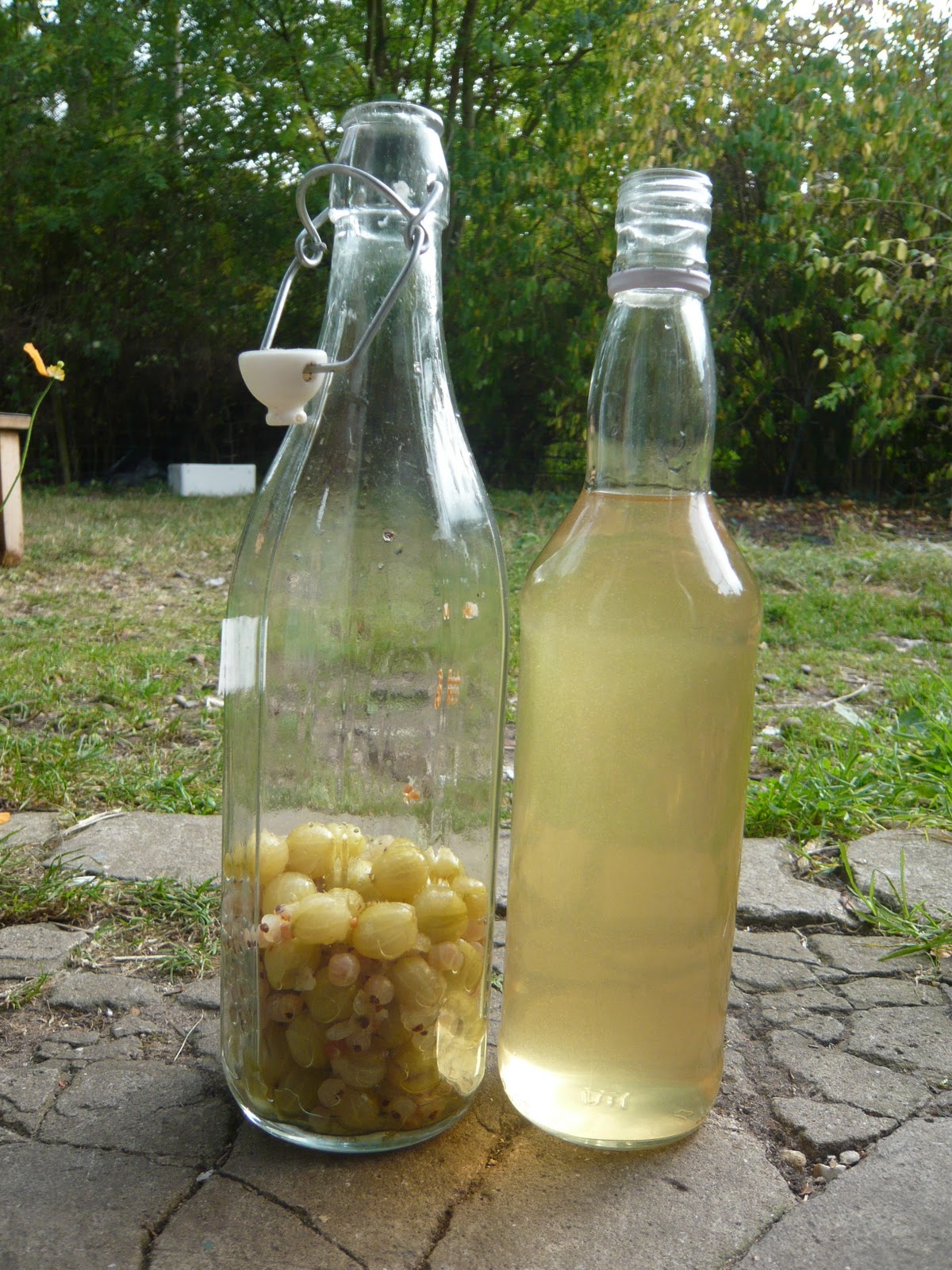
Gooseberry and Elderflower Vodka
Gooseberry and Whitecurrant Gin
Quince Brandy

2010:
Cherry Vodka


As for the brews, the Elderflower Champagne was a dream, drunk young, aged well to a sharper wine, and I shall be making much in the future - despite the explosions in the shed!


Otherwise, I still have to perfect my brewing.  My tactic seems to be: mix it all up, forget about it... and in one case mice had found my muslin bottle tops rather tasty, another had turned to vinegar.  The experts on home-made wines are Carl Legge - see his wonderful blog.  And, Christophe, on Clare Island.  I spent November there racking, bottling, and tasting a variety of brews.  My memory is still sharp with the sweet sour and perfectly musty Rhubarb and Apple Wine, the two years aged Vin de Cassis, which was sweet and rich and drank like a good Port.


The Hedgerow Syrup has been a favourite.  Pasteurised as it was in bottles, it has kept well, and serves as a hot and heartwarming winter drink, to fend off flu, to ward off the weather.  I also made a Quince Syrup, along similar lines, which i drink as a cordial, a lovely flavour, and great quencher of the thirst after a stint in the garden.  Both can also be used in crumbles, compotes and wintry puds...

So... with the coming of Spring, and first the Elderflowers, I look forward to a new spell of concocting drinks to fill the cabinet, for yet another winter hunkered down by the fire.

Sunday, 18 December 2011

Winter Feasting - Partridge; Beef Stouties; Celeriac Gratin; Woodcock on Toast


I haven’t blogged this last month, but I have certainly been eating.  Winter staples, repeated ad infinitum, which we fail to bore of, and so banal I haven’t photographed them are:  Puy Lentils, seasoned with Herbs, Garlic, a dash of Balsamic, of Soy Sauce, of Red Wine, sometimes Bacon... and Cabbage, cooked long and slow in home-made Apple Cider Vinegar, with Carrots or Onions, Beetroot or Marrow, Caraway or Sage, whatever comes to hand.  These bring repeated joy and are quite my favourite foods of a frugal winter, nourishing and full of simple vitamins, piping hot coursing right to the soul…

There have however been occasions of more flamboyant feasting, and, while I failed to note down the exact recipes, I have some photos, and share them here:


Perdriz aux Choux - Patridge cooked in Cabbage


The Partridge a gift, the recipe was taken directly from Elizabeth David's French Country Cooking.  It is the same recipe I used for the Rabbit in October, and you can find it here.  The only adulterations were the additions of Russet Apples and Jerusalem Artichokes to Mrs David's recipe, to not use Sugar, and to cook it in Apple Cider Vinegar.


Beef Stouties with Flageolet Beans


These come from Charcutier Jules of De-Lish.  The Stouties I believe are Beef and Horseradish Sausages soaked in Stout - he'll no doubt correct me.  I cooked them in Onions and a can of Bitter, added the liquid to some Flageolet Beans (cooked previously with herbs), then plunged the whole lot together and baked it in the oven.  This was eaten with Jerusalem Artichoke and Potato Mash and slow-cooked sweet vinegary Cabbage.

Celeriac and Marrow Gratin


This recipe is originally, I hear, a Hugh Fearnley-Whittingstall creation.  I picked it up on Clare Island, and added the Marrow to fill the pot.  Steam thinly sliced Celeriac and fry off peeled half moons of Marrow.  Layer the lot with Olive Oil, Creme Fraiche, Yogurt, Garlic, Chilli, Salt and Pepper in an ovenproof dish.  Cover and cook slowly for about forty minutes. At the last minute top with Curd or similar Fresh Cheese and place under the grill.

This is very rich and doesn't really need an accompaniment - some bread perhaps to mop it up, or a bowl of rice.

Woodcock on Toast with Pickled Crabapples


Le Piece de Resistance - I have always thought Woodcock on Toast quite the sexiest rustic dish, though, need I say, it is utterly inappropriate for the squeamish.  The bird is cooked with all its innards minus the gizzard (remove using your little finger once plucked), its beak spiked through the body, holding the legs together and a piece of bacon over the breast.  A mere eight to twenty minutes, if that, then the Bacon is removed, the guts scraped out, fried with the chopped Bacon, Butter and Port, Salt and Pepper, then spread on toast.  The Woodcock is sat beside, on a separate piece of Toast.

The whole bird is eaten and the ritual approaches that of the Ortolan Bunting.  It is an utter dream, the flavours are rich, indeed, exquisite.   Despite being miniscule, the dish is very filling, often served as  a starter I would suggest this as a main, perhaps with something sharp and light aterwards to cut through the heavenly richness.  Serve with a deep peppery and robust Red Wine.  Here we ate it with the Pickled Crabapples, which stood up superbly and smartly complemented the rich flavours of the bird.

Tuesday, 1 November 2011

Brunch - Shaggy Inkcaps on Toast


 In the fields this morning Amelia came across a huddle of Shaggy Inkcaps, Coprinus Comatus.  


 Eat Shaggy Inkcaps when young and white; as they turn red to black and the rims curl up, the flavour becomes unpleasant.

 The Shaggy Inkcap is also known as the Lawyer's Wig.  Not to be confused with the Common Inkcap, Coprinus atrementarius, poisonous when mixed with alcohol.

...

Mushrooms on Toast 

- Is it not quite the best way to eat Mushrooms?  Fried with Butter and Garlic, served on toast for a late Autumnal breakfast.


 Chop the Mushrooms and fry in a touch of Butter, a tonne of Garlic, a sprinkling of Salt and Pepper.


Serve on Sourdough Toast, scattered with Parsley.


With their delicate flavour rising through the garlic... keen to breakfast on these again!

...


A-foraging Mushrooms with Willow... (background)

...

For more on Mushrooms see: Notes: on Forage, Mushrooms and the Noma Cookbook.

Saturday, 22 October 2011

Apple Wine... Elderflower Champagne; Wine; Gooseberry Whitecurrant Gin - thoughts on.


A bright morning, the fire lit at dawn, a walk and breakfasted, bread in the oven… ode to the joys of country living! Those, the contented glug of the Apple Wine fermenting in the background.

To celebrate today, a post on the various brews in the cottage… A morn’ dram of Elderflower Champagne, of same Wine and a rather more adult Gin.

Apple Wine

First though, the Apple Wine recipe, spawned by my unwillingness to press any more Apples – the recipe is made by chopping and cooking, rather than juicing the fruit. This recipe is adapted from CJJ Berry’s First Steps in Winemaking, shared and dejargoned by DIY sommelier extraordinaire Carl Legge.  The process I have used is the following, it is surely amateur and rudimentary… I shall write more thoughts on bottling and tasting.


I chose to use Russets, and a few Pears.  The Egremont Russet has a creamy sweet and nutty flavour, and I envisage it a delicate and deep wine.

Wash and cut up 2.75 kilos of Apples, skin and all. (Windfalls are fine)  Simmer 20 mins in 5 litres water.  Strain onto 1 kilo of Sugar in Fermenting Bucket.  When lukewarm add rind and juice of 2 Lemons, 1 tsp Marmite, ½ Mug of strong cold Tea, 200g Sultanas, ½ Sachet of winemakers Yeast. 

Cover bucket with Muslin.  Leave to ferment as such, at room temperature, for two-four days until fermentation is less vigorous.  Strain and bottle in airlocked Demijohns.  After about a month rack off into clean jars.  Mature for six months before bottling.


Elderflower Champagne


This year’s batch of Elderflower Champagne has proved a joyful brew, brimming with that floral giddiness that is the drink’s renown.  Light, sweet, sparkling, I find it best drunk young, cold on a Summer’s day.  For a winter variation, add a drop of Hedgerow Syrup giving a stunning aperitif à la Kir Royale.

The inevitable difficulty with home made Champagne is the gaseousness.  This Summer, once-again-rearranging-the-shed, a loud and near terrifying bang proved to be a bottle exploding and in the process smashing two more bottles.  Each has their own remedy to prevent the explosion.  Some say use magnums, others to tie the tops with string or wire, a third, and this is the way I have since managed it, is by occasionally releasing the pressure by part unscrewing the lids.

...

Elderflower Wine

Bottling the Wine with Syphon

You might remember I also put some of my Champagne in a Demijohn under airlock to make a Wine.  This I racked off and bottled about a month ago.  It has produced a lovely, if slightly sharp, dry, pale coloured Wine.  I did worry it had perhaps gone off, a thin white layer had formed on the top of the liquid, but a process of tasting and troubleshooting with Carl Legge, showed me it was indeed the hoped for Wine… and tasting it today I am indeed charmed… it is the stuff of late Summer nights, of Bacchanalia, for what inebriation more profound than that of wine brewed of flowers plucked from one’s own lands.


...

Gooseberry and Whitecurrant Gin

Lastly, I bottled the Gooseberry and Whitecurrant Gin, ever redolent with the summer flavours of the fruits it is in comparison a very sweet concoction… on ice a Summer’s eve, or, for my palate, best with a bitter tonic to balance out the sweetness.  The tendency in alcoholic infusions is to add a tonne of sugar – with Sloe Gin and the like this produces a warming wintry brew, not unlike Port.  However with the lighter, more floral variations I would be tempted on another occasion to use less sugar to produce a drink that is somewhat drier.  I believe the sugar is unnecessary in the process of preserving and simply serves to make the drink palatable.


When bottling fruit alcohols the tipsy fruits can be collected for desserts, cakes, jams.  These I used as an addition to this Apple and Olive Oil Cake, shared by the artiste of Apple Cakes Carla Tomasi.

Carla's Apple and Olive Oil Cake with Tipsy Fruits
...

Off this afternoon to gather the ingredients for a spiced Quince Brandy.  Set to infuse now it should be ready to drink on Christmas day…

Friday, 21 October 2011

A Pheasant - Roadkill roast wi' Autumn Fruits

The roads again amok with Pheasants and the like, driving in the country at this time of year is akin to running the gauntlet, obliging severe and intrepid manoeuvring to avoid the creatures.  Last week however, I hit one.  And, as etiquette prevails, fast wrung its neck.  Unwilling to not eat a bird I had unwittingly killed, I took it home.

Sometime, and yet I haven’t the courage this morning, I shall write a treatise detailing my views on wild and reared meat… Here instead, let me simply say, I had never before eaten roadkill pheasant. 

I hung the hen pheasant in the shed for three days.  On Sunday, returned to the cottage and, as dark fell, put a pot of Lentils on the stove, plucked the bird.  I was lucky to have hit it in the neck/head region as the body was undamaged, the bird clean.

Plucking a Pheasant

On Preparing a Pheasant:
Remove all the feathers, pulling in the direction they grow so as not to tear the skin.  Then take off the Feet and the Head, discard, leaving the Neck intact.  Next remove as much length as possible of the Neck – this is a tasty piece of meat ideal for a stock, a stew or soup.  The Crop where the Pheasant momentarily holds its food (often corn) can be slipped out, the Windpipe likewise extracted from the neck end of the Pheasant.  Any yellow lumps of gathered fat should also be removed as these are not pleasant to eat.  The base of the Pheasant is then slit open.  Plunge a hand in and drag out the insides, of this the edible parts are: the Heart, the Liver, the outer layer of the Gizzard. The Gizzard is a delicious Muscle, which to be eaten has to be peeled off the inner part of the muscle where food is ground.   On one occasion, having gutted and spatchcocked a dozen Pheasant for a New Year’s party, I gathered all the Gizzards and prepared them in a Goose Fat Confit as the French might Gésiers de Canard.  These would then be served hot on Salad leaves with Croutes and Goat’s Cheese for a Provençal feel.


Prepared, the Pheasant was stuffed with chopped Apples, Onion, and Quince.  A knob of Butter, some Garlic Cloves, a bunch of Thyme.  Pheasant is a lean meat with very little of its own protective/ cooking fat, so it was covered in Bacon.  A sudden moment of inspiration led us to fill the tray with chunks of Pumpkin, Swede, Marrow, Parsnip, and more Fruit.  The lot was doused in Apple Juice, more Butter, Salt and Pepper and loads of Rosemary.  Put in the oven about 200C for roughly 30 mins, then 150C for 20 or so until cooked. Rested for ten before serving.

Despite the chaotic end to its life, the bird was beautifully tender, no doubt the Fruit and layers of Bacon kept it thus.  Served on a bed of Puy Lentils with the apple-juice-roasted fruits and veg, the meal was a joy, part medieval banquet part reminiscent of the provincial food of French Wayside Inns.

Wednesday, 21 September 2011

Notes: On Forage, Mushrooms and the Noma Cookbook

We do not stop the world when we eat; 
we go into it a little more deeply.
Olafur Eliasson (Noma)


Cep
... 

Allow me a paintbrush, a palette…a pile of artistic licence to tell of some friends of mine and their wild ways.  Boys they are, a huddle of them, bare’ approachable and and not easy to handle.  They can’t be tethered down and one won’t find them for looking.   But, one might come across them…

On the foreshore by night fighting the tide for a last Sea-bass; atop a tree, gathering Plums to pot a Pigeon in; plucking a Greylag large to feed a crowd.  Adventurous with tastes, unperturbed by roadkill, they’ll be smoking Mackerel in a filing-cabinet-cum-smoker; cooking Mullet in milk for fishcakes; stewing Cockles in a split can of cider on an open fire; barbecuing Samphire.  How very nineteenth century lyrical said a friend as I rhapsodised about baskets of Ceps, and indeed, these are the Huck Finn’s of today, the unassuming artistes of forage.

Dried Chanterelles

Last I called by, Muntjac was roasting in the oven, surfaces brimming with mushrooms gathered, some dried, a hoard: Shaggy Parasols; Chanterelles, orange and sweet-apricot-scented; something blue.  Another fellow appeared a basket in his hand large to gather wood, in it full - Penny-Buns, Ceps, plentiful as a baker’s.

We ate then Parasol:
The cap cut into long, thick strips, doused long in egg and salt and pepper breadcrumbs, fried quick and served slathered unashamedly in mayonnaise.  A dream.

Parasol Mushrooms in Bowl of Apples

The Ceps so plentiful I took some home.

This weekend, another scene: ‘midst fashionistas, florists and folklorists, stepping the streets of London town…  On gathering my basket and boots to return home, risen at dawn to the cockney cries of Columbia Road Flower Market, pressed into my hands was a copy of Noma, Time and Place in Nordic Cuisine by René Redzepi.  I have long hankered after this book and was delighted to be given it.  (Thanks Laur!) It is indeed an extraordinary book, but with over half of the pages covered in photos worthy of the wall, it is not a manual.  The recipes themselves, so daunting that I’m glad I didn’t turn to it to cook my Ceps, relying instead on friendly advice and Elizabeth David (see below).


Indeed, I now understand that the book is less a cookbook and more a book to wander through, wonder at, that tells of the story behind the Michelin starred Copenhagen restaurant Noma.  No longer silent, secret, unassuming; at Noma forage is ostentatious, it’s an artform plucked or peacocking, it is the very edgiest of foodthinking, where food overlaps with artthought and critical theory.  But on closer inspection, I am also ready to bow to this.  Of René’s moment of illumination, he writes:

I realized that we had to exploit the seasons in a better way, so that you could only get a particular dish here and now.  We should explore the extremes of nature, seek out the thousand or more species of edible fungi, the many wild plants, roots and seashore plants. […] The guests dining at Noma should feel a sensation of time and place in their very bones.

Ingredients were thus combined not only with those of same season, but those of their natural habitat.  If venison was on the menu, the meat should be served with snails, pine shoots and mushrooms.  Thus recipes such as: Bouillon of Steamed Birchwood, Chanterelles and Fresh  Hazelnut; Stone Crab and Beach Mustard, Cockle Gel or simply Snails and Moss.  And abruptly, the nineteenth century lyricists and the uber modern restaurant look no longer askance upon one another, artistes the both.

Ceps
Not Ceps and Poached Truffle Meringue (à la Noma) but Cèpes à la Bordelaise (Elizabeth David) with Brown Rice Risotto.

In her French Provincial Cooking, Elizabeth David quotes the recipe of Alcide Bontou (refer to the book to read more).  I shall do likewise:
“Choose 12 firm cèpes, small rather than large, and with dark heads; remove the stalks and peel them, but only wipe the heads; make incisions on the underside of the heads with the point of a knife.  Put a glass of olive oil in a frying-pan; when it is hot, put in the heads of the cèpes; turn them over when they have browned on one side.  Season with salt and pepper.
Chop the stalks with four cloves of garlic and some parsley.  Throw this mixture over the cèpes.  Let them all sauter in the pan for 3 or 4 minutes.
You may add a tablespoon of soft white breadcrumbs.  Serve.”

I made a pseudo-risotto with Short Grain Brown Rice, butter, Shallots, Bay-Leaves, White Wine and Wighton, a local creamy but hard cheese.  And served the Ceps on top.  Divine.

...

Another great friend, longdeserving of a blog post dedicated to her green fingers, her inexhaustible creative energy and her kitchen concoctions, whose latest addition to the home is a goat in the back garden (soon I hope we’ll be on milk and cheese)… makes a Puffpall Pâté of such flavour it is also worthy of Michelin stars.  

Puffball Pâté
I haven’t the exact recipe, and I rather doubt there is one.  Try:
Chop and very gently fry up Puffballs with Garlic and Cumin in Butter.  Blend the lot adding Salt and Pepper or a touch of Soy Sauce.  Spread on bread for a deeply mushroom flavour edged with garlic and cumin.  You could also try adding cream, cream-cheese.

If you do attempt this let me know!

Notes:
 -The Noma cookbook is indeed a gift, only on the verge of my foray into it, I hope to write more anon.
 -Writing at first light, I espy another forager: a grey squirrel feasting on the last of the overripe Bullace.
(In postscript - now mid-November, a friend writes from wild woodlands of Tuscany: I strongly reccommend Parasol Mushrooms, ripped, dipped in Egg, Breadcrumbs, Garlic and drizzled in Lemon Juice...  As only yesterday Amelia came across a field thick with same Macrolepiota procera, I too hope to try this in the week.)

Saturday, 17 September 2011

Blackberries - wi' Beetroot Relish, wi' Cinnamon Whisky, in Vinegar et cetera


Beetroot, Blackberry and Walnut Relish


Apparently nonsensical, it is often colours that define choices of food combinations.   Not quite for this reason alone, I decided to give a touch of the wild to a conventional Beetroot Relish, with the addition of Blackberries and Apples.   More likely, I based my choice on an only-part-forgotten Beetroot and Blackcurrant Relish espied once in the Riverford Cookbook, but the colour, as well as the gluts of berries nearing their end on plentiful briars outside the house, were certainly influential factors in the concoction of this recipe.


On cooking, my head was chiming with shouts of Chilli! Horseradish! Ginger!  But I forestalled such fervour, deciding that the addition of Blackberry was quite quirky enough. Indeed, on bringing a pot to dinner that evening,  there was already a raised eyebrow, a giggle, a sneer...


1/2lb Blackberries, 4 medium Beetroot, 1 Apple, 1 Onion, 100ml Apple Juice, 100ml Cider Vinegar, 100ml Balsamic Vinegar, 1tbsp Blackberry Jam (optional), 100g Sugar, Port (optional), handful Walnuts (optional).


Heat half the Blackberries in the Apple Juice, till cooked, strain and keep the juice.  Grate the apple into this juice, bring to simmer, stir in Jam, set aside.  Heat Vinegars with Sugar and add grated raw Beetroot and chopped Onion, turning so that all the ingredients are covered.  Add Apple and Blackberry Juice.  Stir.  Add slosh of Port rest of Blackberries and Walnuts, simmer a minute longer.  Press into hot sterilised jars, seal.  Leave for a month (although it is lovely immediately) and serve as a sweet/sharp addition to rich wintry meats.


Unlike the Bullace, Port and Walnut Jam, which is given edge by the tartness of the fruit, this is incredibly sweet.  In the future I would indeed add something fiery to lift it.  If making this yourself, why not slice in a Chilli with the Onion, or grate in some Horseradish...

Despite my convincing myself this is a Relish, it has turned out not unlike my Beetroot Pickle, I rather thought the Sugar and Jam would make it more of a spread - I understand a Relish to be something between a Pickle and a Chutney.  In future to make it more Relish-like I shall try cooking it for longer.

...


Blackberry and Cinnanmon Whisky

I have had to turn my thoughts from simply: preserving, to: preserving in the most practical manner... So, despite enjoying the flamboyant, the flippant and the fun, I have started questioning what is really necessary.  It might seem odd that I am talking about practicality under the seemingly superfluous heading of Blackberry Whisky.  But, I am headily conscious of living in a chilly house, am predicting another icy winter, and know well that a nip of something sweet and strong is not only pleasant, but vital on those winter eves...

My recipe went thus:  Fill a very large bottle (1.5lt) to a third with Blackberries (about 250g), cover these in Sugar (about 250g), add 1 bottle cheap Whisky (1lt) and a splash of very good single malt.  I also added a Cinnamon stick.  Shake the lot, and leave in bottle, shaking on occasion, for three months. Strain through muslin, drink when necessary.  The addition of the Single Malt ( a tip for any impoverished Whisky-lover) is said, in a mere drop, to transfer the flavour of the malt to the cheaper stuff.

...


Blackberry and Elderberry Vinegars

Another practicality is how can we make what we tend to buy.  So, vinegar-phile that I am, I was delighted when Carl Legge shared Sandor Ellix Katz's recipe for DIY Vinegar.  Having a so-far-successful Apple/Crabapple Vinegar on the go, I decided yesterday to try Blackberry Vinegar, Elderberry Vinegar and Quince Vinegar.  Rather than using the whole fruits, I have used the Apple and Quince skins and cores, potting and pasteurising the fruits themselves (see pic below).

Briefly: Fill a 2pt Mason Bowl with washed cores and skins of Apples and about 100g of Berries.  Cover with 1pt of 10% Sugar Solution at room temperature.  Place plate on top to keep fruit under liquid and cover with tea-towel.  Leave until starts fermenting, stirring on ocassion if deemed necessary.  After about a week of fermentation remove fruit.  Continue as before, when convincingly vinegar-like, strain and bottle - there's your Vinegar!  


For the Quince, I took the skins and cores of a pile of windfalls, fallen during last week's storms, and did as per Carl's recipe.  

Of course, I'm only at stage one, so will relate whether this method is succesful or not once I can confirm.  For further information, please refer to Carl's blog and Sandor's website.


Quince in Syrup - Elderberry and Apple Compote