Showing posts with label Sustainability. Show all posts

Saturday, 22 October 2011

Apple Wine... Elderflower Champagne; Wine; Gooseberry Whitecurrant Gin - thoughts on.


A bright morning, the fire lit at dawn, a walk and breakfasted, bread in the oven… ode to the joys of country living! Those, the contented glug of the Apple Wine fermenting in the background.

To celebrate today, a post on the various brews in the cottage… A morn’ dram of Elderflower Champagne, of same Wine and a rather more adult Gin.

Apple Wine

First though, the Apple Wine recipe, spawned by my unwillingness to press any more Apples – the recipe is made by chopping and cooking, rather than juicing the fruit. This recipe is adapted from CJJ Berry’s First Steps in Winemaking, shared and dejargoned by DIY sommelier extraordinaire Carl Legge.  The process I have used is the following, it is surely amateur and rudimentary… I shall write more thoughts on bottling and tasting.


I chose to use Russets, and a few Pears.  The Egremont Russet has a creamy sweet and nutty flavour, and I envisage it a delicate and deep wine.

Wash and cut up 2.75 kilos of Apples, skin and all. (Windfalls are fine)  Simmer 20 mins in 5 litres water.  Strain onto 1 kilo of Sugar in Fermenting Bucket.  When lukewarm add rind and juice of 2 Lemons, 1 tsp Marmite, ½ Mug of strong cold Tea, 200g Sultanas, ½ Sachet of winemakers Yeast. 

Cover bucket with Muslin.  Leave to ferment as such, at room temperature, for two-four days until fermentation is less vigorous.  Strain and bottle in airlocked Demijohns.  After about a month rack off into clean jars.  Mature for six months before bottling.


Elderflower Champagne


This year’s batch of Elderflower Champagne has proved a joyful brew, brimming with that floral giddiness that is the drink’s renown.  Light, sweet, sparkling, I find it best drunk young, cold on a Summer’s day.  For a winter variation, add a drop of Hedgerow Syrup giving a stunning aperitif à la Kir Royale.

The inevitable difficulty with home made Champagne is the gaseousness.  This Summer, once-again-rearranging-the-shed, a loud and near terrifying bang proved to be a bottle exploding and in the process smashing two more bottles.  Each has their own remedy to prevent the explosion.  Some say use magnums, others to tie the tops with string or wire, a third, and this is the way I have since managed it, is by occasionally releasing the pressure by part unscrewing the lids.

...

Elderflower Wine

Bottling the Wine with Syphon

You might remember I also put some of my Champagne in a Demijohn under airlock to make a Wine.  This I racked off and bottled about a month ago.  It has produced a lovely, if slightly sharp, dry, pale coloured Wine.  I did worry it had perhaps gone off, a thin white layer had formed on the top of the liquid, but a process of tasting and troubleshooting with Carl Legge, showed me it was indeed the hoped for Wine… and tasting it today I am indeed charmed… it is the stuff of late Summer nights, of Bacchanalia, for what inebriation more profound than that of wine brewed of flowers plucked from one’s own lands.


...

Gooseberry and Whitecurrant Gin

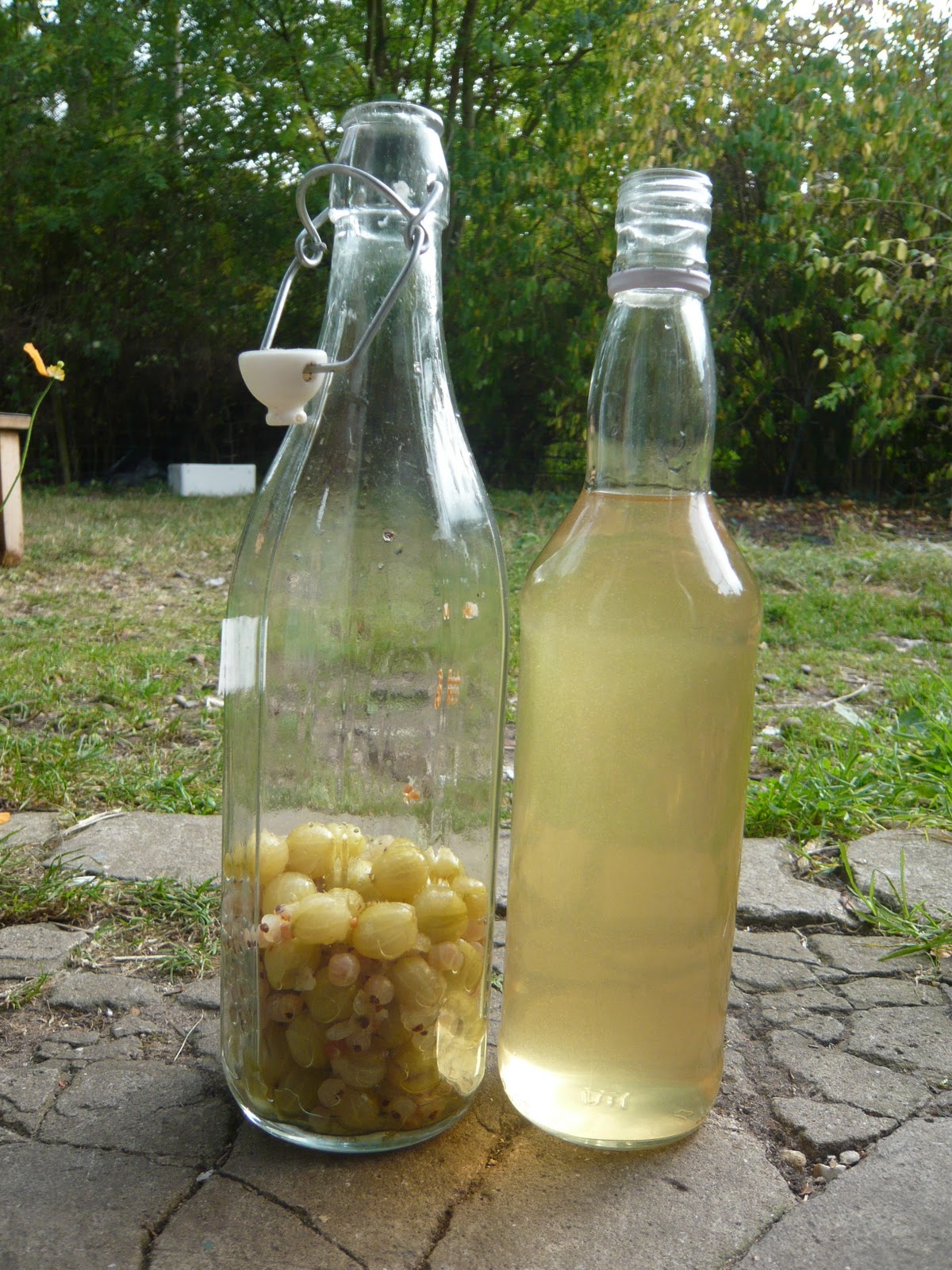
Lastly, I bottled the Gooseberry and Whitecurrant Gin, ever redolent with the summer flavours of the fruits it is in comparison a very sweet concoction… on ice a Summer’s eve, or, for my palate, best with a bitter tonic to balance out the sweetness.  The tendency in alcoholic infusions is to add a tonne of sugar – with Sloe Gin and the like this produces a warming wintry brew, not unlike Port.  However with the lighter, more floral variations I would be tempted on another occasion to use less sugar to produce a drink that is somewhat drier.  I believe the sugar is unnecessary in the process of preserving and simply serves to make the drink palatable.


When bottling fruit alcohols the tipsy fruits can be collected for desserts, cakes, jams.  These I used as an addition to this Apple and Olive Oil Cake, shared by the artiste of Apple Cakes Carla Tomasi.

Carla's Apple and Olive Oil Cake with Tipsy Fruits
...

Off this afternoon to gather the ingredients for a spiced Quince Brandy.  Set to infuse now it should be ready to drink on Christmas day…

Monday, 3 October 2011

Cider Pressing in Suffolk


Charmed as one might be to receive a jovial invitation to a Cider-Making Weekend, a glance between the lines and we’ll find the invite actually reads: come slog away at the squeezing of m’ apples that I might stock up the cellar.  But, the fellow an artiste of the home-made brew, the place a haven, the weather bursting with sunshine… I trundled to the depths of Suffolk county for a weekend spent mastering the art of Wild Cider Making.

Wild Cider is the traditional brew, which harnesses the natural yeasts from the air and the fruit and thus ferments.  We were fortunate to be in the hands of a man whose system is quite perfected… the method being as follows:
The Apples, a muddle of sweet eaters, washed with a jet wash are then bashed, sliced using spades to facilitate the next steps.
These are thrown into a Mill, which further pulps the apples.

A traditional pressing method squeezes the juice from the Apples.

The juice is collected in a bucket.
...

A Second Pressing was attempted, packing the pulp from the first into this most beautiful of presses, gleaned from Italy.  One would imagine this second pressing, much like that of Olives produces the more refined juice?  There was some debate however about the reaction between the apples and the steel, our host wary of the contraption, whether indeed this will produce a pleasant drink remains to be told…


'tis a gentleman's sport this, requiring the mere squeezing of a lever...

...the juice flows
...

The Juice is filtered, then left to ferment in Airlocked Fermenting Bottles until the blossom is again on the apple trees.  All being well the wild yeasts will ferment the natural sugars producing Cider. This will then be racked off into bottles and provide Cider-enough to keep mine host and friends in liquor until the following year’s batch is brewed…


...

While I'm on the subject, tomorrow I shall tell of the distilling of Cider to make a Calvados worthy of late nights and sweet dreams...

Saturday, 17 September 2011

Blackberries - wi' Beetroot Relish, wi' Cinnamon Whisky, in Vinegar et cetera


Beetroot, Blackberry and Walnut Relish


Apparently nonsensical, it is often colours that define choices of food combinations.   Not quite for this reason alone, I decided to give a touch of the wild to a conventional Beetroot Relish, with the addition of Blackberries and Apples.   More likely, I based my choice on an only-part-forgotten Beetroot and Blackcurrant Relish espied once in the Riverford Cookbook, but the colour, as well as the gluts of berries nearing their end on plentiful briars outside the house, were certainly influential factors in the concoction of this recipe.


On cooking, my head was chiming with shouts of Chilli! Horseradish! Ginger!  But I forestalled such fervour, deciding that the addition of Blackberry was quite quirky enough. Indeed, on bringing a pot to dinner that evening,  there was already a raised eyebrow, a giggle, a sneer...


1/2lb Blackberries, 4 medium Beetroot, 1 Apple, 1 Onion, 100ml Apple Juice, 100ml Cider Vinegar, 100ml Balsamic Vinegar, 1tbsp Blackberry Jam (optional), 100g Sugar, Port (optional), handful Walnuts (optional).


Heat half the Blackberries in the Apple Juice, till cooked, strain and keep the juice.  Grate the apple into this juice, bring to simmer, stir in Jam, set aside.  Heat Vinegars with Sugar and add grated raw Beetroot and chopped Onion, turning so that all the ingredients are covered.  Add Apple and Blackberry Juice.  Stir.  Add slosh of Port rest of Blackberries and Walnuts, simmer a minute longer.  Press into hot sterilised jars, seal.  Leave for a month (although it is lovely immediately) and serve as a sweet/sharp addition to rich wintry meats.


Unlike the Bullace, Port and Walnut Jam, which is given edge by the tartness of the fruit, this is incredibly sweet.  In the future I would indeed add something fiery to lift it.  If making this yourself, why not slice in a Chilli with the Onion, or grate in some Horseradish...

Despite my convincing myself this is a Relish, it has turned out not unlike my Beetroot Pickle, I rather thought the Sugar and Jam would make it more of a spread - I understand a Relish to be something between a Pickle and a Chutney.  In future to make it more Relish-like I shall try cooking it for longer.

...


Blackberry and Cinnanmon Whisky

I have had to turn my thoughts from simply: preserving, to: preserving in the most practical manner... So, despite enjoying the flamboyant, the flippant and the fun, I have started questioning what is really necessary.  It might seem odd that I am talking about practicality under the seemingly superfluous heading of Blackberry Whisky.  But, I am headily conscious of living in a chilly house, am predicting another icy winter, and know well that a nip of something sweet and strong is not only pleasant, but vital on those winter eves...

My recipe went thus:  Fill a very large bottle (1.5lt) to a third with Blackberries (about 250g), cover these in Sugar (about 250g), add 1 bottle cheap Whisky (1lt) and a splash of very good single malt.  I also added a Cinnamon stick.  Shake the lot, and leave in bottle, shaking on occasion, for three months. Strain through muslin, drink when necessary.  The addition of the Single Malt ( a tip for any impoverished Whisky-lover) is said, in a mere drop, to transfer the flavour of the malt to the cheaper stuff.

...


Blackberry and Elderberry Vinegars

Another practicality is how can we make what we tend to buy.  So, vinegar-phile that I am, I was delighted when Carl Legge shared Sandor Ellix Katz's recipe for DIY Vinegar.  Having a so-far-successful Apple/Crabapple Vinegar on the go, I decided yesterday to try Blackberry Vinegar, Elderberry Vinegar and Quince Vinegar.  Rather than using the whole fruits, I have used the Apple and Quince skins and cores, potting and pasteurising the fruits themselves (see pic below).

Briefly: Fill a 2pt Mason Bowl with washed cores and skins of Apples and about 100g of Berries.  Cover with 1pt of 10% Sugar Solution at room temperature.  Place plate on top to keep fruit under liquid and cover with tea-towel.  Leave until starts fermenting, stirring on ocassion if deemed necessary.  After about a week of fermentation remove fruit.  Continue as before, when convincingly vinegar-like, strain and bottle - there's your Vinegar!  


For the Quince, I took the skins and cores of a pile of windfalls, fallen during last week's storms, and did as per Carl's recipe.  

Of course, I'm only at stage one, so will relate whether this method is succesful or not once I can confirm.  For further information, please refer to Carl's blog and Sandor's website.


Quince in Syrup - Elderberry and Apple Compote

Monday, 4 July 2011

Slow Food Weekend, on Clare Island, Ireland

The Cove, Clare Island, looking across to Achill

Before time blankets the vibrant tastememories of last weekend’s Slow Food Galway visit to Macalla Farm, on Clare Island, let me tell…

Macalla Farm is home to the artisan, the sustainable, the innovative, regarding food and all aspects of living.  A crowd of twenty or so mainlanders boarded the Pirate Queen or another intrepid sea-faring vessel for an experiential couple of days in the ‘midst of the Macalla household.  Of course.  Of course, when the East of England was baking in temperatures of around 34C, Clare Island was shrouded in a heavy fog, interspersed with deluges unthinkable in an apparently “temperate” climate.  Indeed, the island has been battered now since April with storms ranging up to Force 12, interminable deluges, plagues of Sawfly and the like.. whilst we in the East have been begging for a drop of rain… and the gardens, although abundant were not as bountiful as previous years – the apple trees had lost not only their blossom, but their leaves… a sobering sight for those hoping to be self-sufficient.

Despite the weather, and the garden bereft, a fine show was put on for the Galway Slow-Fooders, the outline as follows:

Saturday Evening

Kir Royale (home-squeezed Blackcurrant Juice with Elderflower Champagne)

Beetroot Soup (with Coconut and Ginger), Sourdough Bread and curls of Bernie’s Island-made Butter
Swiss-Chard, Wild-Rocket and Sheep’s Cheese Tart (with Duck Eggs and home made Ewe’s cheese)
Puy Lentil, Broad Bean, Tomato and Courgette Warm Salad (using the garden’s somewhat scant offerings)
New Potatoes (variety: Sharp’s Express)
Dill Sheep’s Yogurt Dressing
Green Garden Salad, with Nasturtiums and Calendula

Blackcurrant and Strawberry Frozen Yogurts
(Blend 1lb Fruit, 100g Raw Cane Sugar, 500ml Homemade Sheep’s Yogurt.  Then place in the ice-cream maker until frozen)
Ciara’s melt-in-the-mouth Snowball Cookies
(must get hold of a recipe for these)

Lemon Verbena Tea

-- Rye and Spelt Sourdough Breadmaking Demonstration --

Sunday

Breakfast

Tonka Bean and Hazelnut Porridge
Buckwheat and Sheep’s Whey Pancakes
Rhubarb and Blackcurrant Compote
Sheep’s Yogurt
Blackcurrant and Apple Juice
Rye and Spelt Sourdough
Water-Mint Tea

-- Dairy Demonstrations – Making Sheep’s Yogurt, Kefir and Soft Ewe’s Cheese --
-- Visit to the Gardens and Polytunnels --
-- Lacto-Fermentation demonstration – making Lacto-fermented Beetroot, Cauliflower and Carrot Kimchee --
-- Visit to Ballytoughey Loom --

Buffet Lunch

Brown Rice and Seeds Salad with Lacto-Fermented Courgettes and Cauli Greens
Tabbouleh with Garden Herbs (Wild Rocket, Marjoram, Lemon-Balm, Water-Mint, Parsley, Savoury, Oregano, Chives and Borage Flowers)
Potato Salad with Lacto-Fermented Sea-Spaghetti, Chilli and Onion Greens
Courgette Antipasti
(Courgettes macerated in Olive-Oil then Grilled and stored in Oil, Herbs and Garlic)
Tzatziki (with Garden Cucumbers, Garlic, Water Mint and Sheep’s Yogurt)
Stuffed Macalla Vine-Leaves
Wild Rocket and Wild Garlic Pesto
Herby Soft Sheep’s Cheese

Strawberry and Blackcurrant Muffins
Ginger and Cardamom Tea

-- Visit to the Island Farmer’s and Craft Market --

The Cabbage Patch


Christophe and Ciara will be hosting a “Food Matters” course towards the end of August this year, on beautiful Clare Island.  This will be a chance to take part in hands-on workshops and to learn about the myriad aspects of sustainable living as well as enjoying informal discussions as to why food does matter in the current climate. 

We much look forward to seeing you there.

Sunday, 29 May 2011

Sunday Morning, A Basket of Strawberries


A blowy bike trip this morning has the basket full with the Sunday Papers and these beautiful Strawberries 
from a favoured roadside stall.

Thursday, 28 April 2011

Spring Shoots - Nettle, Sorrel, Dandelion, Sea Beet

This is the second part of the article that appeared in Permaculture Magazine, 65, Spring 2011.
 
Sea Beet

NETTLE, SORREL, DANDELION and SEA BEET

The lengthening days herald Spring and the first new shoots.  Young, green, tender, these first greens are the best to be had.  Purging and purifying after the heavy winter vittles, their appearance, like that of the first blossom, is joy!   Surely the best way to salute the arrival of these greens is to gather a handful of each and, keeping the Nettles aside, to throw them together as a bright salad.  Chop up the Nettles very finely to break the stinging needles, mix with garlic, olive oil and vinegar, for a simple Nettle vinaigrette to pour over the salad. 

NETTLE – Urtica dioica
High in protein, Iron and Vitamin C, Nettles are a sturdy and popular spring green.    They appear early, and their young tops are the best parts to use.  As well as eating them fresh, they can be picked and dried for teas or frozen as greens for stir-frys, tarts and soups.

Nettle Pesto
Chop 500g fresh Nettles finely.  Add to this 250g of Pine nuts toasted and crushed (lay in a tea towel and roll over with a rolling pin), the same of coarsely grated parmesan, a lot of finely chopped garlic (for garlic lovers as much as a whole head) and coarse sea-salt to taste.   Mix lightly with a favourite olive oil, until it reaches a chunky, thick consistency.    Serve the pesto with pasta, spread on bread, add to courgette soup.  Freeze or pot and pasteurise.

The recipe can be done with a blender, but the oil tends to emulsify and create a brown sludge.  Chopping all the ingredients separately by hand creates a vibrant green pesto of myriad textures. 
Vegans can replace the parmesan with sunflower seeds.
Those nettle-venturers who are not yet convinced aficionados might want to supplement half the nettles with a more docile green, such as rocket, basil or sorrel…


SORREL – Rumex acetosa
One of my favourite wild greens, Common Sorrel is much like French Sorrel in appearance and flavour.  It is perennial and grows vivaciously all over the UK and Ireland.  A Rumex, it is related to the dreaded dock, and forms a similar seed-head in Summer.  Like Oca, it is high in oxalic acid, giving it a sour, lemony bite.  The wild version is much stronger in taste than the French, cultivated variety.  Like all the other greens it can be eaten raw in salad, chopped into a vinaigrette, wilted, steamed or stir fryed – although the flavour remains good when cooked, it does lose its emerald green colour to become a sludgy khaki.  If you don’t mind the colour, then just use sorrel in the following recipe for a really sharp flavour, otherwise mix sorrel with other greens, such as young spinach or sea-beet.

Sorrel tart
On a blind-baked pastry case layer buttered softened onions, wilted sorrel and chunks of blue cheese. (In Norfolk Mrs Temple’s “Binham Blue” is a particularly good local alternative to Stilton).  Whisk 4 eggs (duck eggs are very good in this wild and rich tart), mix with a small pot of Crème Fraiche and a dollop of milk.  Pour the egg mix up to the edges of the tart and cook for about twenty to thirty minutes at 180C, or until the egg is cooked.  The quiche should be starting to brown on top and risen in the middle.

DANDELION – Taraxacum officianalis
The name comes from the French “dents-de-lion” (lion’s teeth) due to the toothed leaves.  The French actually call the plant “pissenlit” (wet-the-bed), as it is a well-known diuretic.  As well as a diuretic, Dandelion is a versatile detox.  In tea or tincture it is good for the liver and kidneys, as well as for the bladder and it is used by those suffering from anaemia.  It can be eaten raw, picked green or blanched (grown in the dark – easy to do at home, under a bucket, as rhubarb, endive…), and again, stir-fryed, steamed, added to soups, casseroles or stir-frys.

A favourite memory of feasting on dandelions was in France, where they are quite a common form of sustenance.  As the first swallows sailed in to announce Spring we picked great handfuls of dandelions and served them as they were, the leaves and the flowers, bathed in vinaigrette, tossed only with a few compulsory lardons and a baguette, spread on a table in the sun on the side of a village road.
  
Dandelion Salad
Use the youngest and most vibrant dandelion leaves.  Cut out the stalks of any larger ones as they can be bitter.  Toss in vinaigrette.  Add lardons if desired.  Finish with a mass of flowerheads.  Serve when the swallows arrive for a glorious sun-shone spring salad.

SEA BEET – Beta vulgaris sp. maritima
Growing on the edge of the marshes, and along the coast, Sea Beet is a staple spring green.  Recognised by its thick, fleshy leaves, shaped as arrowheads in a rosette, it can grow into a large shrub.  Although it is apparent year round, in Spring it provides an early source of substantial greens.  It has a good texture and rich flavour and is used like spinach in a variety of recipes.   Blanche it, steam it, stir fry, wilt or fill tarts with it.  Or serve with fish or shellfish to continue the coastal theme.

Stir-fryed Sea-Beet.
Stir fry young sea-beet leaves with onions, garlic and caraway seeds in olive oil.  At the last minute douse with Tamari and Balsamic Vinegar.  Serve on its own or on the top of Puy Lentils with a spoonful of yogurt.

Wednesday, 27 April 2011

Winter Roots - Oca, Salsify, Jerusalem Artichoke


Vaguely untimely, this article appeared in Permaculture Magazine, (67, Spring 2011), Part 2 to follow shortly...

Wearied of frostbitten greens, sprouts and mincemeat, pickles and preserves, the temptation is to plunge, without a glance backward, into the onset of Spring.  I would first like to offer one last eulogy to winter vegetables, to three of the less common and more remarkable tubers, hoarded in the dank depths of the vegetable underworld.

JERUSALEM ARTICHOKE, OCA and SALSIFY

These, beside their ruddy counterparts, are the rockstars of the roots: sultry, elegant, with extravagant tastes, ebullient spirits…  But this isn’t about their looks.  Stubby, grubby and hairy, they are the sweetest, the most delicate flavoured, most exotic of the roots.
JERUSALEM ARTICHOKEHelianthus tuberosus
Towering eight-feet-high in triffid-esque arrogance, the stalks nodding with yellow flowerheads at the height of Summer, the Jerusalem Artichoke, also known as the Sunchoke, is related to the Sunflower.  Indeed, the name Jerusalem is thought to come from a confusion with the original name, originating in Peru, the Girasol. They are one of the most labour-free plants to grow, and if a few tubers are left in the ground when harvesting, will provide a crop the following year.  Unfortunately, the Jerusalem Artichoke is famed for being the cause of foul wind and tortuous flatulence – I have yet to hear of a sure-fire remedy.  But their sweet, delicate flavour, reminiscent of artichokes, keeps me growing and eating them.  As for the baneful after-effects I have a couple of suggestions.  Don’t eat Jerusalem Artichokes in large quantities and try and combine them with herbs and spices that ease digestion such as fennel, bay and cumin.  I also take the time to first peel and blanche the vegetables in acidulated water (add vinegar or lemon-juice), which is then discarded, in an attempt to lessen the effects. 

You can roast, soup and mash Jerusalem artichokes, or eat them raw as, somewhat surprisingly, you can most roots… Their reputation has taken a recent upturn and they are to be found, in the form of diaphanous Soufflés and Veloutés, in the very highest realms of haute cuisine.

Jerusalem Artichoke Purée
Purée Jerusalem Artichokes for a jazzed-up variation on mashed potatoes.  Peel, then boil in acidulated water with a potato.  When beginning to fall apart, drain and blend with butter and black pepper.

Jerusalem Artichoke Salad
For the sassiest raw Winter salad.  Slice very thinly, cover immediately with lemon juice to prevent discolouring.  Add walnut oil and toss with toasted walnuts.  Sprinkle with chives or an available green.

SALSIFY- Tragopogon porrifolius
Salsify, or Scorzanera – the two varieties vary only slightly – can be planted in Autumn for a Winter harvest.  A showering grass-like fountain above ground, Salsify tapers to a long hairy root.  It is related to the Jerusalem Artichoke but, fortunately, did not inherit the side effects.  Its taste is light and difficult to define, somewhere between oysters, chestnut and coconut.  It can be put in gratin, and the Irish chef Dennis Cotter, of Café Paradiso renown, braises it with star anise...  I think, as with all these delicate roots, it’s best as it is.

Salsify as it is
Boil unpeeled for twenty to thirty minutes in acidulated water (it exudes a sticky, milky sap and discolours).  Once cooked slip off the skin and add a squeeze of lemon juice or Umeboshi seasoning for a breathtaking combination.  A nut-oil or a knob of butter gives a gentler flavour.  Serve warm with salt and pepper to taste. 

OCA – Oxalis tuberosa
Oca, long unknown, has likewise recently hit the headlines of haute cuisine.  The tubers are planted like potatoes in Spring and grow slowly to be harvested in the depths of Winter.  A shrub of shamrock shaped leaves and pretty yellow flowers, it originates in Latin America.  The leaves and flowers are edible and make pretty additions to Summer salads, but the plant is high in oxalic-acid so beware of gorging!

Oca on the table
Like a lemon-scented new potato in the depths of December, the tuber is a welcome addition to the Winter table.  Serve as new potatoes for that Summer zing, roast in their skins with garlic and rosemary for a taste of Italy, or cook up with cinnamon, ground ginger and orange rind for a festive feel. 

Saturday, 26 March 2011

Tomato Chilli Cinnamon Chutney, a note on experimentation.


With experimental preserving, the tendency is to concoct a certain food on one inspired day, to eat it several months later and in the mean time to have forgotten what impulsion gave rise to said concoction.

There is but one way:  A very meticulous method of noting down experiments and recipes (step 1) is imperative, to be  followed by a taking down of results: tasting notes/success or otherwise (step 2) in order that processes may be repeated, altered, improved etc…

All too oft’ I find myself wondering yet another time how on earth I had preserved a certain jar of tomatoes, or what quantities of salt I had used in that perfect sauerkraut.

There are many methods and each to his own, I love to write the recipe on the label of the jar, but 'tis utterly impractical, tending to have faded or run when eventually the preserve is tasted.

All this to say: 

On Clare Island, in the depths of the stores:  a small jar of last year’s Tomato Chilli Cinnamon Chutney.  An eccentric experiment, that had now had time to mature.

And what a chutney!  The sweetness of the Summer-ripened tomatoes was picked up by the Cinnamon and then, all at once, a sharp chilli bite… it spread thick like butter and deep rusty red, it was quite the marvel of the crowd.

For once, I had written the recipe down, and still had to hand the little book I had inscribed it in, here it is:

Tomato Chilli Cinnamon Chutney, an experiment.

3lb of the Tomato glut (eat your best and ripest raw and sweet, use the rest for chutney)
1 lb Onions
1 lb Demarara
1 pt Vinegar
3-6 Chillies (according to strength)
2-3 Sticks of Cinnamon (ground)

Bring the lot to the boil.
Reduce, simmering and stirring till thick and sludgy. (a spoon should stand up in it)
Pot in Sterilised Jars.
Allow to mature several months, then gorge with friends.

Chillies on Clare Island

Monday, 14 February 2011

Chick-a-Pics

  The aforementioned "at-long-last-laying hens"  in a snowy Kabul garden...


...the three black ones are named after warlords who continue to have a large stake in the current government - Sayyaf, Marshal Fahim and Dostum. The white one, which is bullied by the others and doesnt produce eggs, is called Bashardost, after the most outspoken MP who frequently rails against corruption and warlordism to much ridicule from others.


Notes on the omelette to follow...

Thursday, 3 February 2011

Storing...


An art indeed in the post-modern, post-global, peak oil, food-insecure… era is the storing of foodstuffs in order to be able to provide in times of scarcity. Jo Newton of Irish Seed Savers teaching on Patrick Whitefield’s excellent Sustainable Land Use Course looked yesterday at the myriad methods of doing this, an enabling and empowering step towards self-sufficiency.   I offer a list here, and hope to cover most of the means of food storage in this blog over the seasons.

 In the GROUND
Recent harsh winters are making it harder to store in the ground, but many roots, such as Oca, Swede, Jerusalem Artichokes, Salsify and Parsnips will happily sit snug in the ground over winter – the only difficulty is in digging them.
 SILOS and CLAMPS
Both are traditional methods of food storage.  A SILO is a hole in the ground, aerated with straw, leaves and branches into which the roots are placed and then covered in earth.  While more suited to wet climates, a CLAMP is a pile of veg on the ground, similarly mixed with a material – nettle straw a traditional one for keeping off vermin, around which a trench is dug, the earth is used to cover the pile.  The terms are continue to be used in modern industrial agriculture, but the meanings are somewhat altered.
 STORING ROOTS and FRUITS
Otherwise, buckets or boxes in which particularly carrots, beetroots and celeriac are layered and covered with sand, peat, leaf mould, straw or sawdust, a slightly moist mulch to keep the veggies fresh, at a constant 4C or thereabouts to prevent roots shooting or freezing. 
  Apples and pears can be stored on palettes with air circling between them.  They keep better than roots due to their high level of acidity.
  Pumpkins and Squashes keep very well, and in warmer temperatures (up to 10C) provided they have been ripened off and their shells are hard.  Ripen off by leaving in direct sunlight, or using a cloche if necessary.
 Don’t keep anything showing signs of mould or rot as this will spread fast. 
 DRYING and DEHYDRATION
Windowsills, Dashboards and Airing Cupboards can be used for drying pulses, fruits, tomatoes…  hang your apple rings in the kitchen window.  Herbs are best dried away from direct sunlight in order to preserve their volatile oils.  In the case of wetter fruits and veggies a solar-dehydrator might be in order…
 SMOKING and CURING
Used for meats and fishes and often involving salt these are pre-freezer methods of storing… Gravadlax is one of my favourite and all-too-easy to do at home.  Recipe to be posted, one day.
 PASTEURISATION and STERILISATION
While Pasteurisation (see previous blog) happens at 72C for 20 minutes, Sterilisation happens over a longer period of time at 100C.
  FREEZING
While freezing is an exceptional means of conserving fresh vegetables without them losing any nutrients it demands much gas and electricity… commodities not to be reckoned on.
  LACTO-FERMENTATION
A no-energy means of preserving, a skill lost and returning to Europe with a new-found sense, see my many previous blogs on the subject.
  In SUGAR, In SALT, In BRINE, In VINEGAR, In ALCOHOL…
A myriad ideas and recipes to follow over the coming year.

Wednesday, 2 February 2011

Pasteurisation... Wintry Apple Compote

As ‘tis the season of eating all those vittles so lovingly preserved in the height of the harvest season, I thought I’d write a note on Pasteurisation.

Pasteurisation is a means of preserving fruits and veggies in jars.   It slows microbial growth and is particularly useful in storing products of high acidity such as tomatoes and fruits, the results keep for up to a year.  The process simply involves heating the jar containing the product to 72C, keeping it at that temperature for twenty minutes, and then rapidly cooling it. 

Wintry Apple Compote

Chop up a variety of apples, particularly those that don’t keep well, are better cooked than eaten or have a particular flavour.  I like using nutty Egremont Russets and Bramley for the sharpness, this also gives a really nice mix of textures.

Cook gently in a pan, with a little water to prevent burning.  Stir and add grated Root Ginger and a Spice Bag containing Cloves, Mace, Cinnamon sticks and a touch of Star Anise.  If cooked quickly the apples will break down, if simmered very slowly they will retain some of their shape.

Taste for sweetness and add a raw Sugar or Syrup to taste.  Heat, stirring.

Remove Spice Bag and pot in Kilner or Jam Jars rinsed with boiling water to sterilise.

Place the jars in a Water Bath to their necks, bring the water up to 72C and retain at this heat for twenty minutes.  Remove jars and allow to cool rapidly.  The compote will keep like this for up to a year.

Much like Apple Compote, Tomato Pasatas, Ratatouilles, Summer Soups and Stews, Curries and Gruels can be stored like this.  Keep them in a cool, dark place and enjoy when the garden is bare.

Thursday, 27 January 2011

A note from Harry on Cider... Vinegar


We've been making some cider over the last couple of months, and this batch turned to vinegar.  It's tasty stuff - we used Cox, D'Arcy Spice & Worcester apples & Japanese pears, all in equal quantities, but it did throw some massive protein-tannin ectoplasm after the yeasts died. We filtered out the protein-tannins with some muslin and let it settle - and I think we'll have to do another filtering later. I also ran some tests using the soil testing equipment at work, and discovered that it has a fearsome pH 3.5!

...

A note on the apples - Cox is the well-known Orange Pippin, a very full flavour, best in early autumn, recognisable by its rattling seeds when shaken.  D'Arcy Spice, an East Anglian apple, belongs to the Russet family, sweet, small apples of grey/green colour, popular in Cider.  Worcester is most likely Worcester Pearmain, a desert apple, very crisp and used cut up in salads very early Autumn.  The Japanese pears... I know not.   

...

More to follow on Cider making, but perhaps not till the Autumn.

Tuesday, 25 January 2011

Sourdough Share


A furore of sourdough last week…

I have a lovely Wheat/Rye Sourdough, given to me last year by the Clare Island fellows.  It is, unlike my homemade Rye pictured previously, very stoic, and easy to revive even after a couple of months.  The sourdough was passed on to them seven years hence by a German friend, and they have sent it in jars, in pockets, all over Ireland, to the UK and to France.  A nice thought – the fermented dough putting bread on the table the breadth of Europe, perhaps even further abroad… a share much like sharing a good loaf, sat by the hearth…

A very simple recipe, passed over the sea from Clare Island.  Make at night, Bake at dawn.

For two loaves

1 (lg) yogurt pot of Rye
1 yogurt pot of Wholemeal Wheat
¾ yogurt pot of White Wheat
Salt
Water
Seeds (optional)

Add small amount of water to the Sourdough. Stir.
Add wet Sourdough to mixed Flours.
Stir.
Add water to mixture until dry dough.
Add Salt.
Knead briefly and then bring from bowl onto wet surface.
Knead adding water for ten minutes, until the dough becomes a wet, but manageable consistency.
Remove a hunk of dough to act as the successive sourdough.
Leave this in a open jar for between 10-15 hours, until well-risen, then store it, airtight in the fridge until next baking occasion.
Fold/knead seeds into the rest of the dough if desired, I use Pumpkin, Lin, Sunflower seeds for a lovely crunchy, nutty bread.
Put into greased and floured loaf tins.
Leave to rise between 10-15 hours, the warmer and moister the conditions, the faster the bread will rise, the dough should have doubled in size and small geyser-like bubbles appearing on the surface.
Bake at 220C for 20mins then 180C for another 20 mins. 
The bread should knock easily out of the loaf tins.  Now bake the loaves upside down for five to fifteen minutes depending on how thoroughly cooked it is.  This creates a lovely crust.
Knock on the base of the bread, a hollow sound means it is done.
Leave a while, for a day even, particularly if the quantity of rye flour is high, before cutting into as the crumb can be very wet and sticky immediately out of the oven.

Pass the sourdough on!

(Notes on the science of sourdough to follow at another stage)

Wednesday, 1 December 2010

The Art of Lacto-fermentation


It first occurred with samphire, this only-locally-known marshplucked food became haute-cuisine overnight, in fact timbales lain with samphire sprigs in chic London restaurants are now so commonplace they are nearly passé. Then nettles: not just in soups, but in gnocchi, in vinaigrettes, and before long, the likes of sautéed foie-gras and roasted veal sweetbreads were being served on a bed of wilted Dorset nettles. Then game: woodcock on toast, head still on, beak spiking through body, became the sexiest starter. Now, with the latest rustic DIY trends, nudging into foodspeak is lacto-fermentation. It may sound horribly Heston Blumenthal, but lacto-fermentation is not only simple, but a highly nutritious, tasty, ethical and low-energy way of preserving vegetables and dealing with autumnal garden gluts.

Fermentation heralds from ancient traditions the world over, and, used in the production of alcohols, sourdoughs, yogurts, cheeses, miso and a host of lesser known foods, it remains a fairly common part of our everyday diet. As to the lacto-fermentation of vegetables, it is best-known in Europe in the too-often-dismissed form of sauerkraut. Before you turn your gaze away in festering disgust, I beg you to look again on this sour cabbage, which has too long mouldered in the cupboards of pungent Northern European cuisine. Today, nutritionally, ethically and ecologically, lacto-fermentation is proving to be the edgiest in food thinking.

Lacto-fermentation preserves vegetables in an environment of living cultures. These good bacteria are known as lactobacilli, they break the vegetables’ nutrients into more digestible forms, thus facilitating their assimilation, remove toxins and increase (yup!) vitamin levels, all whilst conserving the vegetables in a raw state. And, you can try this at home!

The lacto-fermenters of this world suggest that a diet in which everything is bacteria free and pasteurised starves our intestinal flora of the necessary nourishment, making us more susceptible to disease. Acknowledging that certain bacteria are very important for the functioning of the immune system and also provide competition for heavier, more potent bacteria, we can begin to dispel these current hygiene frenzy myths. Indeed, barrels of sauerkraut onboard ships saved sailors from the recurrent sea-disease, scurvy. And, the process of lacto-fermentation, as opposed to pickling and pasteurizing, by using living cultures keeps vegetables crunchy, sharp and alive over the winter months. What offers more delight than, in deep winter when barely a leek is standing in the garden, levering the lid of one of your fermented pots to let the smell of sparky summer vegetables pervade the room.

When fermenting, I refer to two excellent writers, perfect opposites, they are perfect complements. The first is highly practical Scandinavian Annelies Schöneck, hers is a deep technical knowledge, and she tends to offer an introduction reminiscent of science lessons, followed by step by step fermentation recipes. She has at least a couple of books that have been translated into English: Making Sauerkraut and Pickled Vegetables at Home: Creative Recipes for Lactic-Fermented Food to improve your health and The cultured cabbage. Vaguely retro, you might just spot their faded covers on the bookshelves of your local charity shop.

At the other extreme is a startling book by Sandor Ellix Katz, called Wild Fermentation. Quite as wild as the title suggests, Katz looks at fermentation as a means of revolt amidst a mainstream culture of mass produced, plastic packaged foods. With sections entitled: Cultural homogenization; Fermented stimulants and the rise of globalization; Resisting the commodification of culture; his book outlines how “we can merge appetite with activism and choose to involve ourselves in food as cocreators”. Wild Fermentation is an extraordinary, lucid food process, a recipe book which is less about quantities and ingredients, but about concepts, methods and practice.

Katz’s lesson is important, that the consumption of live foods offers a spiritual and practical interaction, interdependence and interconnection with the surrounding life forces. Lacto-fermentation shifts the food process from the near passive consuming of long dead food, to a creative, transformative action, from one of decomposition and decay to one of life, reproduction and transformation.

On a more practical level, lacto-fermentation manages to preserve vegetables without the use of freezers, canners, without pasteurizing or heating, simply by placing them in conditions that encourage the production of lactic-acid bacteria (lactobacilli), this natural preservative that inhibits the production of other bacteria. These conditions are Anaerobic and demand Pressure, a Catalyst and Salt. As with all food, the best results will be obtained with the best ingredients, so a wild sea-salt (such as Sel de Guérande) a pure unfiltered water or natural spring water and of course the freshest vegetables.

The catalyst is usually already present in vegetables, for example in the organisms on the cabbage leaves. However, to ensure a good outcome, I tend to use a supplementary catalyst. This can be blackcurrant (or gooseberry, raspberry or similar) leaves, which are high in lactic acid bacteria, and have their own sweet, subtle yet unmistakeable flavour. Whey can also be used, I make it straining yogurt or separating milk.

Although there are beautiful ceramic crocks made for the purpose, with a water airlock system, these are expensive (keep an eye open in flea markets). Kilner jars are likewise good fermentation apparatus, and can be found cheap on markets, however, do get hold of new rubber seals...
Otherwise, a bucket will do.

For a one gallon bucket of sauerkraut:
Roughly 5lb cabbage, 3tbsp sea salt, ¼ pt whey and/or 12 blackcurrant leaves.
Chop or grate cabbage. Pack it into bucket layering it with salt, blackcurrant leaves or whey and other ingredients of your choosing (chopped apples, turnip, horseradish, rocket, caraway seeds, juniper...), pushing down with your fists, kitchen implement or feet as you go. This (pressure) and the salt will help force water from cabbage, to create the brine in which the cabbage will ferment. Once bucket is full put a snugly fitting plate on top and weigh it down with a clean weight (i.e. a large stone you have washed). Cover the whole thing with a cloth. Leave for three or so days at warmish room temperature to get fermentation going, then move to cooler place and allow to ferment slowly. Don’t be afraid to check on it regularly, touching, tasting, noticing changes in consistency... mould may appear on the top, scrape it off, the kraut underneath will be fine, the white substance is lactobacilli... Leave at least three weeks, before digging in... Sauerkraut improves with age!
For a jar of lacto-fermented French beans:

Chop young French beans (roughly 1lb) and push into jar (1 pt), layering with salt (1/2tbsp), blackcurrant leaves (or spoonful of whey) and flavourings of choice (onion, garlic, dill heads, mustard seed, tomatoes...) Put on pressure and add more beans until jar is full and can take no more, cover with water, pressure again and fix lid. 3 days room temp, might start bubbling, then move to cool dark place for at least three weeks. Store until needed, open and enjoy!

This recipe for beans will suit most vegetables, some (such as cabbage, beetroot) will produce their own liquid under pressure, and you probably won’t need to add any water. Always make sure the top layer of vegetables remains under the water, you can use a weight of sorts, as this creates the necessary anaerobic conditions. The amount of salt will affect the speed of fermentation and the length of time the vegetables will remain preserved for, I estimate between ½ - 1 tbsp per pint jar of vegetables.

Lacto-fermentation is experimental, success or failure is bound up in a symphony of tiny details. A serious stench will warn you if things have gone bad. Keep an eye on the developments, test according to your singular tastes, and this curiosity will in its turn allow you to adventure further... Once you have the basics you can experiment, last summer, as well as the staple sauerkrauts and French beans, we had buckets of cucumbers bubbling all over, a pile of delicious carrot kimchi (using chillies, ginger and spices), jars of broad beans (ours were foul, as was our kale!), lacto-fermented beetroot, courgettes, seaweed...

Serve these bright crunchy veggies simply with rice, mix into a potato salad, for breakfast with kippers, amuse-bouche or as a tangy side. You can use the remaining juice as a starter for your next batch of lacto-fermented veggies, or drink it for a serious health-boost.

Fermentation is not only a highly practical skill in this peak-oil era, but is a domain for the curious and those keen to approach food in a more ethical manner. Encouraging a slight deviation in one’s mindset one can begin to experiment with what is growing around us, our climate and living conditions. So, why not reconsider that sour cabbage and join in this latest food frenzy!

“Come participate in a cultural revolution! Wild fermentation is a way of incorporating the wild into your body, becoming one with the natural world. Wild foods possess a great, unmediated life force which can help us adapt to shifting conditions and lower our susceptibility to disease. These microorganisms are everywhere and the techniques for fermenting with them are simple and flexible.”

Sandor Ellix Katz, Wild Fermentation

...

More posts on Lacto-Fermenation: Purge! , Fermentation Fervour


This article was published in Permaculture Magazine, PM 64, Summer 2010