Showing posts with label Festive. Show all posts

Monday, 1 September 2014

Hedgerow Loaf Cake


It has to be said that, after a hot and close Summer, this past fortnight has definitely felt like Autumn.  Along with the cooler weather, the hedgerow fruits are here in abundance.  Here then a recipe for a hedgerow fruit and nut cake, which will hold whatever fruits you deign to gather.  This simplest of recipes served as a wholesome birthday cake for a mother-in-law fond of the hedgerows, and is seen here the following day with coffee.

Cream 200g Butter with 150g Sugar.  Beat in 4 Eggs one by one.  Fold in 150g Spelt Flour, 1 level tsp Bicarb., 1 level tsp Baking Powder (all sieved) and 150g Ground Almonds.  Then fold in autumnal fruits, nuts and seeds.  In this case I have used Windfall Apples, Elderberries, Blackberries, Walnuts and Hazelnuts.  The fruits and nuts should be about the same volume as the mix so that when folded into the mixture it contains them, but only just.  Spoon into a lined loaf tin.  I have then topped it with slices of Apple and Flaked Almonds.

Bake at 180C for about 40 mins until cooked through.

...

Notes:
You could try replacing some of the ground almonds with ground hazelnuts - heat them, rub off the skins, then grind to flour.  I think that Maple Syrup instead of Sugar might taste really lovely in this cake.  I have yet to try this... Also, this is not a very sweet cake.  If you would like it to be sweeter you could sprinkle with Brown Sugar before cooking or drizzle with Honey or Maple Syrup once cooked and when still warm.

Thursday, 12 January 2012

Winter Feasting (iii) A Feast Indeed! or How to eat Terrine: with lashings of Bread & Butter, Pickles, the like...


Besides the Terrines, how to satiate the stomachs of twenty-odd banqueters?


Game Terrine

The stoic winter staples: Puy Lentils, Cabbage and Bread.  These, and piles of Pickles and Jellies from the shed.  This finished with Baked Apples, and a variety of alcoholic fruit, again to be found in the shed-cum-pantry.  A moment to rejoice in that Summer-Autumn of perpetual preserving!

Redcurrant Jelly and Pickled Crabapples

Before dining: long milling over Mulled Cider.  The Cider, a dream, made by a friend and sweetened slightly in its flagon with the addition of Honey.  It was mulled with Quince, Allspice, Cinnamon, Cloves, Lemons.

The Lentils I failed, once again, to photograph in their steaming glory.  Simply: cooked the night before with Onions softened in Butter, Garlic Cloves in their skins, Thyme, Bay Leaves, Juniper and Water, flavoured nearing the end with Balsamic Vinegar, Red Wine, some Apple/Rosemary Jelly, a touch of Soy Sauce, Salt and Pepper.  They sat luxuriating in their sauce for a day, and were then heated up.

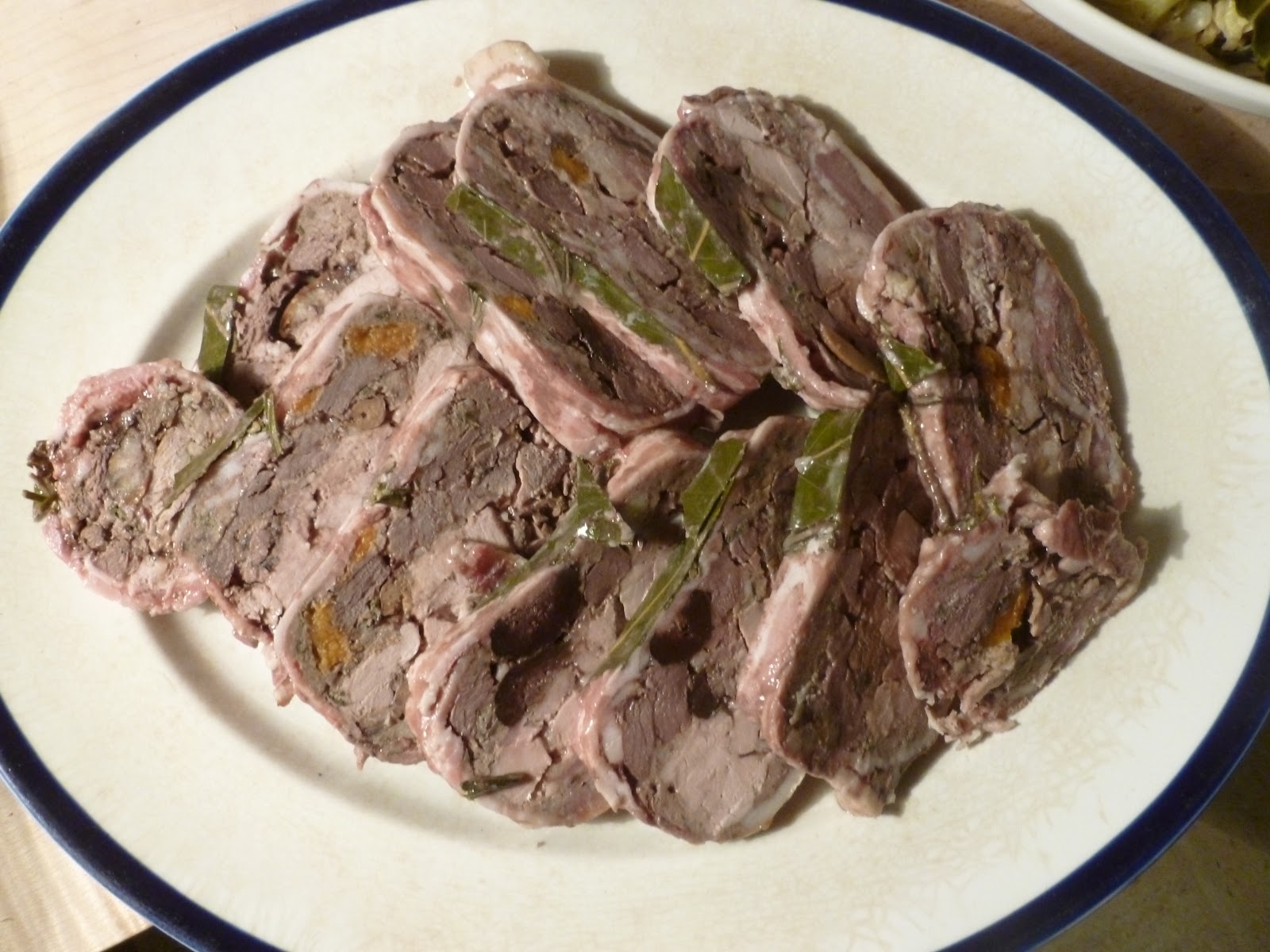
Sliced Terrine and Cabbage

The Cabbage was cooked in batches on the day, first with onions in Olive Oil, then slowly in a light, homemade Cider Vinegar, and masses of Caraway.  Reheated at the last minute, laid on Cabbage leaves and topped with roast Pumpkin Seeds.

An enormous Pumpkin

The enormous Pumpkin, was chopped into big beautiful chunks, and doused in a Marinade of Olive Oil, Chilli, Demarara Sugar (for lack of Maple Syrup), and a touch of Balsamic and Soy Sauce, and French coarse Sea Salt.  After about an hour of marinating it was roasted at high heat in the oven, and served hot.  The idea for the recipe (minus Soy and Balsamic) came from a fortnight spent in November back ‘midst the gales on Clare Island, a recipe for Pumpkin Crisps made with Uchiki Kuri.  I shall tell about the fortnight anon.

...chopped in big, beautiful chunks, sat in marinade

The Bread, all five loaves, were cooked as per the previous recipe.

Bread


Great sloshing bowls of Pickled Apples, Pickled Crabapples, Bar-Le-Duc Redcurrant Jelly and Rosemary Jelly were lain between bowls full of Butter.

Apples baked in Gin-soaked Bullace

Following on from that Baked Apples, stuffed with Figs (Norfolk Figs – oven dried) and Sultanas soaked in Quince Brandy.  Cooked in a bed of Gin-soaked Bullace, these the remnants from the Bullace Gin.  With those, to feed the multitude, Potted Brandy Figs, and a selection of post-Christmas chocolates of all varieties, Satsumas, and bowls of Hazelnuts and Walnuts (again from local gardens).

Potted Brandy Figs

Oh ‘twas a feast indeed…

...

...breakfasting on leftovers

Tuesday, 3 January 2012

Winter Feasting (ii) - Venison and Game Terrines


In a moment of over-zealous Christmas jollity, a last-minute festive feast was planned, friends were invited, crockery searched out, rugs shook, candles borrowed, firewood cut, a Christmas Tree erected.  Long debates necessarily ensued over the menu, how to seat and feed such numbers, more to the point, on what… So it was that we settled on a variety of cold Terrines, and on Boxing Day, while others slept off their Christmas indulgence, banqueted languorously on cold cuts, on Tongue and the previous day’s Plum Pudding, or set themselves up for a serious bout of telly-watching, we mopped our brows and set to concocting Terrines.


Now, it has to be said that a Terrine, like a Chutney, improves with age.  If covered with Goose fat, or clarified butter, it can happily last a week, longer even.  Time however, had pressed us to last minute structuring, and I have to say these seemed none the worse off for having sat a mere twenty-four hours.  Both of us claiming to be experts, and each distrusting the other’s method, cookery books – Elizabeth David, Constance Spry, Hugh Fearnley-Whittingstall – were heavily consulted.  Eventually we took ideas from all, a hefty pinch of common sense, of foody inspiration and adoration… and the recipe that follows is what we came up with.

Before I begin however, two things:  Firstly, a Terrine is simply a Pâté, made in a terrine dish.  Once you have the method you can adulterate it as you wish, adding and removing ingredients according to preference or what is available.  That said, I have known a Terrine to fall apart, so I do suggest having at least equal quantities of farce to chopped meat.  Secondly, in a burst of immodesty, I have to say these were the best Terrines I have ever eaten, not only did they look sublime, but the flavourings, the texture, the moistness, all combined to make them taste utterly heavenly, and quite worthy of French charcuterie…  Whether this is repeatable simply by following a recipe, I don’t know – but do have a go, and do let me know.

The following should fill three two pint Terrine dishes.

For the Farce:
2lb Sausage Meat
½ lb Pheasant Livers
8 Chestnuts
6 Dried Figs
6 Dried Apricots
Sage
Rosemary
Thyme
15 Juniper Berries
2 Blades Mace
1 Egg
1 tea-cup White Wine
Black Pepper


Chop the Pheasant Livers; Roast the Chestnuts; 
Soak the chopped Figs and Apricots

The Farce is literally the stuffing, it holds the Terrine together.  To make it, first chop the Pheasant (or Chicken) Livers very small, keeping any blood; Roast the Chestnuts and peel them, breaking them into small bits; Soak the chopped Figs and Apricots in hot water; Crush the herbs and spices (to taste).  Then mix all ingredients, including the blood from the Pheasant Livers.  Season with Black Pepper.  If you find you want to further moisten the mixture, you can use the water the fruit soaked in.  If you want to dry it or bulk it out, use stale Breadcrumbs or Oatmeal.

Crush the herbs and spices

For one Venison Terrine, one Pheasant Terrine, one Venison and Pheasant Terrine:
1 ½  lb Pheasant meat
1 ½   lb Venison
21b streaky Bacon
Bay Leaves

Thus using about 1lb of meat in each Terrine.  The meat should be in pieces, but chopped thinly so it can be lain in layers through the Terrine.  Stretch the Bacon on a chopping board using the back of a knife.  Any Bacon Fat or bits that break off can be added to the Farce.  Line Terrine dishes, or Loaf Tins with the Bacon, leaving enough so it can fold over the top and wrap around the whole Terrine.  You can place Bay Leaves or other Herbs in the base, these will produce a pattern when the Terrine is turned out.

Line Terrine dishes with Bacon

Now layer Farce, followed by meat in thin layers, to fill the Terrine.  Aim to commence and finish with Farce, so that the Terrine holds together.  In the Venison Terrine I added a layer of Bar-Le-Duc Redcurrant Jelly, made this Summer, after the Meat, this added a tart sweetness to the Terrine.  


Finally the Bacon is wrapped around, tucked in and the Terrines are covered and cooked for 1 ½ to 2 hours in a Bain-Marie at 160-180C until firm, shrunken from the sides, the juices running clear when a knife is stuck in.


Any juices will eventually form a jelly when the Terrine cools.  If you are fortunate this might even enrobe the sides and top of the Terrine when turned out and provide a delicious glaze – ours slipped off.  The Terrines are then left, pressed under a weight to finalise the togetherness of the Terrine and to create a flat base for when they are turned out.   Leave for up to three days, or, if longer cover with a fat, or freeze. Turn them out prior to serving using a butter knife to slip around the edges.


When sliced, all the layers of meat and farce, as well as the fruits and nuts become apparent:


...to follow: the entire feast.  

Sunday, 18 December 2011

Winter Feasting - Partridge; Beef Stouties; Celeriac Gratin; Woodcock on Toast


I haven’t blogged this last month, but I have certainly been eating.  Winter staples, repeated ad infinitum, which we fail to bore of, and so banal I haven’t photographed them are:  Puy Lentils, seasoned with Herbs, Garlic, a dash of Balsamic, of Soy Sauce, of Red Wine, sometimes Bacon... and Cabbage, cooked long and slow in home-made Apple Cider Vinegar, with Carrots or Onions, Beetroot or Marrow, Caraway or Sage, whatever comes to hand.  These bring repeated joy and are quite my favourite foods of a frugal winter, nourishing and full of simple vitamins, piping hot coursing right to the soul…

There have however been occasions of more flamboyant feasting, and, while I failed to note down the exact recipes, I have some photos, and share them here:


Perdriz aux Choux - Patridge cooked in Cabbage


The Partridge a gift, the recipe was taken directly from Elizabeth David's French Country Cooking.  It is the same recipe I used for the Rabbit in October, and you can find it here.  The only adulterations were the additions of Russet Apples and Jerusalem Artichokes to Mrs David's recipe, to not use Sugar, and to cook it in Apple Cider Vinegar.


Beef Stouties with Flageolet Beans


These come from Charcutier Jules of De-Lish.  The Stouties I believe are Beef and Horseradish Sausages soaked in Stout - he'll no doubt correct me.  I cooked them in Onions and a can of Bitter, added the liquid to some Flageolet Beans (cooked previously with herbs), then plunged the whole lot together and baked it in the oven.  This was eaten with Jerusalem Artichoke and Potato Mash and slow-cooked sweet vinegary Cabbage.

Celeriac and Marrow Gratin


This recipe is originally, I hear, a Hugh Fearnley-Whittingstall creation.  I picked it up on Clare Island, and added the Marrow to fill the pot.  Steam thinly sliced Celeriac and fry off peeled half moons of Marrow.  Layer the lot with Olive Oil, Creme Fraiche, Yogurt, Garlic, Chilli, Salt and Pepper in an ovenproof dish.  Cover and cook slowly for about forty minutes. At the last minute top with Curd or similar Fresh Cheese and place under the grill.

This is very rich and doesn't really need an accompaniment - some bread perhaps to mop it up, or a bowl of rice.

Woodcock on Toast with Pickled Crabapples


Le Piece de Resistance - I have always thought Woodcock on Toast quite the sexiest rustic dish, though, need I say, it is utterly inappropriate for the squeamish.  The bird is cooked with all its innards minus the gizzard (remove using your little finger once plucked), its beak spiked through the body, holding the legs together and a piece of bacon over the breast.  A mere eight to twenty minutes, if that, then the Bacon is removed, the guts scraped out, fried with the chopped Bacon, Butter and Port, Salt and Pepper, then spread on toast.  The Woodcock is sat beside, on a separate piece of Toast.
The whole bird is eaten and the ritual approaches that of the Ortolan Bunting.  It is an utter dream, the flavours are rich, indeed, exquisite.   Despite being miniscule, the dish is very filling, often served as  a starter I would suggest this as a main, perhaps with something sharp and light aterwards to cut through the heavenly richness.  Serve with a deep peppery and robust Red Wine.  Here we ate it with the Pickled Crabapples, which stood up superbly and smartly complemented the rich flavours of the bird.

Tuesday, 25 October 2011

Spiced Quince Brandy


With a scent at once floral and of exotic fruits, the Quince is more akin to the Guava it seems than to any fruit of local cultivation.  Originating in South West Asia, it grows readily in our climate and was once a popular element of the English diet.  In the last years this most regal of fruits is enjoying a revival.  When asked to describe it, for it has not quite entered the domains of common parlance, I often find myself sketching medieval still-lifes: think on a painting thus, against a dark 'ground, a hare hanging long, a goose splayed over a table, to its side a bowl of shapely, knobbly yellow fruit, no, not pears… Indeed it is often a surprise that a fruit of such stoic mien have such delicate flavour.

Still Life with Quince

I desired thus to try capture these heady scents redolent of Carribean dusks, of Medieval banquets, in a bottle.  The Quince can however be prepared in many manners (more to follow on this subject): besides Membrillo, a Hispanic Quince Paste, it can be made into jellies, popped in crumbles and compotes, baked and stewed, or at best served with meats, whether stuffed in Pheasant, as I did here or popped in a casserole or Tagine.  It is very good with Lamb, and I have a little plan to cook it soon with Mutton.


The difficulty with the Quince is that it is a hard fruit, demanding a lot of preparation, and its dreamy flavours are hard to extract.  I was determined to try it in an alcoholic infusion, but long deliberated over which alcohol to infuse and how best to capture those scents.  There was talk of Gin, Vodka, of grating, stewing, mashing the fruit.  Eventually I decided on a Spiced Brandy, wanting to make a warming winter drink to keep me company by the fireside.  With two months ‘til Christmas, I sensed this the apt time for infusion – it will toast in the festivities of Christmas Day!

I eventually decided to try one batch cooked and one raw, so see which gave the best flavours. 

Stewed Spiced Quince Brandy


Chop four small Quince into chunks.   Place in pan with a dash of water and (if possible) some of Drove Orchards Quince Juice (quite the essence of Quince).   Bring to the boil then simmer gently over several hours until the Quince has turned deep pink.  


Top up with liquid as necessary, there should be just enough to stop it from drying.  You could add the Sugar and Spices to the pan when cooking.  I, however, added them later.  Spoon half of the Quince into each of 500ml wide-necked bottles, add Spices of choice (Cinnamon, Allspice, Cloves, Star Anise, Nutmeg etc) and two level tablespoons of Sugar per bottle.  Don’t go too overtop on the spices, as they will be in the alcohol for a long time and only the tiniest amount will give flavour.  Fill to the brim with Brandy, close.  Store in a cool dark place, shaking occasionally.  Serve on awakening Christmas Day.


Raw Spiced Quince Brandy
Wash and slice one very large Quince thinly and layer in 1 litre Kilner Jar with Cinnamon, Cloves, Star Anise, Allspice, and three level tablespoons of Demarara Sugar.  Cover with Brandy.  Leave to infuse until Christmas morn’.


This Recipe can be altered by varying the Alcohol, the amount of Sugar, the Spices used…. For some ideas see the Recipes on this blog for: Bullace Gin; Sloe Gin; Gooseberry and Whitecurrant Gin; Elderflower and Gooseberry Vodka; Blackberry WhiskyCherry Vodka

Saturday, 22 October 2011

Apple Wine... Elderflower Champagne; Wine; Gooseberry Whitecurrant Gin - thoughts on.


A bright morning, the fire lit at dawn, a walk and breakfasted, bread in the oven… ode to the joys of country living! Those, the contented glug of the Apple Wine fermenting in the background.

To celebrate today, a post on the various brews in the cottage… A morn’ dram of Elderflower Champagne, of same Wine and a rather more adult Gin.

Apple Wine

First though, the Apple Wine recipe, spawned by my unwillingness to press any more Apples – the recipe is made by chopping and cooking, rather than juicing the fruit. This recipe is adapted from CJJ Berry’s First Steps in Winemaking, shared and dejargoned by DIY sommelier extraordinaire Carl Legge.  The process I have used is the following, it is surely amateur and rudimentary… I shall write more thoughts on bottling and tasting.


I chose to use Russets, and a few Pears.  The Egremont Russet has a creamy sweet and nutty flavour, and I envisage it a delicate and deep wine.

Wash and cut up 2.75 kilos of Apples, skin and all. (Windfalls are fine)  Simmer 20 mins in 5 litres water.  Strain onto 1 kilo of Sugar in Fermenting Bucket.  When lukewarm add rind and juice of 2 Lemons, 1 tsp Marmite, ½ Mug of strong cold Tea, 200g Sultanas, ½ Sachet of winemakers Yeast. 

Cover bucket with Muslin.  Leave to ferment as such, at room temperature, for two-four days until fermentation is less vigorous.  Strain and bottle in airlocked Demijohns.  After about a month rack off into clean jars.  Mature for six months before bottling.


Elderflower Champagne


This year’s batch of Elderflower Champagne has proved a joyful brew, brimming with that floral giddiness that is the drink’s renown.  Light, sweet, sparkling, I find it best drunk young, cold on a Summer’s day.  For a winter variation, add a drop of Hedgerow Syrup giving a stunning aperitif à la Kir Royale.

The inevitable difficulty with home made Champagne is the gaseousness.  This Summer, once-again-rearranging-the-shed, a loud and near terrifying bang proved to be a bottle exploding and in the process smashing two more bottles.  Each has their own remedy to prevent the explosion.  Some say use magnums, others to tie the tops with string or wire, a third, and this is the way I have since managed it, is by occasionally releasing the pressure by part unscrewing the lids.

...

Elderflower Wine

Bottling the Wine with Syphon

You might remember I also put some of my Champagne in a Demijohn under airlock to make a Wine.  This I racked off and bottled about a month ago.  It has produced a lovely, if slightly sharp, dry, pale coloured Wine.  I did worry it had perhaps gone off, a thin white layer had formed on the top of the liquid, but a process of tasting and troubleshooting with Carl Legge, showed me it was indeed the hoped for Wine… and tasting it today I am indeed charmed… it is the stuff of late Summer nights, of Bacchanalia, for what inebriation more profound than that of wine brewed of flowers plucked from one’s own lands.


...

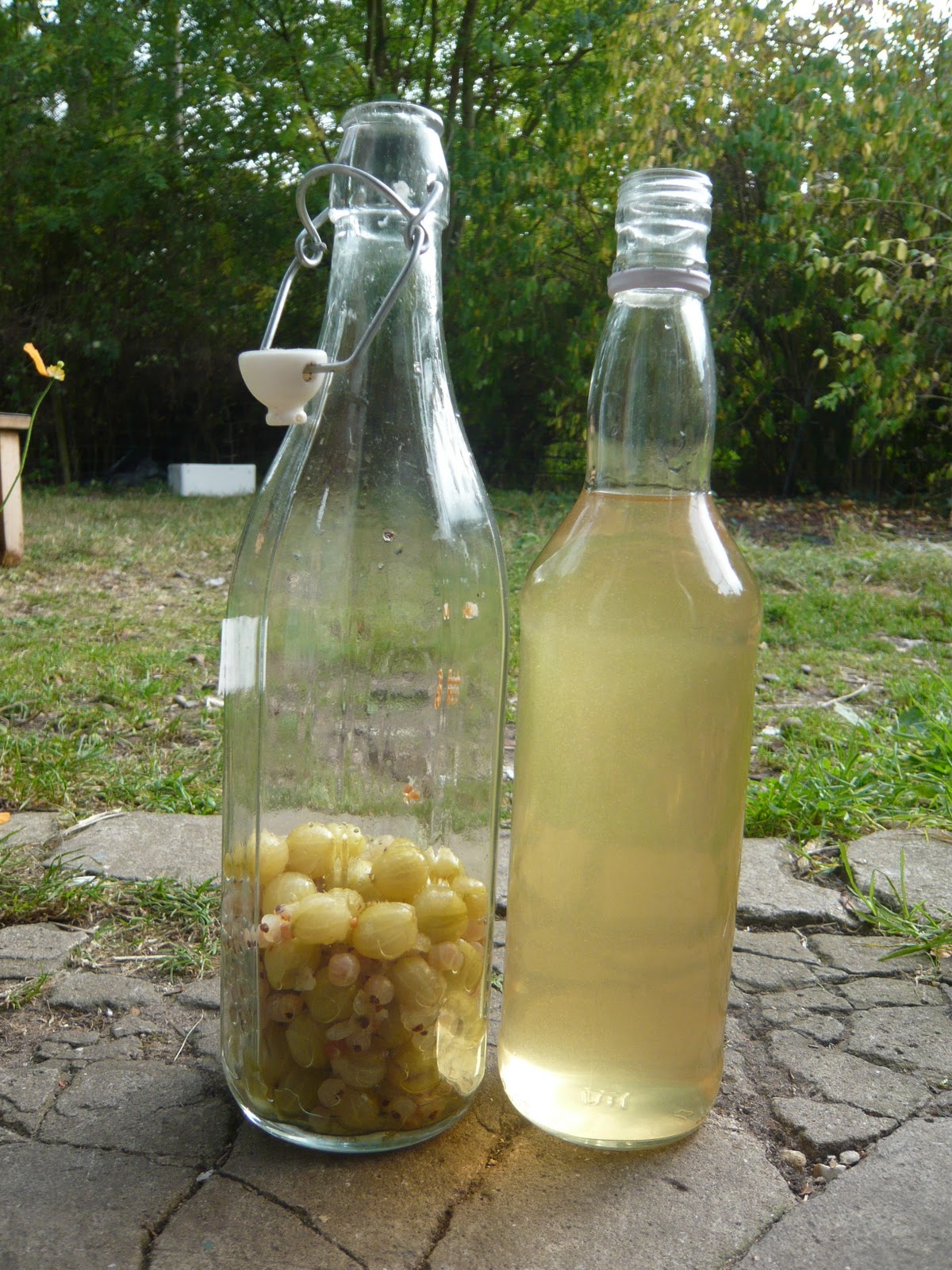
Gooseberry and Whitecurrant Gin

Lastly, I bottled the Gooseberry and Whitecurrant Gin, ever redolent with the summer flavours of the fruits it is in comparison a very sweet concoction… on ice a Summer’s eve, or, for my palate, best with a bitter tonic to balance out the sweetness.  The tendency in alcoholic infusions is to add a tonne of sugar – with Sloe Gin and the like this produces a warming wintry brew, not unlike Port.  However with the lighter, more floral variations I would be tempted on another occasion to use less sugar to produce a drink that is somewhat drier.  I believe the sugar is unnecessary in the process of preserving and simply serves to make the drink palatable.


When bottling fruit alcohols the tipsy fruits can be collected for desserts, cakes, jams.  These I used as an addition to this Apple and Olive Oil Cake, shared by the artiste of Apple Cakes Carla Tomasi.

Carla's Apple and Olive Oil Cake with Tipsy Fruits
...

Off this afternoon to gather the ingredients for a spiced Quince Brandy.  Set to infuse now it should be ready to drink on Christmas day…

Monday, 3 October 2011

Cider Pressing in Suffolk


Charmed as one might be to receive a jovial invitation to a Cider-Making Weekend, a glance between the lines and we’ll find the invite actually reads: come slog away at the squeezing of m’ apples that I might stock up the cellar.  But, the fellow an artiste of the home-made brew, the place a haven, the weather bursting with sunshine… I trundled to the depths of Suffolk county for a weekend spent mastering the art of Wild Cider Making.

Wild Cider is the traditional brew, which harnesses the natural yeasts from the air and the fruit and thus ferments.  We were fortunate to be in the hands of a man whose system is quite perfected… the method being as follows:
The Apples, a muddle of sweet eaters, washed with a jet wash are then bashed, sliced using spades to facilitate the next steps.
These are thrown into a Mill, which further pulps the apples.

A traditional pressing method squeezes the juice from the Apples.

The juice is collected in a bucket.
...

A Second Pressing was attempted, packing the pulp from the first into this most beautiful of presses, gleaned from Italy.  One would imagine this second pressing, much like that of Olives produces the more refined juice?  There was some debate however about the reaction between the apples and the steel, our host wary of the contraption, whether indeed this will produce a pleasant drink remains to be told…


'tis a gentleman's sport this, requiring the mere squeezing of a lever...

...the juice flows
...

The Juice is filtered, then left to ferment in Airlocked Fermenting Bottles until the blossom is again on the apple trees.  All being well the wild yeasts will ferment the natural sugars producing Cider. This will then be racked off into bottles and provide Cider-enough to keep mine host and friends in liquor until the following year’s batch is brewed…


...

While I'm on the subject, tomorrow I shall tell of the distilling of Cider to make a Calvados worthy of late nights and sweet dreams...