Showing posts with label Waste. Show all posts

Sunday, 6 November 2011

Mutton and Quince Tagine


Partly inspired, I have to admit, by Hugh FW’s Lamb and Quince Salad, which featured in The Guardian a fortnight ago, I endeavoured last week to concoct a Mutton and Quince Tajine.

It was a feast of medieval charm.  The meat falling off the shoulder of Mutton, the Quince a fragrant, if slightly tart companion to the meat.  Spicing the dish Morroccan style gave it an edge, cutting through ingredients that might otherwise have verged on stodgy.

The recipe I concocted was as follows:

Marinade

Toast 1 tbsp Cumin Seed, 1 tbsp Coriander Seed, crush.  Chop 2 Chillis.  Slice 1 Lemon.  Crush and peel 1 head of Garlic with the back of a knife.  Mix the lot in Olive Oil, adding a sprinkle of Salt, lots of Black Pepper, 1 tsp Paprika.  Rub into the shoulder of Mutton and leave to marinade for two to three hours.
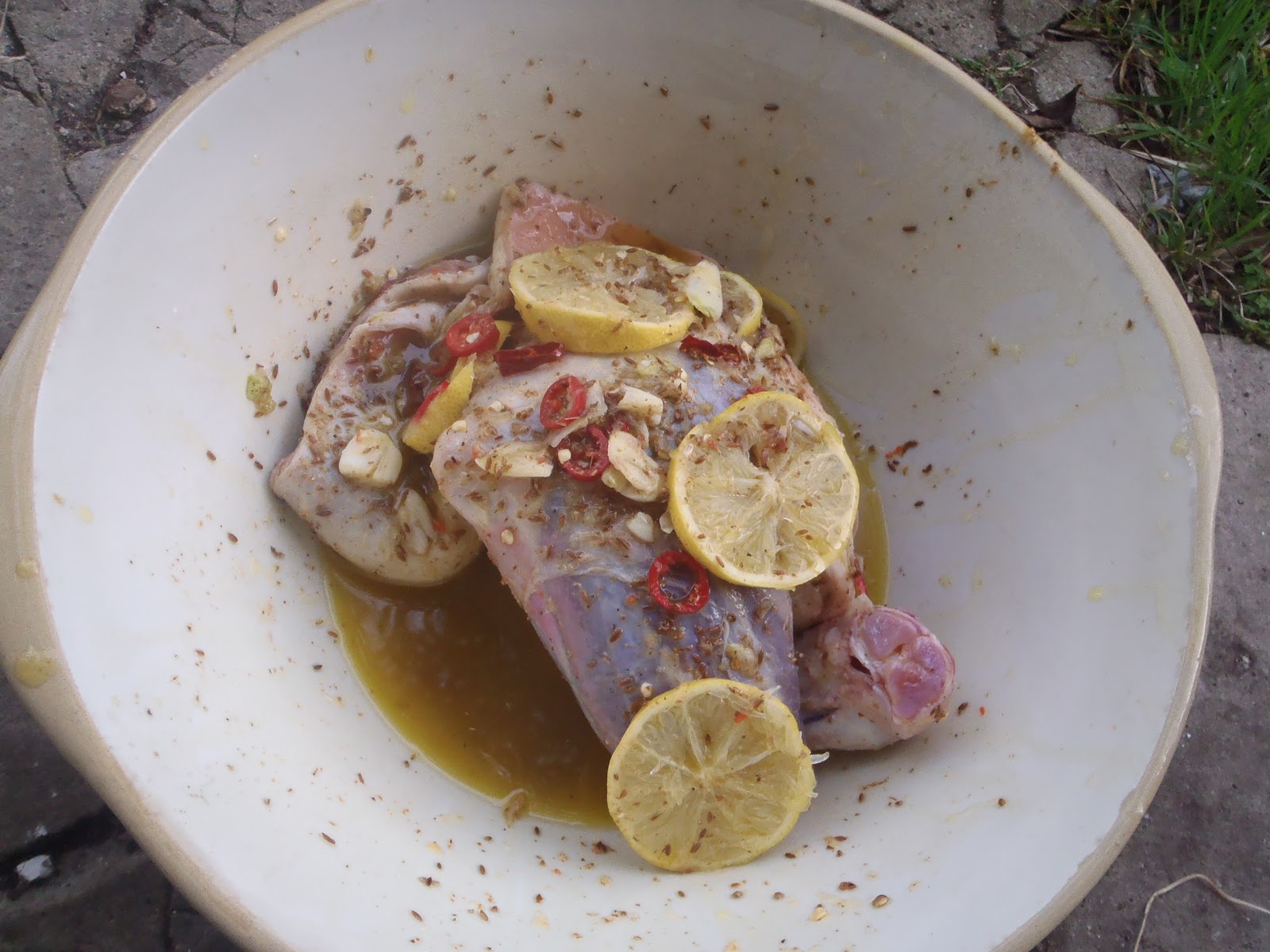
Mutton in Marinade

Meanwhile cut 1 large Quince into 8 slices.  Poach very gently in water with a sprig of Rosemary, 2 tbsp of Honey for about 20 minutes.  (Normally I wouldn’t cook the veg prior to placing it in the Tagine, but Quince being such a stubborn fruit, I decided to do so.)  Remove Quince, saving liquid and mix it into Marinade with Mutton.

While these are marinating prepare the Bread Dough
I use a Nigella recipe, which I adapt only slightly.  500g White Flour (mixture Strong White and French) sprinkled with 1tsp Yeast.  Mix.  Mix 2 tbsp Yogurt with 2 tbsp Olive Oil and add a touch of warm water.  Add this to Flour mix, adding more warm water, stirring with a wooden spoon into a dough.  Knead gently.  Leave ten minutes.  Knead again.  Rise in a warm place covered in a plastic bag.


Tagine

A couple of hours before eating layer 1 large Onion, or in my case several Torpedo Shallots, in the bottom of the Tagine.  Follow this with some large slices of Pumpkin.  Seal the shoulder of Mutton.  If your Tagine is not large enough cut part of the meat off to bake separately.   Place the Quince and Mutton in the Tagine with a handful of Olives and Chillies.  Pour on the remainder of the Marinade and bring to heat.  Once the Tagine is hot, pour on the liquid saved from the Quince, adding more water if necessary to bring to reach the edges of the Tagine base.   Lid, bring to the boil, then simmer very slowly for one to two hours.

Bread

The bread should be punched down, salted one hour before eating.  It is stretched on an oiled baking tray in a warm place to prove for twenty minutes.  Then cooked at heat for 20-40 minutes until browning and bubbling.  Wrap in a tea-towel when removing from the oven to keep the crust soft.

Mutton and Quince Tagine for dinner

Serve the Tagine with Bread, a simple Cucumber Yogurt.  If necessary pour off some of the juice from the Tagine at the last minute and reduce with Rosemary to make a jus.  Serve baking hot, don’t be afraid to eat with the hands, and extra Harissa.


...

The Following day

A Mutton and Chilli Sandwich in Flatbread, leftovers were packed up for lunch-break working at the bookshop.


....

For other Quince Recipes, see my Pheasant Roast with Autumn Fruits and my Quince Brandy.  For another Tagine see:  Lamb and Fig Tagine

Monday, 24 October 2011

Got a Rabbit ... Lapin aux choux


Joy that is the coming of winter, lengthy, frosty nights spent hunkered down by the fire.  Autumn, ‘midst forays for wood, mulching of the garden or hanging heavy curtains has obliged late night fireside feasts…and this weekend it was themed: Rabbit.

For a mere fistful of coins, P & S Butchers in Holt – one reputed for its panoply of wild bird and beast – handed over a large Wild Rabbit, skinned, gutted and jointed and with that a slip of Pork Belly…


Unsure of how then to cook the creature, Amelia pronouncing Rabbit Satay to be quite the best manner in which to eat a rabbit, I shied once again from the fusional towards the provincial. Keen to use Cabbage and in my thoughts the eternal Pot au Feu, staple of the French home, I came across a recipe for Partridge in Elizabeth David’s French Country Cooking: Perdrix au choux, which proved the source of inspiration.

The recipe reads thus:

Brown the birds in Bacon fat; blanch the cabbages in boiling water for 7 or 8 minutes; drain them carefully, cut out the stalks and the hard inner part.  Cut the cabbages in fine slices and put a layer at the bottom of a large earthenwear pot; on top put the bacon, cut in large slices, the carrots, the sausages and the partridges; season with salt, pepper, a few juniper berries, 2 or 3 cloves of garlic, 2 lumps of sugar, nutmeg and a little grated lemon peel.
Cover with the rest of the cabbage, moisten with stock to half way up the cabbage, cover the casserole and cook in a very slow oven for 4 or 5 hours.

Cabbage layer topped with veg, bacon etc

My rabbit variation went thus:

Briefly sauté chunks of Pork Belly with Shallots in pan.  Remove.  Deglaze with Red Wine.  Brown rabbit.  Remove.  Sauté slices of Apple, Sage Leaves and whole cloves of Garlic in same pan, adding butter.  Meanwhile blanch Cabbage, retaining water, and chop as above.  Layer half the Cabbage in bottom of coverable oven dish.  Then layer on Pork, Shallots, Apples, Sage, Garlic, Rosemary, Thyme ,half Carrots, followed by Rabbit. Cover the lot with remaining Cabbage.  Mix 50ml Balsamic Vinegar, 50ml Cider Vinegar, 50ml Apple Juice/Cider, 50ml Red Wine, Pour over dish, topping to half way with Cabbage Water, season with Black Pepper.

Cook covered at 150C for about 3 hours, topping up with liquid and basting as necessary.

...and browned Rabbit

...finally, smothered with cabbage.


The ultimate in rustic fireside feasting, a near emulation of Russian peasantdom in its quintessential rurality.  Served as it was with a touch of Wholegrain Mustard, the Rabbit was delicious, if a touch dry, the vegetables a dream.   Perhaps placing the Rabbit lower in the pan, stacking it more and even stuffing the Saddle with fruit and veg that it remain moist, or as it is again a lean meat, enrobing it in Bacon as we did the Pheasant, would keep it tender.  On Sunday we cooked it for a further two hours, by which time the vegetables were of a sweetness near’ caramel, the rabbit meat falling from the bones, served with baked potatoes and a jus made of the Rabbit juices, Rosemary, Garlic, Red Wine…


The following day:
Luncheon of Pasta and Rabbit - serve, terribly continental, with the jus, the remaining veg and rabbit on a bowl of  hot pasta.


Monday, 3 October 2011

Cider Pressing in Suffolk


Charmed as one might be to receive a jovial invitation to a Cider-Making Weekend, a glance between the lines and we’ll find the invite actually reads: come slog away at the squeezing of m’ apples that I might stock up the cellar.  But, the fellow an artiste of the home-made brew, the place a haven, the weather bursting with sunshine… I trundled to the depths of Suffolk county for a weekend spent mastering the art of Wild Cider Making.

Wild Cider is the traditional brew, which harnesses the natural yeasts from the air and the fruit and thus ferments.  We were fortunate to be in the hands of a man whose system is quite perfected… the method being as follows:
The Apples, a muddle of sweet eaters, washed with a jet wash are then bashed, sliced using spades to facilitate the next steps.
These are thrown into a Mill, which further pulps the apples.

A traditional pressing method squeezes the juice from the Apples.

The juice is collected in a bucket.
...

A Second Pressing was attempted, packing the pulp from the first into this most beautiful of presses, gleaned from Italy.  One would imagine this second pressing, much like that of Olives produces the more refined juice?  There was some debate however about the reaction between the apples and the steel, our host wary of the contraption, whether indeed this will produce a pleasant drink remains to be told…


'tis a gentleman's sport this, requiring the mere squeezing of a lever...

...the juice flows
...

The Juice is filtered, then left to ferment in Airlocked Fermenting Bottles until the blossom is again on the apple trees.  All being well the wild yeasts will ferment the natural sugars producing Cider. This will then be racked off into bottles and provide Cider-enough to keep mine host and friends in liquor until the following year’s batch is brewed…


...

While I'm on the subject, tomorrow I shall tell of the distilling of Cider to make a Calvados worthy of late nights and sweet dreams...

Saturday, 17 September 2011

Blackberries - wi' Beetroot Relish, wi' Cinnamon Whisky, in Vinegar et cetera


Beetroot, Blackberry and Walnut Relish


Apparently nonsensical, it is often colours that define choices of food combinations.   Not quite for this reason alone, I decided to give a touch of the wild to a conventional Beetroot Relish, with the addition of Blackberries and Apples.   More likely, I based my choice on an only-part-forgotten Beetroot and Blackcurrant Relish espied once in the Riverford Cookbook, but the colour, as well as the gluts of berries nearing their end on plentiful briars outside the house, were certainly influential factors in the concoction of this recipe.


On cooking, my head was chiming with shouts of Chilli! Horseradish! Ginger!  But I forestalled such fervour, deciding that the addition of Blackberry was quite quirky enough. Indeed, on bringing a pot to dinner that evening,  there was already a raised eyebrow, a giggle, a sneer...


1/2lb Blackberries, 4 medium Beetroot, 1 Apple, 1 Onion, 100ml Apple Juice, 100ml Cider Vinegar, 100ml Balsamic Vinegar, 1tbsp Blackberry Jam (optional), 100g Sugar, Port (optional), handful Walnuts (optional).


Heat half the Blackberries in the Apple Juice, till cooked, strain and keep the juice.  Grate the apple into this juice, bring to simmer, stir in Jam, set aside.  Heat Vinegars with Sugar and add grated raw Beetroot and chopped Onion, turning so that all the ingredients are covered.  Add Apple and Blackberry Juice.  Stir.  Add slosh of Port rest of Blackberries and Walnuts, simmer a minute longer.  Press into hot sterilised jars, seal.  Leave for a month (although it is lovely immediately) and serve as a sweet/sharp addition to rich wintry meats.


Unlike the Bullace, Port and Walnut Jam, which is given edge by the tartness of the fruit, this is incredibly sweet.  In the future I would indeed add something fiery to lift it.  If making this yourself, why not slice in a Chilli with the Onion, or grate in some Horseradish...

Despite my convincing myself this is a Relish, it has turned out not unlike my Beetroot Pickle, I rather thought the Sugar and Jam would make it more of a spread - I understand a Relish to be something between a Pickle and a Chutney.  In future to make it more Relish-like I shall try cooking it for longer.

...


Blackberry and Cinnanmon Whisky

I have had to turn my thoughts from simply: preserving, to: preserving in the most practical manner... So, despite enjoying the flamboyant, the flippant and the fun, I have started questioning what is really necessary.  It might seem odd that I am talking about practicality under the seemingly superfluous heading of Blackberry Whisky.  But, I am headily conscious of living in a chilly house, am predicting another icy winter, and know well that a nip of something sweet and strong is not only pleasant, but vital on those winter eves...

My recipe went thus:  Fill a very large bottle (1.5lt) to a third with Blackberries (about 250g), cover these in Sugar (about 250g), add 1 bottle cheap Whisky (1lt) and a splash of very good single malt.  I also added a Cinnamon stick.  Shake the lot, and leave in bottle, shaking on occasion, for three months. Strain through muslin, drink when necessary.  The addition of the Single Malt ( a tip for any impoverished Whisky-lover) is said, in a mere drop, to transfer the flavour of the malt to the cheaper stuff.

...


Blackberry and Elderberry Vinegars

Another practicality is how can we make what we tend to buy.  So, vinegar-phile that I am, I was delighted when Carl Legge shared Sandor Ellix Katz's recipe for DIY Vinegar.  Having a so-far-successful Apple/Crabapple Vinegar on the go, I decided yesterday to try Blackberry Vinegar, Elderberry Vinegar and Quince Vinegar.  Rather than using the whole fruits, I have used the Apple and Quince skins and cores, potting and pasteurising the fruits themselves (see pic below).

Briefly: Fill a 2pt Mason Bowl with washed cores and skins of Apples and about 100g of Berries.  Cover with 1pt of 10% Sugar Solution at room temperature.  Place plate on top to keep fruit under liquid and cover with tea-towel.  Leave until starts fermenting, stirring on ocassion if deemed necessary.  After about a week of fermentation remove fruit.  Continue as before, when convincingly vinegar-like, strain and bottle - there's your Vinegar!  


For the Quince, I took the skins and cores of a pile of windfalls, fallen during last week's storms, and did as per Carl's recipe.  

Of course, I'm only at stage one, so will relate whether this method is succesful or not once I can confirm.  For further information, please refer to Carl's blog and Sandor's website.


Quince in Syrup - Elderberry and Apple Compote

Thursday, 8 September 2011

Pickled Crab Apples - a flamboyant addition to the winter table


Fed up of endless yearly Jelly-Making…Indeed, does it not seem a pity to see the fruits thrown, only the liquid kept, not to mention the vast amounts of sugar demanded?  I was delighted to come across a recipe for pickling Crab Apples.  The idea came from quite one of my favourite forage books: Suzanne Beedell’s Pick Cook and Brew… I picked it up second-hand on the Charing Cross Road years ago, the name alone won me over, and at the time I thought it a gift suited to my father.  It has since been relinquished, and found a home in the cottage here as if meant to be. It's particularly appropriate, as the forager herself lived in North Norfolk - what she found in the seventies can likely still be found locally today.

So, amidst recipes and illustrations for Crab Apple Pudding, Crab Apple Wine…there I read: Crab Apple Pickle.  An incorrigible pickler, this could not fail to whet the appetite.


I altered her recipe to suit me, and pickled as follows:

Heat 750ml Cider Vinegar, 250ml Apple Juice, 600g Sugar in a pan stirring until sugar dissolves.  Add 1kg Crab Apples, washed, the blossom end removed, I chose to keep the stalks on an aesthetic whim.  The liquid should cover the Crab Apples.  Add 2in. grated Root Ginger, a few Cloves and Peppercorns, 3 All Spice, 3 Star Anise, 2 Cinnamon Sticks,1tbsp Mustard Seed, and her recipe also calls for garlic cloves wrapped in muslin, to be removed at the end.  (The terrible stench of pickled garlic made me think I would choose onions on another occasion).  Simmer until Crab Apples are tender.  Pot fruit in sterilised jars and reduce syrup if necessary.  Pour syrup over Apples, making sure they are well covered.  Seal immediately.  Leave a few months to mature before eating.

These beautiful pickled yellow fruits would look glorious adorning Beast and Fowl in winter months.  Try also on a Cheese Plate, with Pork, even Suckling Pig.  A sharp bite they make a statement both in taste and looks, cutting through fats and rich flavours… I cannot recommend enough for adding a touch of the ostentatious, the extraordinary, the medieval to a winter banquet.


For other alternate Crab Apple uses, see: Hedgerow Syrup and Carl Legge’s Blackberry Chutney.  Carl also has a recipe for DIY Cider Vinegar, hope maybe to get to that this afternoon..


I also pickled some beautiful tiny Epicurean Apples.  These were windfalls, and have a great flavour, but are small enough to fit whole in pots.  I used this Recipe, which I used for the Pear windfalls of last year, only replacing the distilled vinegar with White Wine Vinegar and adding some All Spice.

...

Follow this link for all the Chutney and Pickle Recipes on this blog.

Tuesday, 6 September 2011

Potted Figs, Bullace Jam, Pumpkin Chutney...perpetual preserving


Halved Figs to be macerated in Honey, Lemon and Vanilla.

The Figs have been wondrous this year, and indeed, it seems a pity to cook them at all, when, despite an impoverished summer they are sweet, soft and nearly-not-quite comparable with memories of those bursting, bulbous falling from the trees of the Andalusian countryside.  If your tree hasn't produced same sumptuous crop, do bear in mind, as far as I understand, that Fig Trees like stress and sun.  They are often put in pots or planted in amongst builders' rubble against a South-facing wall to encourage fruiting and ripeness.

But, we are unable to eat them all, and besides piling them into a Tagine, as I did last week, potting is an excellent way of preserving them.  That said, drying now comes to mind.  A solar-dehydrator would do the trick, as would a hot no-too-damp greenhouse, or strung up inside the car.  Whether our Figs are sweet enough to preserve successfully dried, and whether Autumnal Norfolk has enough heat, I don't know. (Do let me know of any of your own experiements...)

Potted Figs.  I posted the recipe here when enjoying last-years potted figs, and simply mention it again as it's the season and I've been taking great pleasure in doing so at the cottage.  On this occasion I replaced the Whisky with Brandy and for lack of Vanilla Pod I used good quality (Nielsen-Massey) Vanilla Extract.

As, it seems to be the season of perpetual preserving, do bear in mind that you can also pot Pears, Peaches, Apples along these lines.  In most cases I would take the precaution of pasteurising as well.  On another note, the tradition of Rumtopf offers a great way of preserving fruits for pudding.

...


Bullace, Port and Walnut Jam

This recipe was shared by Jules Jackson of De-lish (@dehyphenlish).  It's so good that I was near' pouring scalding hot spoonfuls of the stuff down my throat...only some last hold on reason prevented me.

Place about 2kg of stoned Bullace (Plums, Damsons etc will do equally as well) in a bowl.  Cover with Port and leave to macerate overnight.  The following day bring to the boil.  Take off the heat and add 2kg of Sugar, stirring until dissolved.  Add 400g of Walnuts, halved or quartered as desired.  I also added a good slosh of Balsamic vinegar (red-wine vinegar would do equally) to give the jam a slightly sharp edge.  Bring to heat again and simmer hard until setting-point is reached.  Pot in warmed, sterilised jars.

Despite being called a "Jam", a touch tart, this is really more of a confiture, to be served with savouries, such as Cheeses, Pork and Game.  Mr Jackson resolutely sticks to the term "Jam" merely, I suspect, due to a certain pleasure in the mundanity of the word... Or, indeed, he simply prefers to spick with the Anglicised version. Either way, I am sure this would be quite as dreamy on toast, but, truth told, I'm not really one for spreading jam on toast, and much prefer the savoury combinations...

...


Pumpkin and Apple Chutney

Again, it seems a pity to put a Pumpkin in chutney as they store so well as they are.  This chutney was really a result of half a Pumpkin sitting around not being eaten and the eternal Apple glut.  I have quite a variety of Apple Chutney recipes up my sleeve, but this is a blend of the quirky and the traditional.


Chop 2 Onions, half a small Pumpkin (Uchiki Kuri), 8 large Apples (peeled, cored), oh, I see, a handful of green tomatoes (optional!),  1 Chilli (more or less depending on heat) into small pieces.  Grate 2 in. Root Ginger.  Put the lot in a pan with 1lt Cider vinegar.  Bring to the boil then take off heat and add 400g Demarara Sugar, 1 tbsp Corinader Seed, 1 tbsp. black Peppercorns, 1tbsp Brown Mustard Seed, a handful yellow Sultanas, a pinch of salt.  Stir and bring once again to the boil.  Simmer gently for several hours, stirring to prevent sticking.  Once the mixture is considerably reduced and of a thick, sludgy consistency which holds a wooden-spoon upright, it is ready to be potted.  Pot in warmed, sterilised jars.
Leave several months to mature before eating.

Tuesday, 12 July 2011

Pea-Pod Stock


The Peas have swelled.  As we are picking, pea-ing and podding away, I thought to share a quick note on what to do with Peapods - and I welcome (please) any other suggestions.  For what sadness but to find great baskets of peas in their shells provide but a scarce handful of peas.  Now, they do reccommend Peapod Wine.  But tonight, instead, a simple stock:
Bring the peapods, covered in water, to the boil.  Simmer gently for about forty minutes.   Take off the heat.

This gives a lovely light and pea-tasting stock.  Great in Summer Soups, Veggie Stews or to flavour Grains.  Try adding Onion Skins for a heartier flavour, Carrot tops, Cabbage Stalks, Herbs and general Vegetable Waste creates a more ordinary Vegetable Stock.  I tend not to salt my stocks, allowing one to then decide how much salt to add in cooking.  

If you wish to keep the stock, freeze or seal and pasteurise it.  Or, I have never tried, you could a la Mrs Beeton, boil it down to bare flakes and make of it a stock-cube.

...

For another simple Stock Recipe.
See also The Frugal Cook for uses of Beetroot tops (quite my favourite seasonal green, as sweet and buttery as spinach) and, who'd 'a' thought: broad-bean skins... though, I rare' manage to peel them m'self!

Monday, 4 July 2011

...here's that thrifty Gooseberry and Elderflower (Vodka) Fool I mentioned...


Ever so simple:  Remove some of the Elderflower stalks from the strained remains of the Gooseberry and Elderflower Vodka.  (The Elderflower scent has actually somewhat pervaded the Gooseberries) Cook up the remaining Gooseberries with a splash of water and a dash of Raw Cane Sugar, gently so they hold their shape.  Once soft-ish, leave to cool, tasting the liquid for sweetness.

When cool, layer in a glass with Yogurt, (Sheep's Yogurt or Goat would give it a lovely rural depth of flavour) Marscapone, Creme Fraiche, or Whipped Cream, depending how gluttonous you are feeling.   Tart up with a sprig of Mint, a spray of Whitecurrants, a splash of Gooseberry and Elderflower Vodka, or leave it as it is (in picture).

Enjoy on a hazy Summer evening, lazing in the garden, with a long spoon.

Sunday, 3 July 2011

Sunday Morning - Bottling (Tasting) the Elderflower and Gooseberry Vodka

Bottling/Tasting


The Gooseberries and Eldeflowers were left a month to brew in Vodka, merely shaken on occasion, in a Demijohn… [Gooseberry and Elderflower Vodka Recipe].  A Sunday dawn, before the wasps did awake, commenced the bottling of the brew.  Fragile Elderflowers willn’t withstand the length of time sat in alcohol as a Sloe, for example, might.  [Sloe Gin Recipe].  Indeed, With Knife and Fork’s Blog advises that once strained the vodka should be drunk in a mere few months, to forestall the loss of the floral nuances.

To bottle (when lacking a funnel): Strain through muslin into large bowl – scoop from bowl into jug – pour from jug into clean bottles – seal, label, store.

Despite being slightly sweet for my palate (keener on the bitter, the sour, the salty), the sharp, indeed hearty Gooseberry flavour is heightened by the Floral notes of the Elderflower, near’ shimmering, near’ effervescent, what a delightful manner of breaking-the-fast (!).  This is quite the most delicately perfumed of flavoured vodkas.   (That said I long to attempt Sarah Pettegree’s Rose Vodka, another Sunday brewing escapade.)

…Pour on ice, drink neat, or with a splash of something fizzy, to fully enjoy the gustative combination.


And, now to the bowl full of Vodka-imbued Gooseberries – promise of a sparky Gooseberry Compote (simmer with a touch of sugar), a stunning Gooseberry-Vodka Jelly…. Or perhaps a little pot of Gooseberry-Vodka Jam…  hmmm... a Gooseberry Fool me thinks

(The use of the remnants is inspired by Christophe of Macalla Farm, Clare Island, who makes Elderflower and Lemon Marmalade and Cordial with the strained remains of his Elderflower Champagne.  I shall try persuade him to share his recipes.)

Saturday, 28 May 2011

Pickled Beetroot, The Frugal Meal


This is a house of pickles.  Our breakfast, a poached local egg, (be it Chicken, Duck or even Turkey), a slice of Rye Sourdough and a Pickle of sorts, perhaps a spicy home-made Sauerkraut, Sweet Pickled Cucumbers, a briny Green Chilli… whatever sits beckoning on the dedicated shelf… an apparently frugal meal is in fact a feast.

Poached Turkey Egg on Sourdough with various Pickles

Gifted or gleaned the veg box is also often brimming. And fed up with several weeks of watching some once very fetching beetroot shrivelling, I decided yesterday to pickle them… in a month’s time these will provide a welcome variation on the breakfast table. 

Boil up: 50ml Apple Juice, 100ml Cider Vinegar, 100ml Balsamic Vinegar, 1/2tbsp Demerara Sugar, 6 peppercorns, 6 cloves, 1 tsp brown mustard seeds, I tsp coriander seed.

Add grated remains of 5 shrunken beets and ½ in. grated Root Ginger.  Bring to the boil again, then pot rapidly in sterilised jar with a pair of bay leaves, covered in the vinegar mix.  Allow at least a month to mature.

Eat Pickled Beetroot with: Goat's Cheese, serve with Mackerel to cut through the oil, with Pates and Rich Meats to give some bite or, simply, with a spoonful of yogurt on a bowl of Lentils.


This pickling Recipe can be used as a basis for pickling many a vegetable.  You might want to replace the Apple Juice with Orange or skip it all together, and although the Balsamic goes well with Beetroot, in a conventional pickle I would use a simpler Vinegar, such as Cider.

Other Pickle Recipes:  A Pickled Pear ; Pickled Gooseberries

 Le repas frugal, Pablo Picasso

Friday, 20 May 2011

Not-Quite-Raw Sour-Milk Soft Goat’s Cheese / Home-Made Herby Labneh


This is a creamy, dreamy cheese.
The sublimeness perhaps dependent on Fielding Cottage’s sublime Raw Goat’s Milk.  For lack of fridge the milk turned rather quick and, as has become habit on such (all-too-common) occasions, I put myself to the task of making Sour Milk Soft Cheese.

Despite uncertain glances at the souring milk all too-readily put to use, Mary Norvak in The Farmhouse Kitchen has quite obliged me:  To make cheese, she writes unabashed: “Put sour milk in a warm place until thick.  Add half teaspoon salt to each pint of milk.  Put into a muslin bag and leave to drain over night”. 

I combined this with Yotam Ottolenghi’s ‘Labneh with Olives, Pistachios and Oregano Recipe’ (a tear-out from The Guardian Weekend 10th October 2009, but I imagine it now features in his latest book: Plenty.)

Thus:

Scald the Sour Goat’s Milk so it splits (this speeds up the process), without boiling.  If your milk is not sour you can split it with ½ tbsp of vinegar. Allow to cool slightly and combine with a similar quantity of Natural Yoghurt and 1 tsp of good salt to pint of milk.  Strain through muslin for several hours or overnight. 

(The resulting liquid is Whey.  This can be used in bread as I am reminded by Linda of withknifeandfork, or in Lacto-Fermentation, as it abounds in Lactobacilli.  I actually used it in Buckwheat Pancakes… I shall tell anon).

And there, in the muslin sits the lovely soft cheese.  The yoghurt gives it a creamy texture and a sharp depth of flavour sometimes absent in DIY cheeses.  Inspired by Ottolenghi, I combined the Soft Cheese with a mix of Palestinian spices I had to hand (Toasted Sesame, Syrian Marjoram, Sumac), some finely chopped Oregano from the garden, and Olives. 

Douse the cheese in Olive Oil and serve for breakfast with just-baked Flat Bread, more Olives and Black Coffee.
Dream yourself into the Middle-East.

Saturday, 26 March 2011

Tomato Chilli Cinnamon Chutney, a note on experimentation.


With experimental preserving, the tendency is to concoct a certain food on one inspired day, to eat it several months later and in the mean time to have forgotten what impulsion gave rise to said concoction.

There is but one way:  A very meticulous method of noting down experiments and recipes (step 1) is imperative, to be  followed by a taking down of results: tasting notes/success or otherwise (step 2) in order that processes may be repeated, altered, improved etc…

All too oft’ I find myself wondering yet another time how on earth I had preserved a certain jar of tomatoes, or what quantities of salt I had used in that perfect sauerkraut.

There are many methods and each to his own, I love to write the recipe on the label of the jar, but 'tis utterly impractical, tending to have faded or run when eventually the preserve is tasted.

All this to say: 

On Clare Island, in the depths of the stores:  a small jar of last year’s Tomato Chilli Cinnamon Chutney.  An eccentric experiment, that had now had time to mature.

And what a chutney!  The sweetness of the Summer-ripened tomatoes was picked up by the Cinnamon and then, all at once, a sharp chilli bite… it spread thick like butter and deep rusty red, it was quite the marvel of the crowd.

For once, I had written the recipe down, and still had to hand the little book I had inscribed it in, here it is:

Tomato Chilli Cinnamon Chutney, an experiment.

3lb of the Tomato glut (eat your best and ripest raw and sweet, use the rest for chutney)
1 lb Onions
1 lb Demarara
1 pt Vinegar
3-6 Chillies (according to strength)
2-3 Sticks of Cinnamon (ground)

Bring the lot to the boil.
Reduce, simmering and stirring till thick and sludgy. (a spoon should stand up in it)
Pot in Sterilised Jars.
Allow to mature several months, then gorge with friends.

Chillies on Clare Island

Friday, 4 February 2011

A Good Stock

Mrs Beeton writes a recipe for Pocket-Soup.  An elaborate recipe, bringing one step-by-step through a lengthy process in which an animal carcass is slowly transformed into a dehydrated stock cube – an art indeed.

While the sight of a pot of Bisto, a stock cube and even an artisanal organic bouillon horrifies me, I will uphold the merits of a good stock.  Primarily, a Stock is an excellent example of the beneficial use of waste products, it’s a sort of alternative to the compost… and it doesn’t have to contain meat, one of the best summer stocks is the simple combination of Pea-Pods and Onion Skins.  

My Uncle has sent through pics of his post-Christmas Goose Stock.  The Recipe is as follows: add one Onion in its skin + 2 large Carrots + 2 Celery Sticks to 1 Goose Carcass, cover with water and simmer for +/- 8 hours, adding water when needed to cover carcass. 
 
Made by covering the ingredients in water, bringing to the boil and then allowing to simmer very slowly, preferable overnight, it is then strained, and the liquid kept.  The liquid can be used in soups or stews, where it adds a depth of flavour and structure to a dish, as a consommé on its own or as a simple addition to rice.

The joy of a stock is that you can use anything you can find, and each is a unique creation.  An excuse to let your creative juices run, Carrot tops, Bay leaves, Garlic Skins, Giblets and Lemon Rind are just some of the ingredients I like to stuff into the stock pot.  It is not quite alchemy, but certainly has something of the potion about it.  I never add salt to a stock but alter the salt levels when actually using the stock to cook with.  It can be used immediately (if it contains a lot of fat cool first and skim off with a metal spoon) or frozen and saved for another occasion.

p.s. More Stock Recipes avidly awaited!  Send to olivheal@gmail.com.


Thursday, 27 January 2011

A note from Harry on Cider... Vinegar


We've been making some cider over the last couple of months, and this batch turned to vinegar.  It's tasty stuff - we used Cox, D'Arcy Spice & Worcester apples & Japanese pears, all in equal quantities, but it did throw some massive protein-tannin ectoplasm after the yeasts died. We filtered out the protein-tannins with some muslin and let it settle - and I think we'll have to do another filtering later. I also ran some tests using the soil testing equipment at work, and discovered that it has a fearsome pH 3.5!

...

A note on the apples - Cox is the well-known Orange Pippin, a very full flavour, best in early autumn, recognisable by its rattling seeds when shaken.  D'Arcy Spice, an East Anglian apple, belongs to the Russet family, sweet, small apples of grey/green colour, popular in Cider.  Worcester is most likely Worcester Pearmain, a desert apple, very crisp and used cut up in salads very early Autumn.  The Japanese pears... I know not.   

...

More to follow on Cider making, but perhaps not till the Autumn.