Showing posts with label Preserving. Show all posts

Sunday, 27 July 2014

Blackcurrant and Windfall Jam... and Raw Blackcurrant Jam


Blackcurrant is quite the headiest of summer flavours, almost musky, a touch tart, the scent of the leaves alone risks intoxicating.  I long to make cakes and sorbets and all sorts, but, better still, to capture this flavour in a jar.

The winds brought down the first Windfall Apples, and I used these to add body, texture, pectin and tartness to the Blackcurrant Jam.

2 1/2 lb ripest Blackcurrants
1/2 lb grated Windfalls
3 lb Sugar
1/2 Lemon juice of

Macerate these overnight in a bowl.  Bring to boil in a jam pan, then simmer quickly until reaches setting point.  Pot in sterilised jars.*

...

I wondered a moment how to capture the raw Blackcurrant flavour, besides freezing, and remembered a recipe, again from Clare Island, for Raw Blackcurrant Jam.  This recipe uses far less sugar and has to be eaten immediately (or frozen) :

Mash Blackcurrants without crushing pips.  Beat until light.  Add sugar to 1/3 of the weight of the currants.  Beat again until light.  Pot in clean jars.  Use as jam  - not just on toast, but with yoghurt, pancakes, cakes, smoothies, on a spoon...

...

*To test for setting point, put a plate in the fridge.  Put a teaspoon of the jam on the cold plate, return to fridge.  Setting point is reached if wrinkles when cool.  Sterilise clean jars by putting in oven at 100 C for 20 minutes.

Tuesday, 23 July 2013

Rocket Pesto


A fiery summer pesto, and a solution to all that rocket going to too quickly to seed.

My preferred pesto is one that both catches the flavours and textures of each separate ingredient, and at the same time appears as a whole, an entity unto its own.  Hmmmm.  The only guide to making it therefore is your own tastebuds.  I go about it something like this :

Fill a colander with Rocket.  Toast a handful of Sunflower Seeds. Grate some Parmesan (miss out if vegan).  Chop the Rocket by hand. [A Pesto made in a blender does not hold the beauty, the texture of a hand chopped pesto, and it really is no more efficient.]  Chop Garlic (fresh if available) with a pinch of coarse Salt.  Cover the Rocket in Olive Oil (and/or mixed with Sunflower Oil according to taste). 

Now add the other ingredients, tasting as you go, until you come to a powerful medley of the green, the nutty, the punch of Garlic, body given by the Cheese, the lot doused in Oil.  Finally, add a touch more Salt to taste.  Remembering the Parmesan is salty, but its saltiness is of a different nature to that of seasalt, you should be able to taste both.

This pesto can be eaten on bread, pasta, in potato salad, on carrots, in Vinaigrette, or in Courgette Soup ...oh the options are endless.

To preserve the pesto cover in oil, and close in a jar.  The layer of oil makes an airtight seal.  It will last about six months thus.  Or, simply freeze it.


Other Pestos :
Garden Pesto
Nettle Pesto
Wild Garlic Pesto

Tuesday, 25 October 2011

Spiced Quince Brandy


With a scent at once floral and of exotic fruits, the Quince is more akin to the Guava it seems than to any fruit of local cultivation.  Originating in South West Asia, it grows readily in our climate and was once a popular element of the English diet.  In the last years this most regal of fruits is enjoying a revival.  When asked to describe it, for it has not quite entered the domains of common parlance, I often find myself sketching medieval still-lifes: think on a painting thus, against a dark 'ground, a hare hanging long, a goose splayed over a table, to its side a bowl of shapely, knobbly yellow fruit, no, not pears… Indeed it is often a surprise that a fruit of such stoic mien have such delicate flavour.

Still Life with Quince

I desired thus to try capture these heady scents redolent of Carribean dusks, of Medieval banquets, in a bottle.  The Quince can however be prepared in many manners (more to follow on this subject): besides Membrillo, a Hispanic Quince Paste, it can be made into jellies, popped in crumbles and compotes, baked and stewed, or at best served with meats, whether stuffed in Pheasant, as I did here or popped in a casserole or Tagine.  It is very good with Lamb, and I have a little plan to cook it soon with Mutton.


The difficulty with the Quince is that it is a hard fruit, demanding a lot of preparation, and its dreamy flavours are hard to extract.  I was determined to try it in an alcoholic infusion, but long deliberated over which alcohol to infuse and how best to capture those scents.  There was talk of Gin, Vodka, of grating, stewing, mashing the fruit.  Eventually I decided on a Spiced Brandy, wanting to make a warming winter drink to keep me company by the fireside.  With two months ‘til Christmas, I sensed this the apt time for infusion – it will toast in the festivities of Christmas Day!

I eventually decided to try one batch cooked and one raw, so see which gave the best flavours. 

Stewed Spiced Quince Brandy


Chop four small Quince into chunks.   Place in pan with a dash of water and (if possible) some of Drove Orchards Quince Juice (quite the essence of Quince).   Bring to the boil then simmer gently over several hours until the Quince has turned deep pink.  


Top up with liquid as necessary, there should be just enough to stop it from drying.  You could add the Sugar and Spices to the pan when cooking.  I, however, added them later.  Spoon half of the Quince into each of 500ml wide-necked bottles, add Spices of choice (Cinnamon, Allspice, Cloves, Star Anise, Nutmeg etc) and two level tablespoons of Sugar per bottle.  Don’t go too overtop on the spices, as they will be in the alcohol for a long time and only the tiniest amount will give flavour.  Fill to the brim with Brandy, close.  Store in a cool dark place, shaking occasionally.  Serve on awakening Christmas Day.


Raw Spiced Quince Brandy
Wash and slice one very large Quince thinly and layer in 1 litre Kilner Jar with Cinnamon, Cloves, Star Anise, Allspice, and three level tablespoons of Demarara Sugar.  Cover with Brandy.  Leave to infuse until Christmas morn’.


This Recipe can be altered by varying the Alcohol, the amount of Sugar, the Spices used…. For some ideas see the Recipes on this blog for: Bullace Gin; Sloe Gin; Gooseberry and Whitecurrant Gin; Elderflower and Gooseberry Vodka; Blackberry WhiskyCherry Vodka

Saturday, 22 October 2011

Apple Wine... Elderflower Champagne; Wine; Gooseberry Whitecurrant Gin - thoughts on.


A bright morning, the fire lit at dawn, a walk and breakfasted, bread in the oven… ode to the joys of country living! Those, the contented glug of the Apple Wine fermenting in the background.

To celebrate today, a post on the various brews in the cottage… A morn’ dram of Elderflower Champagne, of same Wine and a rather more adult Gin.

Apple Wine

First though, the Apple Wine recipe, spawned by my unwillingness to press any more Apples – the recipe is made by chopping and cooking, rather than juicing the fruit. This recipe is adapted from CJJ Berry’s First Steps in Winemaking, shared and dejargoned by DIY sommelier extraordinaire Carl Legge.  The process I have used is the following, it is surely amateur and rudimentary… I shall write more thoughts on bottling and tasting.


I chose to use Russets, and a few Pears.  The Egremont Russet has a creamy sweet and nutty flavour, and I envisage it a delicate and deep wine.

Wash and cut up 2.75 kilos of Apples, skin and all. (Windfalls are fine)  Simmer 20 mins in 5 litres water.  Strain onto 1 kilo of Sugar in Fermenting Bucket.  When lukewarm add rind and juice of 2 Lemons, 1 tsp Marmite, ½ Mug of strong cold Tea, 200g Sultanas, ½ Sachet of winemakers Yeast. 

Cover bucket with Muslin.  Leave to ferment as such, at room temperature, for two-four days until fermentation is less vigorous.  Strain and bottle in airlocked Demijohns.  After about a month rack off into clean jars.  Mature for six months before bottling.


Elderflower Champagne


This year’s batch of Elderflower Champagne has proved a joyful brew, brimming with that floral giddiness that is the drink’s renown.  Light, sweet, sparkling, I find it best drunk young, cold on a Summer’s day.  For a winter variation, add a drop of Hedgerow Syrup giving a stunning aperitif à la Kir Royale.

The inevitable difficulty with home made Champagne is the gaseousness.  This Summer, once-again-rearranging-the-shed, a loud and near terrifying bang proved to be a bottle exploding and in the process smashing two more bottles.  Each has their own remedy to prevent the explosion.  Some say use magnums, others to tie the tops with string or wire, a third, and this is the way I have since managed it, is by occasionally releasing the pressure by part unscrewing the lids.

...

Elderflower Wine

Bottling the Wine with Syphon

You might remember I also put some of my Champagne in a Demijohn under airlock to make a Wine.  This I racked off and bottled about a month ago.  It has produced a lovely, if slightly sharp, dry, pale coloured Wine.  I did worry it had perhaps gone off, a thin white layer had formed on the top of the liquid, but a process of tasting and troubleshooting with Carl Legge, showed me it was indeed the hoped for Wine… and tasting it today I am indeed charmed… it is the stuff of late Summer nights, of Bacchanalia, for what inebriation more profound than that of wine brewed of flowers plucked from one’s own lands.


...

Gooseberry and Whitecurrant Gin

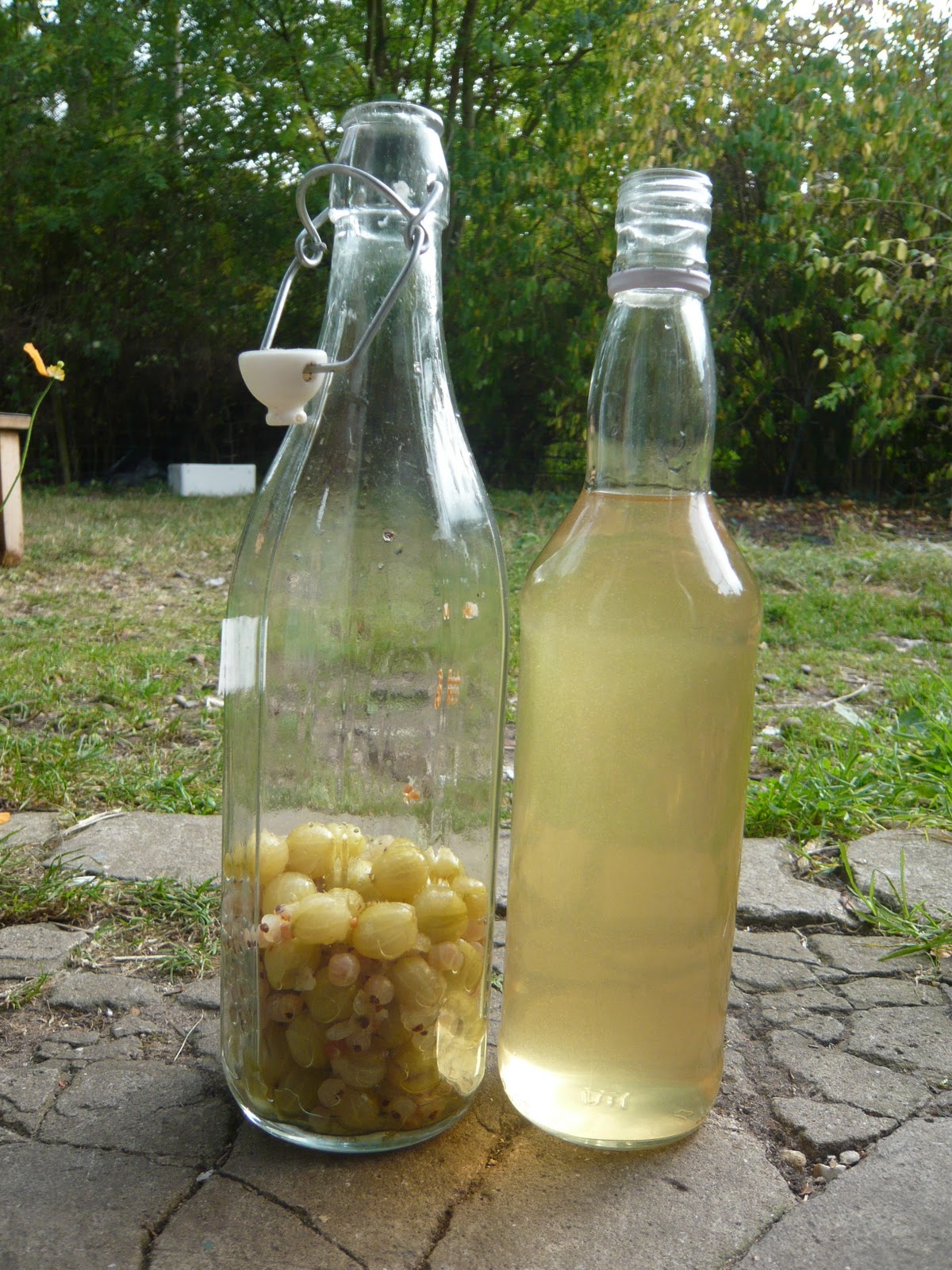
Lastly, I bottled the Gooseberry and Whitecurrant Gin, ever redolent with the summer flavours of the fruits it is in comparison a very sweet concoction… on ice a Summer’s eve, or, for my palate, best with a bitter tonic to balance out the sweetness.  The tendency in alcoholic infusions is to add a tonne of sugar – with Sloe Gin and the like this produces a warming wintry brew, not unlike Port.  However with the lighter, more floral variations I would be tempted on another occasion to use less sugar to produce a drink that is somewhat drier.  I believe the sugar is unnecessary in the process of preserving and simply serves to make the drink palatable.


When bottling fruit alcohols the tipsy fruits can be collected for desserts, cakes, jams.  These I used as an addition to this Apple and Olive Oil Cake, shared by the artiste of Apple Cakes Carla Tomasi.

Carla's Apple and Olive Oil Cake with Tipsy Fruits
...

Off this afternoon to gather the ingredients for a spiced Quince Brandy.  Set to infuse now it should be ready to drink on Christmas day…

Monday, 3 October 2011

Cider Pressing in Suffolk


Charmed as one might be to receive a jovial invitation to a Cider-Making Weekend, a glance between the lines and we’ll find the invite actually reads: come slog away at the squeezing of m’ apples that I might stock up the cellar.  But, the fellow an artiste of the home-made brew, the place a haven, the weather bursting with sunshine… I trundled to the depths of Suffolk county for a weekend spent mastering the art of Wild Cider Making.

Wild Cider is the traditional brew, which harnesses the natural yeasts from the air and the fruit and thus ferments.  We were fortunate to be in the hands of a man whose system is quite perfected… the method being as follows:
The Apples, a muddle of sweet eaters, washed with a jet wash are then bashed, sliced using spades to facilitate the next steps.
These are thrown into a Mill, which further pulps the apples.

A traditional pressing method squeezes the juice from the Apples.

The juice is collected in a bucket.
...

A Second Pressing was attempted, packing the pulp from the first into this most beautiful of presses, gleaned from Italy.  One would imagine this second pressing, much like that of Olives produces the more refined juice?  There was some debate however about the reaction between the apples and the steel, our host wary of the contraption, whether indeed this will produce a pleasant drink remains to be told…


'tis a gentleman's sport this, requiring the mere squeezing of a lever...

...the juice flows
...

The Juice is filtered, then left to ferment in Airlocked Fermenting Bottles until the blossom is again on the apple trees.  All being well the wild yeasts will ferment the natural sugars producing Cider. This will then be racked off into bottles and provide Cider-enough to keep mine host and friends in liquor until the following year’s batch is brewed…


...

While I'm on the subject, tomorrow I shall tell of the distilling of Cider to make a Calvados worthy of late nights and sweet dreams...

Saturday, 17 September 2011

Blackberries - wi' Beetroot Relish, wi' Cinnamon Whisky, in Vinegar et cetera


Beetroot, Blackberry and Walnut Relish


Apparently nonsensical, it is often colours that define choices of food combinations.   Not quite for this reason alone, I decided to give a touch of the wild to a conventional Beetroot Relish, with the addition of Blackberries and Apples.   More likely, I based my choice on an only-part-forgotten Beetroot and Blackcurrant Relish espied once in the Riverford Cookbook, but the colour, as well as the gluts of berries nearing their end on plentiful briars outside the house, were certainly influential factors in the concoction of this recipe.


On cooking, my head was chiming with shouts of Chilli! Horseradish! Ginger!  But I forestalled such fervour, deciding that the addition of Blackberry was quite quirky enough. Indeed, on bringing a pot to dinner that evening,  there was already a raised eyebrow, a giggle, a sneer...


1/2lb Blackberries, 4 medium Beetroot, 1 Apple, 1 Onion, 100ml Apple Juice, 100ml Cider Vinegar, 100ml Balsamic Vinegar, 1tbsp Blackberry Jam (optional), 100g Sugar, Port (optional), handful Walnuts (optional).


Heat half the Blackberries in the Apple Juice, till cooked, strain and keep the juice.  Grate the apple into this juice, bring to simmer, stir in Jam, set aside.  Heat Vinegars with Sugar and add grated raw Beetroot and chopped Onion, turning so that all the ingredients are covered.  Add Apple and Blackberry Juice.  Stir.  Add slosh of Port rest of Blackberries and Walnuts, simmer a minute longer.  Press into hot sterilised jars, seal.  Leave for a month (although it is lovely immediately) and serve as a sweet/sharp addition to rich wintry meats.


Unlike the Bullace, Port and Walnut Jam, which is given edge by the tartness of the fruit, this is incredibly sweet.  In the future I would indeed add something fiery to lift it.  If making this yourself, why not slice in a Chilli with the Onion, or grate in some Horseradish...

Despite my convincing myself this is a Relish, it has turned out not unlike my Beetroot Pickle, I rather thought the Sugar and Jam would make it more of a spread - I understand a Relish to be something between a Pickle and a Chutney.  In future to make it more Relish-like I shall try cooking it for longer.

...


Blackberry and Cinnanmon Whisky

I have had to turn my thoughts from simply: preserving, to: preserving in the most practical manner... So, despite enjoying the flamboyant, the flippant and the fun, I have started questioning what is really necessary.  It might seem odd that I am talking about practicality under the seemingly superfluous heading of Blackberry Whisky.  But, I am headily conscious of living in a chilly house, am predicting another icy winter, and know well that a nip of something sweet and strong is not only pleasant, but vital on those winter eves...

My recipe went thus:  Fill a very large bottle (1.5lt) to a third with Blackberries (about 250g), cover these in Sugar (about 250g), add 1 bottle cheap Whisky (1lt) and a splash of very good single malt.  I also added a Cinnamon stick.  Shake the lot, and leave in bottle, shaking on occasion, for three months. Strain through muslin, drink when necessary.  The addition of the Single Malt ( a tip for any impoverished Whisky-lover) is said, in a mere drop, to transfer the flavour of the malt to the cheaper stuff.

...


Blackberry and Elderberry Vinegars

Another practicality is how can we make what we tend to buy.  So, vinegar-phile that I am, I was delighted when Carl Legge shared Sandor Ellix Katz's recipe for DIY Vinegar.  Having a so-far-successful Apple/Crabapple Vinegar on the go, I decided yesterday to try Blackberry Vinegar, Elderberry Vinegar and Quince Vinegar.  Rather than using the whole fruits, I have used the Apple and Quince skins and cores, potting and pasteurising the fruits themselves (see pic below).

Briefly: Fill a 2pt Mason Bowl with washed cores and skins of Apples and about 100g of Berries.  Cover with 1pt of 10% Sugar Solution at room temperature.  Place plate on top to keep fruit under liquid and cover with tea-towel.  Leave until starts fermenting, stirring on ocassion if deemed necessary.  After about a week of fermentation remove fruit.  Continue as before, when convincingly vinegar-like, strain and bottle - there's your Vinegar!  


For the Quince, I took the skins and cores of a pile of windfalls, fallen during last week's storms, and did as per Carl's recipe.  

Of course, I'm only at stage one, so will relate whether this method is succesful or not once I can confirm.  For further information, please refer to Carl's blog and Sandor's website.


Quince in Syrup - Elderberry and Apple Compote

Thursday, 8 September 2011

Pickled Crab Apples - a flamboyant addition to the winter table


Fed up of endless yearly Jelly-Making…Indeed, does it not seem a pity to see the fruits thrown, only the liquid kept, not to mention the vast amounts of sugar demanded?  I was delighted to come across a recipe for pickling Crab Apples.  The idea came from quite one of my favourite forage books: Suzanne Beedell’s Pick Cook and Brew… I picked it up second-hand on the Charing Cross Road years ago, the name alone won me over, and at the time I thought it a gift suited to my father.  It has since been relinquished, and found a home in the cottage here as if meant to be. It's particularly appropriate, as the forager herself lived in North Norfolk - what she found in the seventies can likely still be found locally today.

So, amidst recipes and illustrations for Crab Apple Pudding, Crab Apple Wine…there I read: Crab Apple Pickle.  An incorrigible pickler, this could not fail to whet the appetite.


I altered her recipe to suit me, and pickled as follows:

Heat 750ml Cider Vinegar, 250ml Apple Juice, 600g Sugar in a pan stirring until sugar dissolves.  Add 1kg Crab Apples, washed, the blossom end removed, I chose to keep the stalks on an aesthetic whim.  The liquid should cover the Crab Apples.  Add 2in. grated Root Ginger, a few Cloves and Peppercorns, 3 All Spice, 3 Star Anise, 2 Cinnamon Sticks,1tbsp Mustard Seed, and her recipe also calls for garlic cloves wrapped in muslin, to be removed at the end.  (The terrible stench of pickled garlic made me think I would choose onions on another occasion).  Simmer until Crab Apples are tender.  Pot fruit in sterilised jars and reduce syrup if necessary.  Pour syrup over Apples, making sure they are well covered.  Seal immediately.  Leave a few months to mature before eating.

These beautiful pickled yellow fruits would look glorious adorning Beast and Fowl in winter months.  Try also on a Cheese Plate, with Pork, even Suckling Pig.  A sharp bite they make a statement both in taste and looks, cutting through fats and rich flavours… I cannot recommend enough for adding a touch of the ostentatious, the extraordinary, the medieval to a winter banquet.


For other alternate Crab Apple uses, see: Hedgerow Syrup and Carl Legge’s Blackberry Chutney.  Carl also has a recipe for DIY Cider Vinegar, hope maybe to get to that this afternoon..


I also pickled some beautiful tiny Epicurean Apples.  These were windfalls, and have a great flavour, but are small enough to fit whole in pots.  I used this Recipe, which I used for the Pear windfalls of last year, only replacing the distilled vinegar with White Wine Vinegar and adding some All Spice.

...

Follow this link for all the Chutney and Pickle Recipes on this blog.

Tuesday, 6 September 2011

Potted Figs, Bullace Jam, Pumpkin Chutney...perpetual preserving


Halved Figs to be macerated in Honey, Lemon and Vanilla.

The Figs have been wondrous this year, and indeed, it seems a pity to cook them at all, when, despite an impoverished summer they are sweet, soft and nearly-not-quite comparable with memories of those bursting, bulbous falling from the trees of the Andalusian countryside.  If your tree hasn't produced same sumptuous crop, do bear in mind, as far as I understand, that Fig Trees like stress and sun.  They are often put in pots or planted in amongst builders' rubble against a South-facing wall to encourage fruiting and ripeness.

But, we are unable to eat them all, and besides piling them into a Tagine, as I did last week, potting is an excellent way of preserving them.  That said, drying now comes to mind.  A solar-dehydrator would do the trick, as would a hot no-too-damp greenhouse, or strung up inside the car.  Whether our Figs are sweet enough to preserve successfully dried, and whether Autumnal Norfolk has enough heat, I don't know. (Do let me know of any of your own experiements...)

Potted Figs.  I posted the recipe here when enjoying last-years potted figs, and simply mention it again as it's the season and I've been taking great pleasure in doing so at the cottage.  On this occasion I replaced the Whisky with Brandy and for lack of Vanilla Pod I used good quality (Nielsen-Massey) Vanilla Extract.

As, it seems to be the season of perpetual preserving, do bear in mind that you can also pot Pears, Peaches, Apples along these lines.  In most cases I would take the precaution of pasteurising as well.  On another note, the tradition of Rumtopf offers a great way of preserving fruits for pudding.

...


Bullace, Port and Walnut Jam

This recipe was shared by Jules Jackson of De-lish (@dehyphenlish).  It's so good that I was near' pouring scalding hot spoonfuls of the stuff down my throat...only some last hold on reason prevented me.

Place about 2kg of stoned Bullace (Plums, Damsons etc will do equally as well) in a bowl.  Cover with Port and leave to macerate overnight.  The following day bring to the boil.  Take off the heat and add 2kg of Sugar, stirring until dissolved.  Add 400g of Walnuts, halved or quartered as desired.  I also added a good slosh of Balsamic vinegar (red-wine vinegar would do equally) to give the jam a slightly sharp edge.  Bring to heat again and simmer hard until setting-point is reached.  Pot in warmed, sterilised jars.

Despite being called a "Jam", a touch tart, this is really more of a confiture, to be served with savouries, such as Cheeses, Pork and Game.  Mr Jackson resolutely sticks to the term "Jam" merely, I suspect, due to a certain pleasure in the mundanity of the word... Or, indeed, he simply prefers to spick with the Anglicised version. Either way, I am sure this would be quite as dreamy on toast, but, truth told, I'm not really one for spreading jam on toast, and much prefer the savoury combinations...

...


Pumpkin and Apple Chutney

Again, it seems a pity to put a Pumpkin in chutney as they store so well as they are.  This chutney was really a result of half a Pumpkin sitting around not being eaten and the eternal Apple glut.  I have quite a variety of Apple Chutney recipes up my sleeve, but this is a blend of the quirky and the traditional.


Chop 2 Onions, half a small Pumpkin (Uchiki Kuri), 8 large Apples (peeled, cored), oh, I see, a handful of green tomatoes (optional!),  1 Chilli (more or less depending on heat) into small pieces.  Grate 2 in. Root Ginger.  Put the lot in a pan with 1lt Cider vinegar.  Bring to the boil then take off heat and add 400g Demarara Sugar, 1 tbsp Corinader Seed, 1 tbsp. black Peppercorns, 1tbsp Brown Mustard Seed, a handful yellow Sultanas, a pinch of salt.  Stir and bring once again to the boil.  Simmer gently for several hours, stirring to prevent sticking.  Once the mixture is considerably reduced and of a thick, sludgy consistency which holds a wooden-spoon upright, it is ready to be potted.  Pot in warmed, sterilised jars.
Leave several months to mature before eating.

Wednesday, 31 August 2011

Lacto-Fermentation, what's bubbling now...


I won't extrapolate once again about the whys and how-tos of Lacto-Fermentation, I do so all-too-often, and the chat can be found on this blog:  here and particularly in this article that appeared in Permaculture Magazine last year, and also of course on Sandor Ellix Katz's fab Wild Fermentation website.

I thought simply, as I chopped green and purple French beans this afternoon, to share what's fermenting at home now, to show what a range of vegetables can be preserved using this method.  As well as the sauerkraut that I made at the end of July and am eating away - for lunch today with beef carpaccio, raw baby yellow courgettes, cucumber and brown rice with toasted pumpkin seeds...

In the pots fermenting are the following:


Lacto-Fermented Cauliflower (1/2 lt jar)
And, in that jar:  1 Cauli head; 5g Salt; 1tsp whole Cumin; Blackcurrant Leaves; Parsley; Spring Onions; Water.

For those that can't stomach cauliflower this is a great alternative to the cheese sauce disguise, it really peps up the cauliflower, and makes of something dull a spritely veg, excellent too in curries and stir-frys.

Lacto-Fermented Courgettes (1lt jar)
In the jar: Sliced Courgette; Fennel Seedheads; Spring Onions; Fennel Leaves; 10g Salt; Blackcurrant Leaves; Water.

Lacto-fermented Cucumbers and Radishes
3 Whole Cucumbers (pricked); 5 Radishes; Blackcurrant Leaves; fennel Seedheads; Landcress; Rocket; Red Mustard; 10g Salt; Water.


Lacto-Fermented Beans
And this afternoon I made these beans, chopped with Fennel Leaves, 5g of Salt and 3tbsp of Cow's Whey (left over from home-made Cheese), squashed down and covered with water.  The Whey is thick with lactobacilli and works as an alternative catalyst to blackcurrant leaves.  I'll also be doing Lacto-fermented Beetroot, a real favourite, in the next few days.

Wednesday, 24 August 2011

Hedgerow Syrup and A Line Made by Walking


A chesty cold and sore throat on waking took me to the fields for some dawn air and to gather some of those Elderberries hanging bulbous, big as Blackcurrants, before the birds did.  Wellybooted over pyjamas - for the Elder grows in patches of nettles high as my hips - I stepped out.  The fields dewladen, my steps marked the grass invoking Richard Long's beautiful artwork - A Line Made by Walking.


A Line Made by Walking - Richard Long

The hedgerows brimming with fruits, as well as the Elderberries, I grabbed handfuls of Haws and Rosehips, Blackberries and Wild Apples... a few Crabapples, some wild Plums all to go in the syruppy concoction.  Chopped up the hard fruit, just covered with water in a pan and brought to simmer, then adding the soft fruits (remove the elderberries from their very bitter and cyanide rich stalks using a fork).  Pummel the lot adding a few Cloves, some grated Ginger and half a stick of Cinnamon.   Simmer gently for up to an hour, so the liquid is rich gloopy purple.


Strain for several hours or overnight through muslin.  Then, adding between 500g-750g of sugar per litre of liquid heat once again until the sugar is dissolved, the syrup just boiling.  Pour immediately into sterilised bottles and seal tightly.   The syrup keeps thus for several months, rich in Vitamin C and wild goodness it is somewhere between a cordial and a medicine.  Drink hot or cold, diluting with water, on those cold-ridden days, or wintry evenings by the fire, adding a splash of brandy when necessary.  Otherwise add to Crumbles, Pies and even stews for some late Summer Hedgerow Flavour.


...

If you happen to have a steam juicer this concoction can be made without sugar, the steamer will pasteurise the juice and it can likewise be kept in sterilised bottles for several months.

Monday, 22 August 2011

Bullace Gin + Sloe Gin


The season is nigh', to rummage again in the hedgerows, concoct what preserves one might.  The next posts will surely be full of forage and preserving, as we hoard in preparation for the winter.  The weekend was spent on bikes foraging, and this evening a brief stint at Sloe and Bullace Gins.


I have already posted a foolhardy recipe for the Sloe Gin... Here's a brew made with something of our rampant garden hedge - we suspect it is Bullace.

The same recipe applies for Bullace as for Sloe -  about 4pts Gin to 3lb Fruit and 1lb Sugar.
(I notice however the River Cottage handbook suggests equiv: 1.2 pt : 1lb :1lb , so perhaps one should say each to their own, depending (always) on what is to hand, and what feels right)
Shake/stir regularly and allow to mature over several months (at least two).  Then strain through muslin, bottle, and age further in bottles.  My father prides himself on drinking his ancient vintages of the stuff, here in the cottage we have trouble keeping it 'til Summer.  Indeed, my father is so abstemious, he would ne'er pick a Sloe before the first frost.... here, we couldn't wait.  There will surely be a post-frost batch to follow.


Drink these wintry Gins in the depths of the season, huddled by the fire, fill a hip-flask on a blustery walk, or use for a farmhouse Kir aperitif, mixing it with home brewed Elderflower Champagne.  Right now however we're drinking a more sober homemade Blackberry + Lemonade with Water Mint.  (Juice of 3 Lemons, 100g Sugar, a few squashed Blackberries and some Water Mint leaves, topped up with Sparkling Water and Ice if you have.)