Tuesday, 25 October 2011

Spiced Quince Brandy


With a scent at once floral and of exotic fruits, the Quince is more akin to the Guava it seems than to any fruit of local cultivation.  Originating in South West Asia, it grows readily in our climate and was once a popular element of the English diet.  In the last years this most regal of fruits is enjoying a revival.  When asked to describe it, for it has not quite entered the domains of common parlance, I often find myself sketching medieval still-lifes: think on a painting thus, against a dark 'ground, a hare hanging long, a goose splayed over a table, to its side a bowl of shapely, knobbly yellow fruit, no, not pears… Indeed it is often a surprise that a fruit of such stoic mien have such delicate flavour.

Still Life with Quince

I desired thus to try capture these heady scents redolent of Carribean dusks, of Medieval banquets, in a bottle.  The Quince can however be prepared in many manners (more to follow on this subject): besides Membrillo, a Hispanic Quince Paste, it can be made into jellies, popped in crumbles and compotes, baked and stewed, or at best served with meats, whether stuffed in Pheasant, as I did here or popped in a casserole or Tagine.  It is very good with Lamb, and I have a little plan to cook it soon with Mutton.


The difficulty with the Quince is that it is a hard fruit, demanding a lot of preparation, and its dreamy flavours are hard to extract.  I was determined to try it in an alcoholic infusion, but long deliberated over which alcohol to infuse and how best to capture those scents.  There was talk of Gin, Vodka, of grating, stewing, mashing the fruit.  Eventually I decided on a Spiced Brandy, wanting to make a warming winter drink to keep me company by the fireside.  With two months ‘til Christmas, I sensed this the apt time for infusion – it will toast in the festivities of Christmas Day!

I eventually decided to try one batch cooked and one raw, so see which gave the best flavours. 

Stewed Spiced Quince Brandy


Chop four small Quince into chunks.   Place in pan with a dash of water and (if possible) some of Drove Orchards Quince Juice (quite the essence of Quince).   Bring to the boil then simmer gently over several hours until the Quince has turned deep pink.  


Top up with liquid as necessary, there should be just enough to stop it from drying.  You could add the Sugar and Spices to the pan when cooking.  I, however, added them later.  Spoon half of the Quince into each of 500ml wide-necked bottles, add Spices of choice (Cinnamon, Allspice, Cloves, Star Anise, Nutmeg etc) and two level tablespoons of Sugar per bottle.  Don’t go too overtop on the spices, as they will be in the alcohol for a long time and only the tiniest amount will give flavour.  Fill to the brim with Brandy, close.  Store in a cool dark place, shaking occasionally.  Serve on awakening Christmas Day.


Raw Spiced Quince Brandy
Wash and slice one very large Quince thinly and layer in 1 litre Kilner Jar with Cinnamon, Cloves, Star Anise, Allspice, and three level tablespoons of Demarara Sugar.  Cover with Brandy.  Leave to infuse until Christmas morn’.


…

This Recipe can be altered by varying the Alcohol, the amount of Sugar, the Spices used…. For some ideas see the Recipes on this blog for: Bullace Gin; Sloe Gin; Gooseberry and Whitecurrant Gin; Elderflower and Gooseberry Vodka; Blackberry Whisky; Cherry Vodka…

Monday, 24 October 2011

Got a Rabbit ... Lapin aux choux


Joy that is the coming of winter, lengthy, frosty nights spent hunkered down by the fire.  Autumn, ‘midst forays for wood, mulching of the garden or hanging heavy curtains has obliged late night fireside feasts…and this weekend it was themed: Rabbit.

For a mere fistful of coins, P & S Butchers in Holt – one reputed for its panoply of wild bird and beast – handed over a large Wild Rabbit, skinned, gutted and jointed and with that a slip of Pork Belly…


Unsure of how then to cook the creature, Amelia pronouncing Rabbit Satay to be quite the best manner in which to eat a rabbit, I shied once again from the fusional towards the provincial. Keen to use Cabbage and in my thoughts the eternal Pot au Feu, staple of the French home, I came across a recipe for Partridge in Elizabeth David’s French Country Cooking: Perdrix au choux, which proved the source of inspiration.

The recipe reads thus:

Brown the birds in Bacon fat; blanch the cabbages in boiling water for 7 or 8 minutes; drain them carefully, cut out the stalks and the hard inner part.  Cut the cabbages in fine slices and put a layer at the bottom of a large earthenwear pot; on top put the bacon, cut in large slices, the carrots, the sausages and the partridges; season with salt, pepper, a few juniper berries, 2 or 3 cloves of garlic, 2 lumps of sugar, nutmeg and a little grated lemon peel.
Cover with the rest of the cabbage, moisten with stock to half way up the cabbage, cover the casserole and cook in a very slow oven for 4 or 5 hours.

Cabbage layer topped with veg, bacon etc

My rabbit variation went thus:

Briefly sauté chunks of Pork Belly with Shallots in pan.  Remove.  Deglaze with Red Wine.  Brown rabbit.  Remove.  Sauté slices of Apple, Sage Leaves and whole cloves of Garlic in same pan, adding butter.  Meanwhile blanch Cabbage, retaining water, and chop as above.  Layer half the Cabbage in bottom of coverable oven dish.  Then layer on Pork, Shallots, Apples, Sage, Garlic, Rosemary, Thyme ,half Carrots, followed by Rabbit. Cover the lot with remaining Cabbage.  Mix 50ml Balsamic Vinegar, 50ml Cider Vinegar, 50ml Apple Juice/Cider, 50ml Red Wine, Pour over dish, topping to half way with Cabbage Water, season with Black Pepper.

Cook covered at 150C for about 3 hours, topping up with liquid and basting as necessary.

...and browned Rabbit

...finally, smothered with cabbage.


The ultimate in rustic fireside feasting, a near emulation of Russian peasantdom in its quintessential rurality.  Served as it was with a touch of Wholegrain Mustard, the Rabbit was delicious, if a touch dry, the vegetables a dream.   Perhaps placing the Rabbit lower in the pan, stacking it more and even stuffing the Saddle with fruit and veg that it remain moist, or as it is again a lean meat, enrobing it in Bacon as we did the Pheasant, would keep it tender.  On Sunday we cooked it for a further two hours, by which time the vegetables were of a sweetness near’ caramel, the rabbit meat falling from the bones, served with baked potatoes and a jus made of the Rabbit juices, Rosemary, Garlic, Red Wine…


…

The following day:
Luncheon of Pasta and Rabbit - serve, terribly continental, with the jus, the remaining veg and rabbit on a bowl of  hot pasta.


Saturday, 22 October 2011

Apple Wine... Elderflower Champagne; Wine; Gooseberry Whitecurrant Gin - thoughts on.


A bright morning, the fire lit at dawn, a walk and breakfasted, bread in the oven… ode to the joys of country living! Those, the contented glug of the Apple Wine fermenting in the background.

To celebrate today, a post on the various brews in the cottage… A morn’ dram of Elderflower Champagne, of same Wine and a rather more adult Gin.

Apple Wine

First though, the Apple Wine recipe, spawned by my unwillingness to press any more Apples – the recipe is made by chopping and cooking, rather than juicing the fruit. This recipe is adapted from CJJ Berry’s First Steps in Winemaking, shared and dejargoned by DIY sommelier extraordinaire Carl Legge.  The process I have used is the following, it is surely amateur and rudimentary… I shall write more thoughts on bottling and tasting.


I chose to use Russets, and a few Pears.  The Egremont Russet has a creamy sweet and nutty flavour, and I envisage it a delicate and deep wine.

Wash and cut up 2.75 kilos of Apples, skin and all. (Windfalls are fine)  Simmer 20 mins in 5 litres water.  Strain onto 1 kilo of Sugar in Fermenting Bucket.  When lukewarm add rind and juice of 2 Lemons, 1 tsp Marmite, ½ Mug of strong cold Tea, 200g Sultanas, ½ Sachet of winemakers Yeast. 

Cover bucket with Muslin.  Leave to ferment as such, at room temperature, for two-four days until fermentation is less vigorous.  Strain and bottle in airlocked Demijohns.  After about a month rack off into clean jars.  Mature for six months before bottling.
…

Elderflower Champagne


This year’s batch of Elderflower Champagne has proved a joyful brew, brimming with that floral giddiness that is the drink’s renown.  Light, sweet, sparkling, I find it best drunk young, cold on a Summer’s day.  For a winter variation, add a drop of Hedgerow Syrup giving a stunning aperitif à la Kir Royale.

The inevitable difficulty with home made Champagne is the gaseousness.  This Summer, once-again-rearranging-the-shed, a loud and near terrifying bang proved to be a bottle exploding and in the process smashing two more bottles.  Each has their own remedy to prevent the explosion.  Some say use magnums, others to tie the tops with string or wire, a third, and this is the way I have since managed it, is by occasionally releasing the pressure by part unscrewing the lids.

...

Elderflower Wine

Bottling the Wine with Syphon

You might remember I also put some of my Champagne in a Demijohn under airlock to make a Wine.  This I racked off and bottled about a month ago.  It has produced a lovely, if slightly sharp, dry, pale coloured Wine.  I did worry it had perhaps gone off, a thin white layer had formed on the top of the liquid, but a process of tasting and troubleshooting with Carl Legge, showed me it was indeed the hoped for Wine… and tasting it today I am indeed charmed… it is the stuff of late Summer nights, of Bacchanalia, for what inebriation more profound than that of wine brewed of flowers plucked from one’s own lands.


...

Gooseberry and Whitecurrant Gin

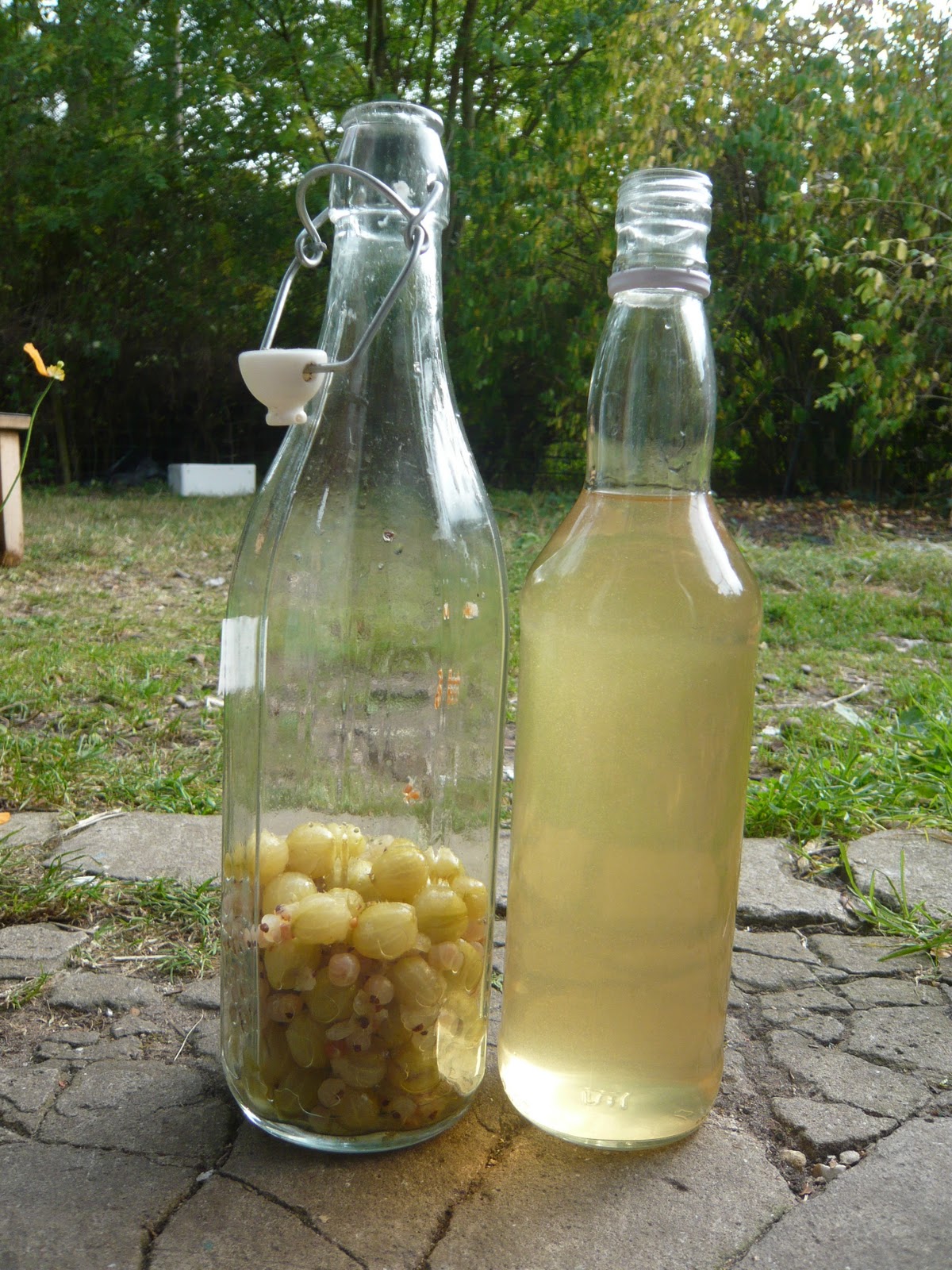
Lastly, I bottled the Gooseberry and Whitecurrant Gin, ever redolent with the summer flavours of the fruits it is in comparison a very sweet concoction… on ice a Summer’s eve, or, for my palate, best with a bitter tonic to balance out the sweetness.  The tendency in alcoholic infusions is to add a tonne of sugar – with Sloe Gin and the like this produces a warming wintry brew, not unlike Port.  However with the lighter, more floral variations I would be tempted on another occasion to use less sugar to produce a drink that is somewhat drier.  I believe the sugar is unnecessary in the process of preserving and simply serves to make the drink palatable.


When bottling fruit alcohols the tipsy fruits can be collected for desserts, cakes, jams.  These I used as an addition to this Apple and Olive Oil Cake, shared by the artiste of Apple Cakes Carla Tomasi.

Carla's Apple and Olive Oil Cake with Tipsy Fruits
...

Off this afternoon to gather the ingredients for a spiced Quince Brandy.  Set to infuse now it should be ready to drink on Christmas day…

Friday, 21 October 2011

A Pheasant - Roadkill roast wi' Autumn Fruits

The roads again amok with Pheasants and the like, driving in the country at this time of year is akin to running the gauntlet, obliging severe and intrepid manoeuvring to avoid the creatures.  Last week however, I hit one.  And, as etiquette prevails, fast wrung its neck.  Unwilling to not eat a bird I had unwittingly killed, I took it home.

Sometime, and yet I haven’t the courage this morning, I shall write a treatise detailing my views on wild and reared meat… Here instead, let me simply say, I had never before eaten roadkill pheasant. 

I hung the hen pheasant in the shed for three days.  On Sunday, returned to the cottage and, as dark fell, put a pot of Lentils on the stove, plucked the bird.  I was lucky to have hit it in the neck/head region as the body was undamaged, the bird clean.

Plucking a Pheasant

On Preparing a Pheasant:
Remove all the feathers, pulling in the direction they grow so as not to tear the skin.  Then take off the Feet and the Head, discard, leaving the Neck intact.  Next remove as much length as possible of the Neck – this is a tasty piece of meat ideal for a stock, a stew or soup.  The Crop where the Pheasant momentarily holds its food (often corn) can be slipped out, the Windpipe likewise extracted from the neck end of the Pheasant.  Any yellow lumps of gathered fat should also be removed as these are not pleasant to eat.  The base of the Pheasant is then slit open.  Plunge a hand in and drag out the insides, of this the edible parts are: the Heart, the Liver, the outer layer of the Gizzard. The Gizzard is a delicious Muscle, which to be eaten has to be peeled off the inner part of the muscle where food is ground.   On one occasion, having gutted and spatchcocked a dozen Pheasant for a New Year’s party, I gathered all the Gizzards and prepared them in a Goose Fat Confit as the French might Gésiers de Canard.  These would then be served hot on Salad leaves with Croutes and Goat’s Cheese for a Provençal feel.


Prepared, the Pheasant was stuffed with chopped Apples, Onion, and Quince.  A knob of Butter, some Garlic Cloves, a bunch of Thyme.  Pheasant is a lean meat with very little of its own protective/ cooking fat, so it was covered in Bacon.  A sudden moment of inspiration led us to fill the tray with chunks of Pumpkin, Swede, Marrow, Parsnip, and more Fruit.  The lot was doused in Apple Juice, more Butter, Salt and Pepper and loads of Rosemary.  Put in the oven about 200C for roughly 30 mins, then 150C for 20 or so until cooked. Rested for ten before serving.

Despite the chaotic end to its life, the bird was beautifully tender, no doubt the Fruit and layers of Bacon kept it thus.  Served on a bed of Puy Lentils with the apple-juice-roasted fruits and veg, the meal was a joy, part medieval banquet part reminiscent of the provincial food of French Wayside Inns.

Monday, 3 October 2011

Cider Pressing in Suffolk


Charmed as one might be to receive a jovial invitation to a Cider-Making Weekend, a glance between the lines and we’ll find the invite actually reads: come slog away at the squeezing of m’ apples that I might stock up the cellar.  But, the fellow an artiste of the home-made brew, the place a haven, the weather bursting with sunshine… I trundled to the depths of Suffolk county for a weekend spent mastering the art of Wild Cider Making.

Wild Cider is the traditional brew, which harnesses the natural yeasts from the air and the fruit and thus ferments.  We were fortunate to be in the hands of a man whose system is quite perfected… the method being as follows:
The Apples, a muddle of sweet eaters, washed with a jet wash are then bashed, sliced using spades to facilitate the next steps.
These are thrown into a Mill, which further pulps the apples.

A traditional pressing method squeezes the juice from the Apples.

The juice is collected in a bucket.
...

A Second Pressing was attempted, packing the pulp from the first into this most beautiful of presses, gleaned from Italy.  One would imagine this second pressing, much like that of Olives produces the more refined juice?  There was some debate however about the reaction between the apples and the steel, our host wary of the contraption, whether indeed this will produce a pleasant drink remains to be told…


'tis a gentleman's sport this, requiring the mere squeezing of a lever...

...the juice flows
...

The Juice is filtered, then left to ferment in Airlocked Fermenting Bottles until the blossom is again on the apple trees.  All being well the wild yeasts will ferment the natural sugars producing Cider. This will then be racked off into bottles and provide Cider-enough to keep mine host and friends in liquor until the following year’s batch is brewed…


...

While I'm on the subject, tomorrow I shall tell of the distilling of Cider to make a Calvados worthy of late nights and sweet dreams...

Thursday, 29 September 2011

Mussels, in Chickpea-Chorizo Stew, Bloody Mary and Moules Marinieres


As the weather simply fails to concede this year to any less-than-extraordinary predictions, in the midst of Autumn we find ourselves sweltering in a heat worthy of the Mediterranean.  A joy to be obliged to laze in the garden in a mere wisp of clothing with an Hispanic it’s too hot to do anything but… attitude.  An appropriately lengthy and late lunch was necessitated, and as, in late September we are in the first throes of the new Mussel season, a bowl of Mussels was timely.

A brief step to the coast, thronged with sheds-cum-fishmongers baring their latest wares.  Mussels splitting plastic bags for a couple of pounds per kilo of the freshest… indeed these are such common fodder they are to be found stacked on tables beside an honesty box. 

And to have with?  Some chick-peas cooked that morning with Hummus pretensions, a wealth of bursting ripe tomatoes awaiting picking, onions just plaited, Chorizo lazing in the fruitbowl – a stew… and of that sourdough I’ll back something lighter and whiter than the usual fare.

...


Tomato, Chorizo and Chick-Pea Mussel Stew with an almost-white Sourdough

Mussels 1kg; 1 large Onion or several Shallots roughly chopped; 3 cloves Garlic, crushed; chunk of Marrow, peeled and cut small; 5 Tomatoes, peeled using hot water, then chopped; 1tsp Paprika; Chilli, chopped; handful of pre-cooked (or tin) Chick Peas; Olives; Capers; Bay Leaf;  White Wine; Celery/Celeriac tops; Parsley.

Heat Olive Oil in pan.  Add Onion, Garlic, Chorizo, Marrow.  After a few minutes add Tomatoes, Paprika, Chilli.  Then add Chick Peas, Capers (or Nasturtium Capers); a few Olives; a dash of Water or Tomato Juice.  Cook gently for half an hour, adding liquid if necessary. Meanwhile, wash, scrub, beard the Mussels.  Just before eating heat a large pan with ½ inch of White wine, another Onion, Celery and Parsley.  When hot add Mussels, stirring or lidding and shaking.  When opened toss Mussels and a bit of their juice into the tomato stew.  Sharpen with a squeeze of Lemon.  Serve steaming hot with bread, under the shade of an Autumnal tree…

For the bread, I took a Wheat and Rye Sourdough, just risen and ready-to-bake, instead kneaded it up with the same again of Strong White Flour, a tiny sprinkle of dried Yeast.  Rose it in a warm place for a couple of hours, baked hot, ate warm.

Moules Marinières

Fresh Mussels are simply delicious, and don’t really necessitate anything fancy.  The method I used to cook the Mussels themselves, above, is that of a simple, and sensational, Moules Marinieres.  Add a slurp of cream on serving hot.


Bloody Mary Mussels à la Jamie Oliver

I am barely acquainted with Jamie Oliver’s recipes, but when I came across his Bloody Mary Mussels in a magazine last year, was sorely tempted.  They were a cinch and a success.  While I'm on Mussels, I'll share that recipe too:

Ingredients: 300ml Passata; 1 tbsp Worcestchire sauce; 3 heaped tsp grated Horseradish; 1 Chilli, sliced ; ½ head of Celery; 4 cloves of Garlic; splash of Port; good splash of Vodka; 1 Lemon; 2 kg cleaned Mussles; Parsley.

Pour Passata into a jug with Worcestershire Sauce;  Horseradish;  Chilli; 2 or 3 Celery stalks, sliced; crushed Garlic; Port and Vodka.  Stir well.  Squeeze in juice of Lemon and season.

Tip Mussels into hot pan, pour in Bloody Mary mixture.  Put lid on, shake pan and leave Mussels to steam open.  Turn heat up high.  Shake again.  Once all open, remove with slotted spoon.  Reduce and thicken sauce.  Pour over Mussels, drizzle with Olive Oil and scatter with chopped Parsley.

Wednesday, 21 September 2011

Notes: On Forage, Mushrooms and the Noma Cookbook

We do not stop the world when we eat; 
we go into it a little more deeply.
Olafur Eliasson (Noma)


Cep
... 

Allow me a paintbrush, a palette…a pile of artistic licence to tell of some friends of mine and their wild ways.  Boys they are, a huddle of them, bare’ approachable and and not easy to handle.  They can’t be tethered down and one won’t find them for looking.   But, one might come across them…

On the foreshore by night fighting the tide for a last Sea-bass; atop a tree, gathering Plums to pot a Pigeon in; plucking a Greylag large to feed a crowd.  Adventurous with tastes, unperturbed by roadkill, they’ll be smoking Mackerel in a filing-cabinet-cum-smoker; cooking Mullet in milk for fishcakes; stewing Cockles in a split can of cider on an open fire; barbecuing Samphire.  How very nineteenth century lyrical said a friend as I rhapsodised about baskets of Ceps, and indeed, these are the Huck Finn’s of today, the unassuming artistes of forage.

Dried Chanterelles

Last I called by, Muntjac was roasting in the oven, surfaces brimming with mushrooms gathered, some dried, a hoard: Shaggy Parasols; Chanterelles, orange and sweet-apricot-scented; something blue.  Another fellow appeared a basket in his hand large to gather wood, in it full - Penny-Buns, Ceps, plentiful as a baker’s.

We ate then Parasol:
The cap cut into long, thick strips, doused long in egg and salt and pepper breadcrumbs, fried quick and served slathered unashamedly in mayonnaise.  A dream.

Parasol Mushrooms in Bowl of Apples

The Ceps so plentiful I took some home.
…

This weekend, another scene: ‘midst fashionistas, florists and folklorists, stepping the streets of London town…  On gathering my basket and boots to return home, risen at dawn to the cockney cries of Columbia Road Flower Market, pressed into my hands was a copy of Noma, Time and Place in Nordic Cuisine by René Redzepi.  I have long hankered after this book and was delighted to be given it.  (Thanks Laur!) It is indeed an extraordinary book, but with over half of the pages covered in photos worthy of the wall, it is not a manual.  The recipes themselves, so daunting that I’m glad I didn’t turn to it to cook my Ceps, relying instead on friendly advice and Elizabeth David (see below).


Indeed, I now understand that the book is less a cookbook and more a book to wander through, wonder at, that tells of the story behind the Michelin starred Copenhagen restaurant Noma.  No longer silent, secret, unassuming; at Noma forage is ostentatious, it’s an artform plucked or peacocking, it is the very edgiest of foodthinking, where food overlaps with artthought and critical theory.  But on closer inspection, I am also ready to bow to this.  Of René’s moment of illumination, he writes:

I realized that we had to exploit the seasons in a better way, so that you could only get a particular dish here and now.  We should explore the extremes of nature, seek out the thousand or more species of edible fungi, the many wild plants, roots and seashore plants. […] The guests dining at Noma should feel a sensation of time and place in their very bones.

Ingredients were thus combined not only with those of same season, but those of their natural habitat.  If venison was on the menu, the meat should be served with snails, pine shoots and mushrooms.  Thus recipes such as: Bouillon of Steamed Birchwood, Chanterelles and Fresh  Hazelnut; Stone Crab and Beach Mustard, Cockle Gel or simply Snails and Moss.  And abruptly, the nineteenth century lyricists and the uber modern restaurant look no longer askance upon one another, artistes the both.
…

Ceps
Not Ceps and Poached Truffle Meringue (à la Noma) but Cèpes à la Bordelaise (Elizabeth David) with Brown Rice Risotto.

In her French Provincial Cooking, Elizabeth David quotes the recipe of Alcide Bontou (refer to the book to read more).  I shall do likewise:
“Choose 12 firm cèpes, small rather than large, and with dark heads; remove the stalks and peel them, but only wipe the heads; make incisions on the underside of the heads with the point of a knife.  Put a glass of olive oil in a frying-pan; when it is hot, put in the heads of the cèpes; turn them over when they have browned on one side.  Season with salt and pepper.
Chop the stalks with four cloves of garlic and some parsley.  Throw this mixture over the cèpes.  Let them all sauter in the pan for 3 or 4 minutes.
You may add a tablespoon of soft white breadcrumbs.  Serve.”

I made a pseudo-risotto with Short Grain Brown Rice, butter, Shallots, Bay-Leaves, White Wine and Wighton, a local creamy but hard cheese.  And served the Ceps on top.  Divine.

...

Another great friend, longdeserving of a blog post dedicated to her green fingers, her inexhaustible creative energy and her kitchen concoctions, whose latest addition to the home is a goat in the back garden (soon I hope we’ll be on milk and cheese)… makes a Puffpall Pâté of such flavour it is also worthy of Michelin stars.  

Puffball Pâté
I haven’t the exact recipe, and I rather doubt there is one.  Try:
Chop and very gently fry up Puffballs with Garlic and Cumin in Butter.  Blend the lot adding Salt and Pepper or a touch of Soy Sauce.  Spread on bread for a deeply mushroom flavour edged with garlic and cumin.  You could also try adding cream, cream-cheese.

If you do attempt this let me know!
…

Notes:
 -The Noma cookbook is indeed a gift, only on the verge of my foray into it, I hope to write more anon.
 -Writing at first light, I espy another forager: a grey squirrel feasting on the last of the overripe Bullace.
(In postscript - now mid-November, a friend writes from wild woodlands of Tuscany: I strongly reccommend Parasol Mushrooms, ripped, dipped in Egg, Breadcrumbs, Garlic and drizzled in Lemon Juice...  As only yesterday Amelia came across a field thick with same Macrolepiota procera, I too hope to try this in the week.)

Saturday, 17 September 2011

Blackberries - wi' Beetroot Relish, wi' Cinnamon Whisky, in Vinegar et cetera


Beetroot, Blackberry and Walnut Relish


Apparently nonsensical, it is often colours that define choices of food combinations.   Not quite for this reason alone, I decided to give a touch of the wild to a conventional Beetroot Relish, with the addition of Blackberries and Apples.   More likely, I based my choice on an only-part-forgotten Beetroot and Blackcurrant Relish espied once in the Riverford Cookbook, but the colour, as well as the gluts of berries nearing their end on plentiful briars outside the house, were certainly influential factors in the concoction of this recipe.


On cooking, my head was chiming with shouts of Chilli! Horseradish! Ginger!  But I forestalled such fervour, deciding that the addition of Blackberry was quite quirky enough. Indeed, on bringing a pot to dinner that evening,  there was already a raised eyebrow, a giggle, a sneer...


1/2lb Blackberries, 4 medium Beetroot, 1 Apple, 1 Onion, 100ml Apple Juice, 100ml Cider Vinegar, 100ml Balsamic Vinegar, 1tbsp Blackberry Jam (optional), 100g Sugar, Port (optional), handful Walnuts (optional).


Heat half the Blackberries in the Apple Juice, till cooked, strain and keep the juice.  Grate the apple into this juice, bring to simmer, stir in Jam, set aside.  Heat Vinegars with Sugar and add grated raw Beetroot and chopped Onion, turning so that all the ingredients are covered.  Add Apple and Blackberry Juice.  Stir.  Add slosh of Port rest of Blackberries and Walnuts, simmer a minute longer.  Press into hot sterilised jars, seal.  Leave for a month (although it is lovely immediately) and serve as a sweet/sharp addition to rich wintry meats.


Unlike the Bullace, Port and Walnut Jam, which is given edge by the tartness of the fruit, this is incredibly sweet.  In the future I would indeed add something fiery to lift it.  If making this yourself, why not slice in a Chilli with the Onion, or grate in some Horseradish...

Despite my convincing myself this is a Relish, it has turned out not unlike my Beetroot Pickle, I rather thought the Sugar and Jam would make it more of a spread - I understand a Relish to be something between a Pickle and a Chutney.  In future to make it more Relish-like I shall try cooking it for longer.

...


Blackberry and Cinnanmon Whisky

I have had to turn my thoughts from simply: preserving, to: preserving in the most practical manner... So, despite enjoying the flamboyant, the flippant and the fun, I have started questioning what is really necessary.  It might seem odd that I am talking about practicality under the seemingly superfluous heading of Blackberry Whisky.  But, I am headily conscious of living in a chilly house, am predicting another icy winter, and know well that a nip of something sweet and strong is not only pleasant, but vital on those winter eves...

My recipe went thus:  Fill a very large bottle (1.5lt) to a third with Blackberries (about 250g), cover these in Sugar (about 250g), add 1 bottle cheap Whisky (1lt) and a splash of very good single malt.  I also added a Cinnamon stick.  Shake the lot, and leave in bottle, shaking on occasion, for three months. Strain through muslin, drink when necessary.  The addition of the Single Malt ( a tip for any impoverished Whisky-lover) is said, in a mere drop, to transfer the flavour of the malt to the cheaper stuff.

...


Blackberry and Elderberry Vinegars

Another practicality is how can we make what we tend to buy.  So, vinegar-phile that I am, I was delighted when Carl Legge shared Sandor Ellix Katz's recipe for DIY Vinegar.  Having a so-far-successful Apple/Crabapple Vinegar on the go, I decided yesterday to try Blackberry Vinegar, Elderberry Vinegar and Quince Vinegar.  Rather than using the whole fruits, I have used the Apple and Quince skins and cores, potting and pasteurising the fruits themselves (see pic below).

Briefly: Fill a 2pt Mason Bowl with washed cores and skins of Apples and about 100g of Berries.  Cover with 1pt of 10% Sugar Solution at room temperature.  Place plate on top to keep fruit under liquid and cover with tea-towel.  Leave until starts fermenting, stirring on ocassion if deemed necessary.  After about a week of fermentation remove fruit.  Continue as before, when convincingly vinegar-like, strain and bottle - there's your Vinegar!  


For the Quince, I took the skins and cores of a pile of windfalls, fallen during last week's storms, and did as per Carl's recipe.  

Of course, I'm only at stage one, so will relate whether this method is succesful or not once I can confirm.  For further information, please refer to Carl's blog and Sandor's website.


Quince in Syrup - Elderberry and Apple Compote

Saturday, 10 September 2011

Simple French Cooking for English Homes by X. Marcel Boulestin


On ne mange bien que chez-soi

In the traditions of Elizabeth David and Julia Child, with Simple French Cooking for English Homes, Marcel Boulestin brings the best of French cooking to the English table.  In his terms, this is not the food eaten in chichi Hotels or pretentious French restaurants, this is the food of wayside inns and the family home.  As my own lean is likewise, towards the provincial and the homely, I cannot but champion a book that demystifies a cassoulet or a pot of rilletes and spends a lengthy paragraph on the art of an oeuf poché.

Marcel Boulestin does not skimp on the preface, peppered with idiosyncratic literary quotations, which demonstrate his own background as a journalist and translator.  He appears to believe that food should be common parlance of the cultured, not shut behind scullery doors.  Indeed, the preface is followed by a collection of Remarks, one of which, endorsing food’s place in conversation, I particularly liked:

Do not be afraid to talk about food.  Food which is worth eating is worth discussing. And there is the occult power of words which somehow will develop its qualities.

A brief glossary, further quotes, including brilliant Brillat-Savarin on hospitality, and then we are thrown into the recipes.  It is always a pleasure to decipher the French terminology, much like one might rifle through the pages of a Menu, sat at a brasserie in France.  The translations given might even serve to illuminate what that incomprehensible plat du jour indeed was!  A chapter on Soups, including a Pot au Feu, is followed by one on Sauces - a favoured French skill - and then Eggs; Fish; Meat; Pastries and Sweets; and a delightful final chapter Sundries in which Marcel Boulestin amasses the remainder of what he considers vital French food:  Gherkins are here placed alongside Pineapple Wine and the extraordinary, and quite delicious-sounding Crème de Camembert, in which the cheese is steeped in White wine, left over night, beat with butter, reshaped and topped with breadcrumbs. 

Unlike cookbooks of today, rich with lifestyle, colloquialisms and sumptuous photography, those of yesteryear such as this Simple French Cooking…, published in 1923, were manuals in the strictest sense of the term.  Marcel Boulestin does not take any knowledge, or common-sense it seems, for granted.  To the point that the poached egg recipe is followed by one for Oeufs Pochés Béarnaise – Poach your eggs and put them on a stiff béarnaise sauce, for Oeufs Pochés Sauce Tomate – Poach your eggs and cover them with tomato sauce.  And, indeed, for Oeufs Pochés au Maïs – Poach your eggs and put them on a dish of sweetcorn.  But, perhaps this is where the charm of this cookbook lies.  Rife with idiosyncratic whim, it serves also as an efficient culinary reference… particularly astute at capturing those French meals of days yonder.  Although not as rich in anecdote as the books of Elizabeth David, the writing is lucid, the tone eloquent and Marcel Boulestin succinctly renders French food accessible to the English cook.  

…

By X. Marcel Boulestin
Introduction by Jill Norman

First Published in 1923
Published by Quadrille Publishing, Classic Voices in Food, 2011
ISBN – 978-1-84400-981-7

…

My thanks to Quadrille for the review copy of this book.

Thursday, 8 September 2011

Pickled Crab Apples - a flamboyant addition to the winter table


Fed up of endless yearly Jelly-Making…Indeed, does it not seem a pity to see the fruits thrown, only the liquid kept, not to mention the vast amounts of sugar demanded?  I was delighted to come across a recipe for pickling Crab Apples.  The idea came from quite one of my favourite forage books: Suzanne Beedell’s Pick Cook and Brew… I picked it up second-hand on the Charing Cross Road years ago, the name alone won me over, and at the time I thought it a gift suited to my father.  It has since been relinquished, and found a home in the cottage here as if meant to be. It's particularly appropriate, as the forager herself lived in North Norfolk - what she found in the seventies can likely still be found locally today.

So, amidst recipes and illustrations for Crab Apple Pudding, Crab Apple Wine…there I read: Crab Apple Pickle.  An incorrigible pickler, this could not fail to whet the appetite.


I altered her recipe to suit me, and pickled as follows:

Heat 750ml Cider Vinegar, 250ml Apple Juice, 600g Sugar in a pan stirring until sugar dissolves.  Add 1kg Crab Apples, washed, the blossom end removed, I chose to keep the stalks on an aesthetic whim.  The liquid should cover the Crab Apples.  Add 2in. grated Root Ginger, a few Cloves and Peppercorns, 3 All Spice, 3 Star Anise, 2 Cinnamon Sticks,1tbsp Mustard Seed, and her recipe also calls for garlic cloves wrapped in muslin, to be removed at the end.  (The terrible stench of pickled garlic made me think I would choose onions on another occasion).  Simmer until Crab Apples are tender.  Pot fruit in sterilised jars and reduce syrup if necessary.  Pour syrup over Apples, making sure they are well covered.  Seal immediately.  Leave a few months to mature before eating.

These beautiful pickled yellow fruits would look glorious adorning Beast and Fowl in winter months.  Try also on a Cheese Plate, with Pork, even Suckling Pig.  A sharp bite they make a statement both in taste and looks, cutting through fats and rich flavours… I cannot recommend enough for adding a touch of the ostentatious, the extraordinary, the medieval to a winter banquet.


For other alternate Crab Apple uses, see: Hedgerow Syrup and Carl Legge’s Blackberry Chutney.  Carl also has a recipe for DIY Cider Vinegar, hope maybe to get to that this afternoon..

…


I also pickled some beautiful tiny Epicurean Apples.  These were windfalls, and have a great flavour, but are small enough to fit whole in pots.  I used this Recipe, which I used for the Pear windfalls of last year, only replacing the distilled vinegar with White Wine Vinegar and adding some All Spice.

...

Follow this link for all the Chutney and Pickle Recipes on this blog.